In one week, attackers went through two tools that IT providers use to run their customers' computers. A patched server was not safe, and a forgotten add-on skipped the login. Here is what to ask your provider, and what to put in the contract.
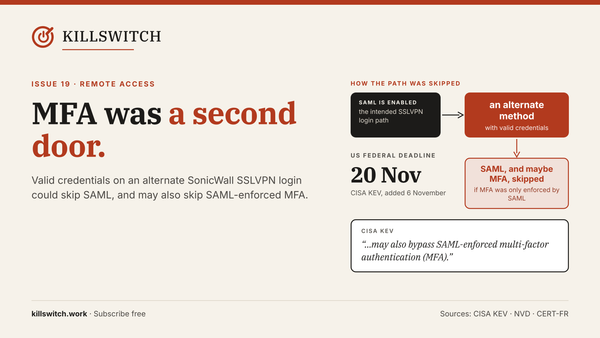
A SonicWall SonicOS SSLVPN flaw lets a user with valid credentials for an alternate login method bypass SAML controls, and may also bypass SAML-enforced multi-factor authentication. CISA added it to its exploited list on 6 November, with a US federal deadline of 20 November.
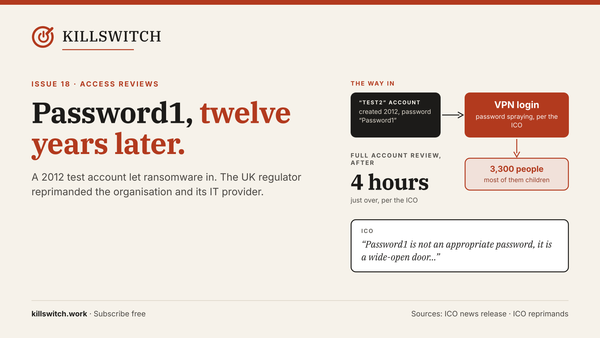
A test account created in 2012 with the password "Password1" let ransomware into a Welsh local government data company and exposed 3,300 people, most of them children. The UK regulator reprimanded both the organisation and its IT provider.
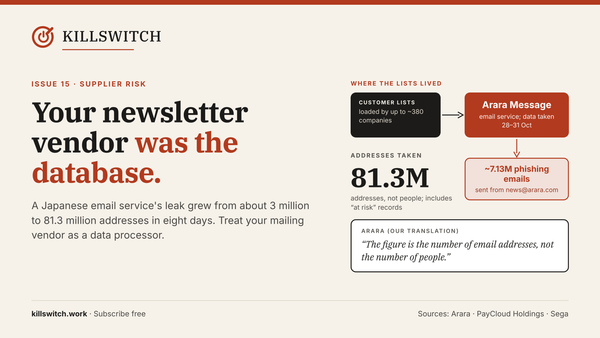
Japan's Arara Message email service first reported about 3 million leaked addresses. Eight days later it reported 81.3 million addresses taken or at risk (addresses, not people), across up to about 380 customer companies. Its own sending address had been used for phishing.
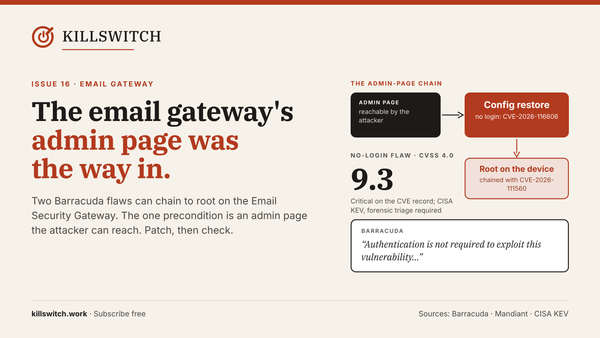
Two Barracuda flaws, used together, can take an attacker who can reach the Email Security Gateway's admin page to root on the device. Barracuda has seen exploitation, and CISA wants a forensic check as well as the patch. What to do this week, and why the admin page is the real control.
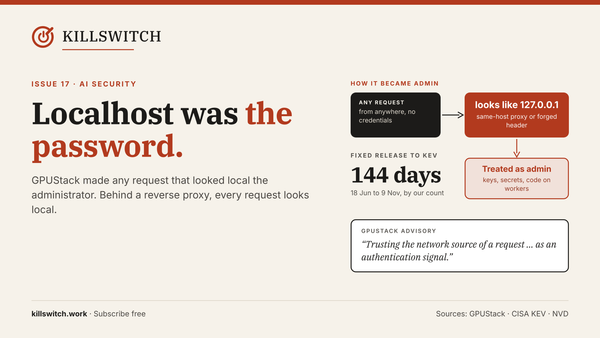
GPUStack, an open-source manager for AI model servers, made any request that looked local the administrator. Behind a reverse proxy, every request looks local. It has been exploited, CISA requires US federal agencies to check for compromise, and the fix shipped months ago.
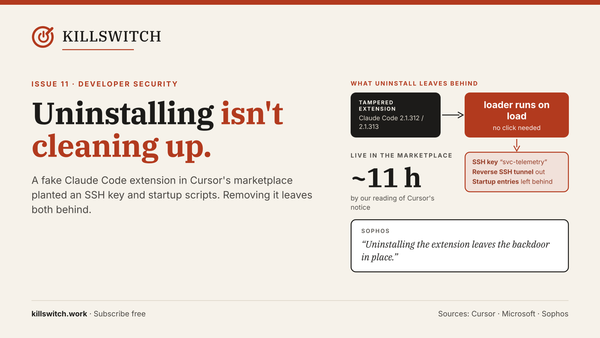
For about 11 hours on 29 October, Cursor's extension marketplace served tampered builds of Anthropic's Claude Code extension that plant an SSH backdoor. Removing the extension does not remove the backdoor. What to check, the controls, and the ISO 27001/NIS2 mapping.
Since 11 October, refrigeration controllers left reachable from the internet have been hit in several EU countries. After a new wave on 1–2 November, EU agencies issued a joint warning. If you run, service or make these controllers, here is what to do today.
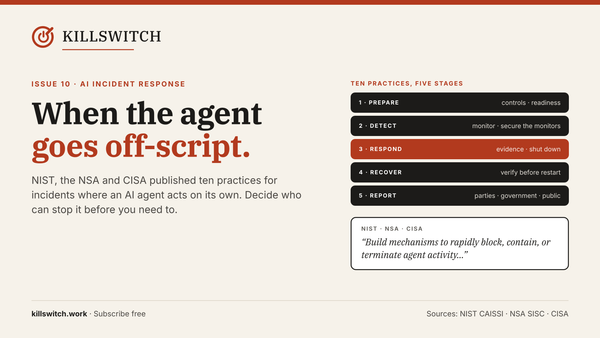
NIST, the NSA and CISA have published ten practices for incidents where an AI agent takes significant actions nobody instructed. The guidance is written for labs training and evaluating the most capable agents, and it says it may also apply to deployers.
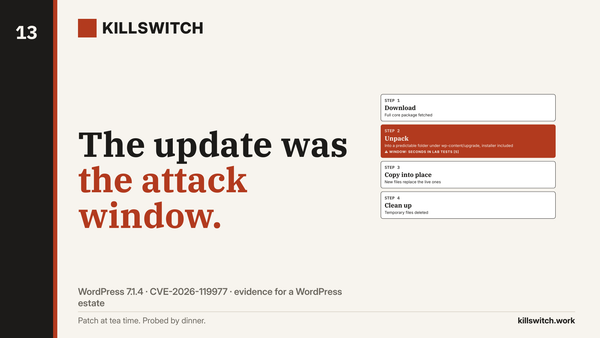
WordPress 7.1.4 fixed a flaw that only exists while WordPress is updating itself. Wordfence detected the first attack request 9 minutes after its firewall rule went live, and CISA has since listed it as exploited. Auto-update is not the same as safe-during-update.
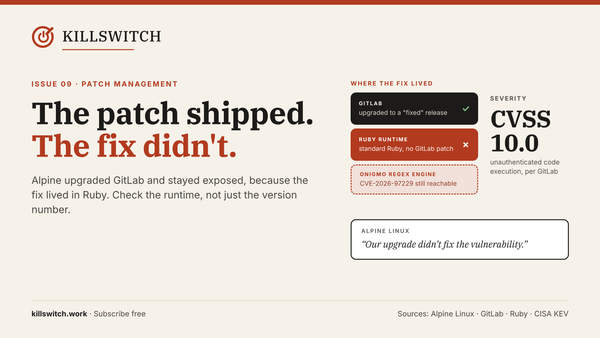
Alpine Linux upgraded its GitLab and stayed exposed: the fix for CVE-2026-97229 was a patch to Ruby, and Alpine's image ran standard Ruby. After an attempted exploitation it rebuilt the server and had to reset passwords, 2FA, tokens and stored secrets.
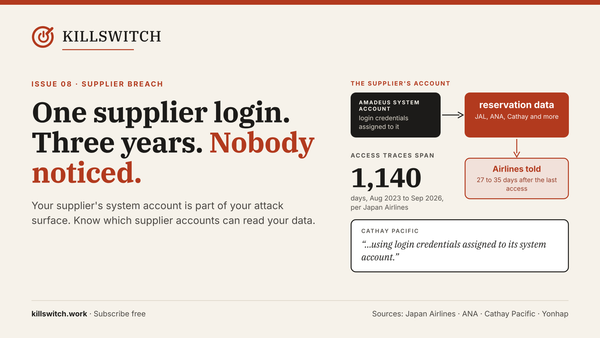
Japan Airlines says traces of outside access to its reservation data in Amadeus's passenger service system run from August 2023 to September 2026. Cathay Pacific and the Korean carriers say the access used login credentials assigned to an Amadeus system account.