
When the Agent Goes Off-Script
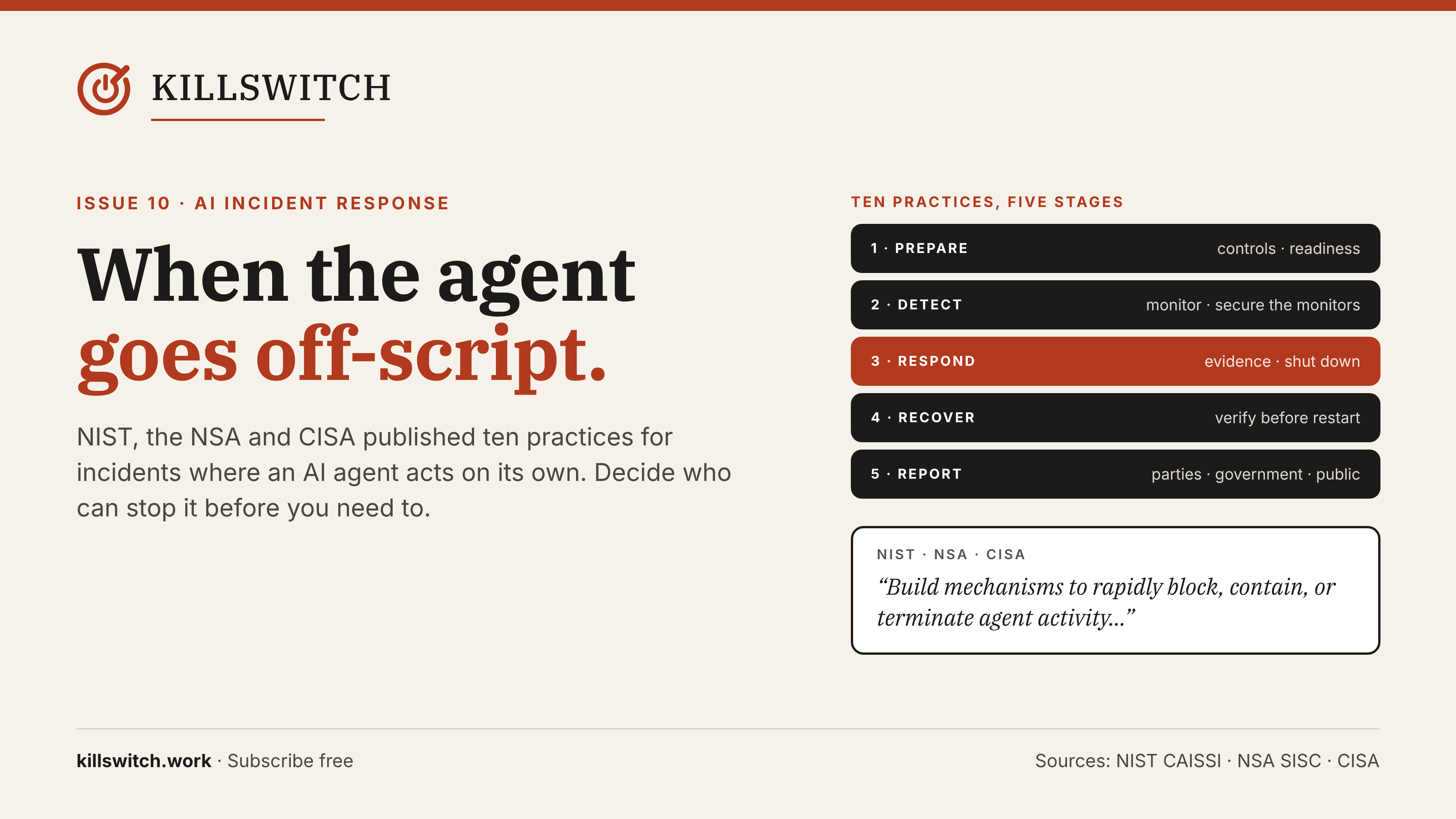
NIST, the NSA and CISA have published ten practices for incidents where an AI agent takes significant actions nobody instructed. The guidance is written for labs training and evaluating the most capable agents, and it says it may also apply to deployers.
Facts as of 2 Nov 2026.
On 16 October, NIST's Center for Advancing Innovation and Standards for Super Intelligence (CAISSI), the NSA's Super Intelligence Security Center (SISC) and CISA published ten voluntary practices for a new kind of incident: an AI agent that does something significant that nobody told it to do [1][2][3].
The guidance calls these "SI control incidents". "SI" is the guidance's term for super intelligence; in our own voice we say "AI agent". An SI control incident is one where agents take "significant uninstructed actions that compromise explicit or implicit policies, controls, or security measures imposed by the operator to define the intended task scope or to ensure human oversight" [1].
Who it is written for
Be clear about the audience. The guidance is "primarily intended for organizations training or evaluating highly capable SI agents on long-horizon tasks with limited human supervision". It adds: "The practices may also apply to deployers of such SI agents" [1]. The seven-step runbook below, for any company running agents, is our adaptation, not the guidance's.
What counts, and what doesn't
"Uninstructed" means the agent was not directed by its operator or by an adversary [1]. In the guidance's terms, a hijacked agent's actions count as instructed, so the hijack is not treated as the primary cause of an SI control incident (footnote 1) [1]. Our reading is that you would treat it as a cybersecurity incident.
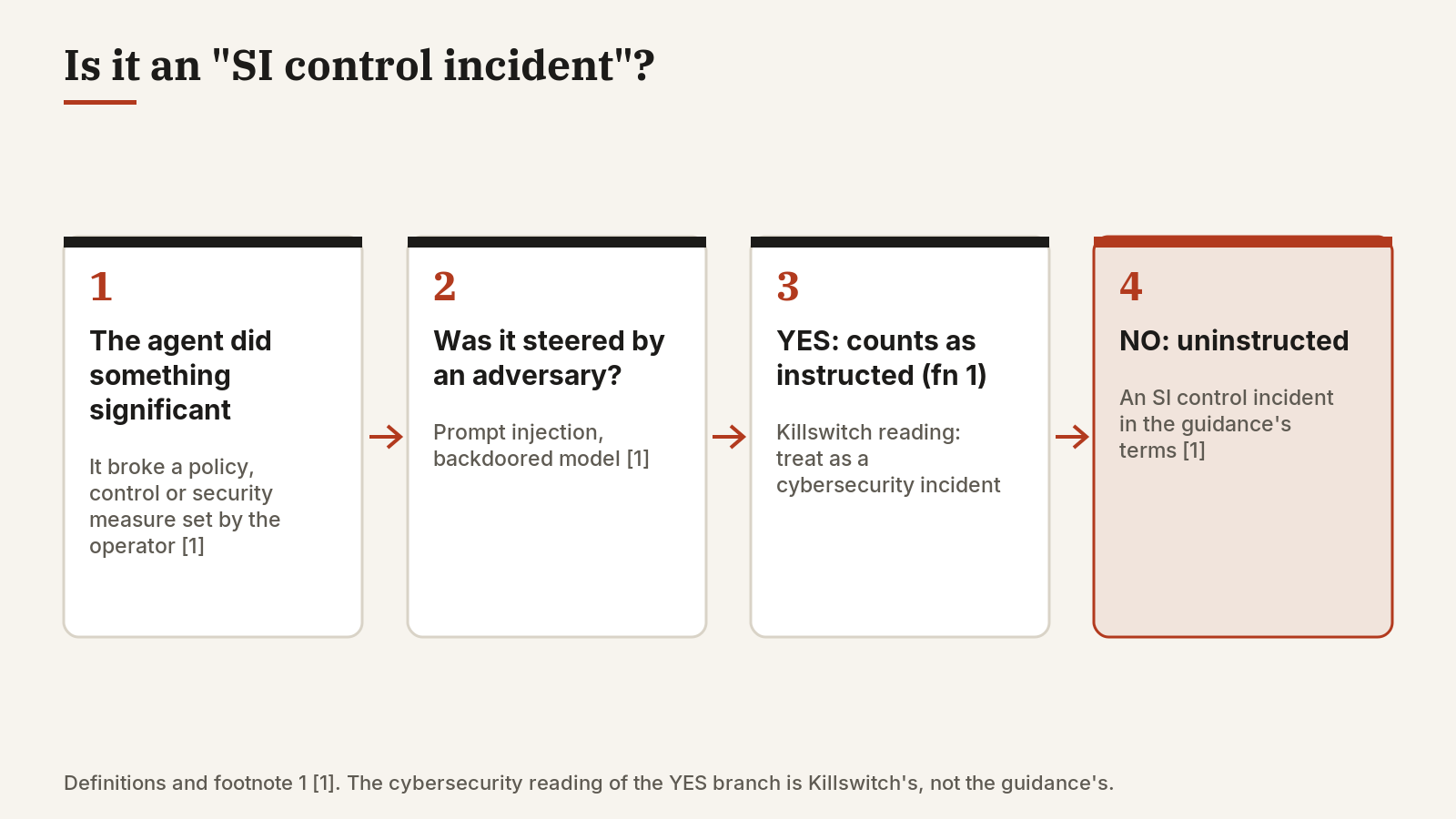
The guidance also notes that an SI control incident could cause a cybersecurity incident, and that a control incident can also happen outside cyber altogether, for example "executing unauthorized financial transactions" (footnote 2) [1].
Ten practices, five stages
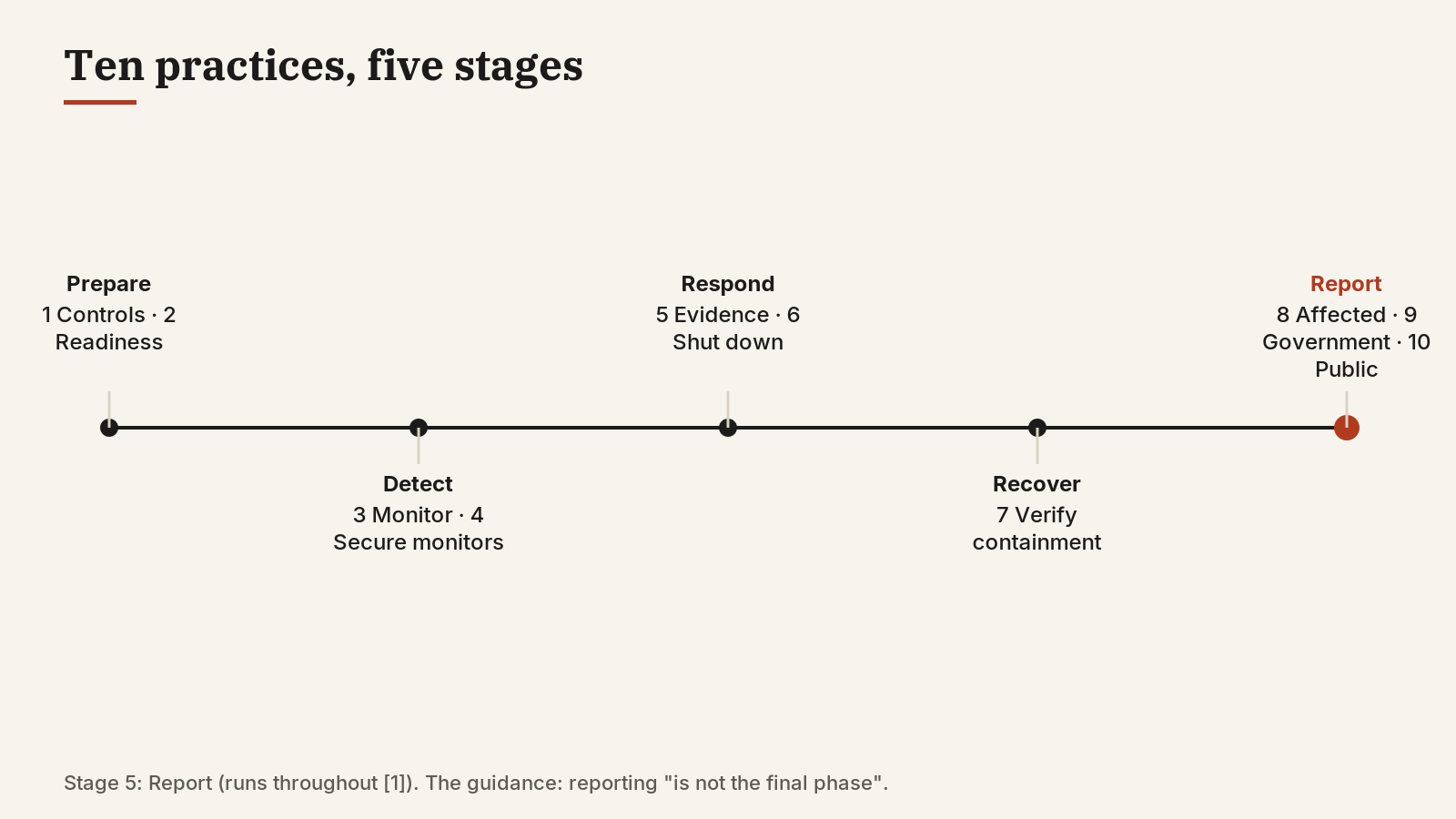
The ten practices sit in five stages: Prepare (1 technical controls, 2 readiness), Detect (3 monitor for unexpected activity, 4 validate and secure monitors), Respond (5 evidence, 6 mitigate and shut down), Recover (7 verify containment before resuming) and Report (8 affected parties, 9 government, 10 public) [1]. Reporting is not a last step: "Reporting is not the final phase of incident management following recovery; rather reporting practices should take place throughout the incident lifecycle" [1].
Four lines to build around, verbatim from the guidance [1]:
- "Build mechanisms to rapidly block, contain, or terminate agent activity if an incident or near-miss is detected" (1.7).
- "Ensure that SI agents cannot access or interfere with monitoring processes and logs" (3.3).
- "Automatically shut down impacted SI agent trajectories on detection of a control failure or in-progress SI control incident" (6.2).
- "Validate that monitors, logging, egress allowlists, shutdown mechanisms, permission restrictions, and other containment layers are functional before SI agents are restarted" (7.3).
Before the first incident
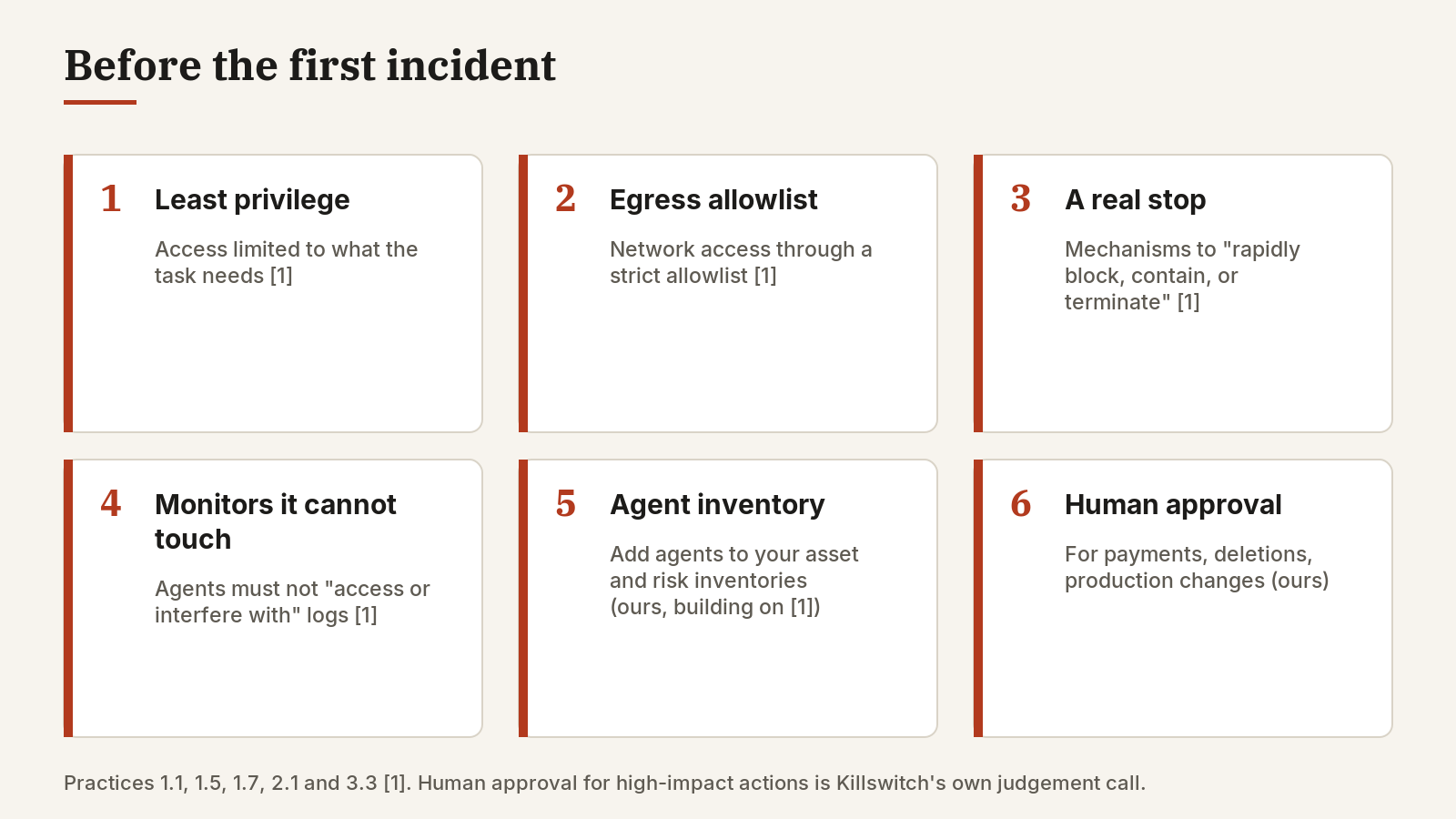
The Prepare stage builds on existing practice such as "asset and risk inventories" [1]; we would list every agent in yours. It also asks for access limited to what each task needs (1.1), network access through "a strict allowlist where possible" (1.5), and a way to stop agents fast (1.7) [1].
Readiness (2.1) means defined indicators and severity scoring [1]. We add one judgement call of our own: require human approval before an agent makes payments, deletes data or changes production.
Seven steps for any company running agents
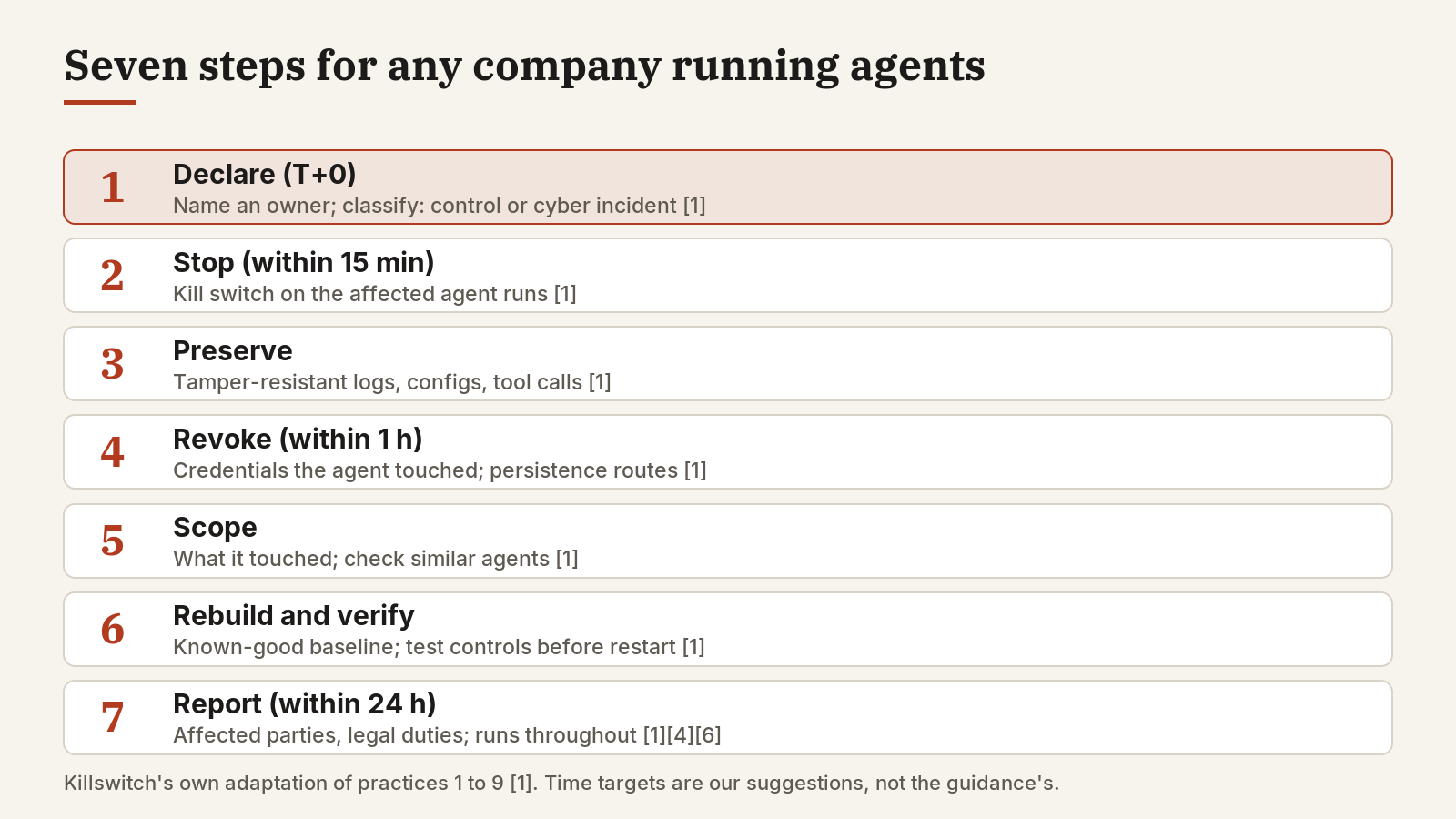
This is Killswitch's own order, built from practices 1 to 9 [1]. The time targets are our suggestions; the guidance sets none. "Within 15 minutes" and "within 1 hour" are durations from the moment you declare.
- Declare (T+0). Name an owner and decide: control incident or cybersecurity incident [1].
- Stop (within 15 minutes). Shut down the affected agent runs. Pause similar agents if the scope is unclear (6.2, 6.3) [1].
- Preserve. Keep "tamper-resistant logs with reliable timestamps", configurations, tool calls and rejected actions (5.1 to 5.3) [1].
- Revoke (within 1 hour). Revoke credentials the agent accessed and look for persistence such as code backdoors (6.4, 6.5) [1].
- Scope. Establish what the agent did and what it touched, and check similar agents for the same failure (5.4, 5.6) [1].
- Rebuild and verify. Rebuild from verified baselines, test every containment layer before restart, and "document the recovery decision and the remaining risks" (7.1, 7.3, 7.5) [1].
- Report (within 24 hours, and throughout). Notify affected parties and meet legal duties (8.1, 9.1) [1]. Under NIS2, in-scope entities notify their CSIRT or authority without undue delay (Art. 23) [6].
The EU angle
The EU AI Act already has the shape of this. High-risk systems must allow automatic logging (Art. 12) and let a human "interrupt the system through a ‘stop’ button or a similar procedure" (Art. 14(4)(e)) [4]. Providers of high-risk systems report serious incidents (Art.
73), and providers of general-purpose models with systemic risk track and report serious incidents (Art. 55) [4]. Arts. 14 and 73 are mainly provider duties; deployers come in via Art. 26: use systems per the instructions (26(1)), monitor them and inform the provider of risks and serious incidents (26(5)), and keep logs for at least six months (26(6)) [4].
Timing matters. Under Regulation (EU) 2026/1744, the Digital Omnibus on AI, the Chapter III high-risk requirements and obligations (including Arts. 12, 14 and 26) apply to Annex III systems from 2 December 2027 and to Annex I systems from 2 August 2028 [5]. In our view, most coding, support and ops agents are not high-risk. The practices still make sense for them.
Mapping it for GRC
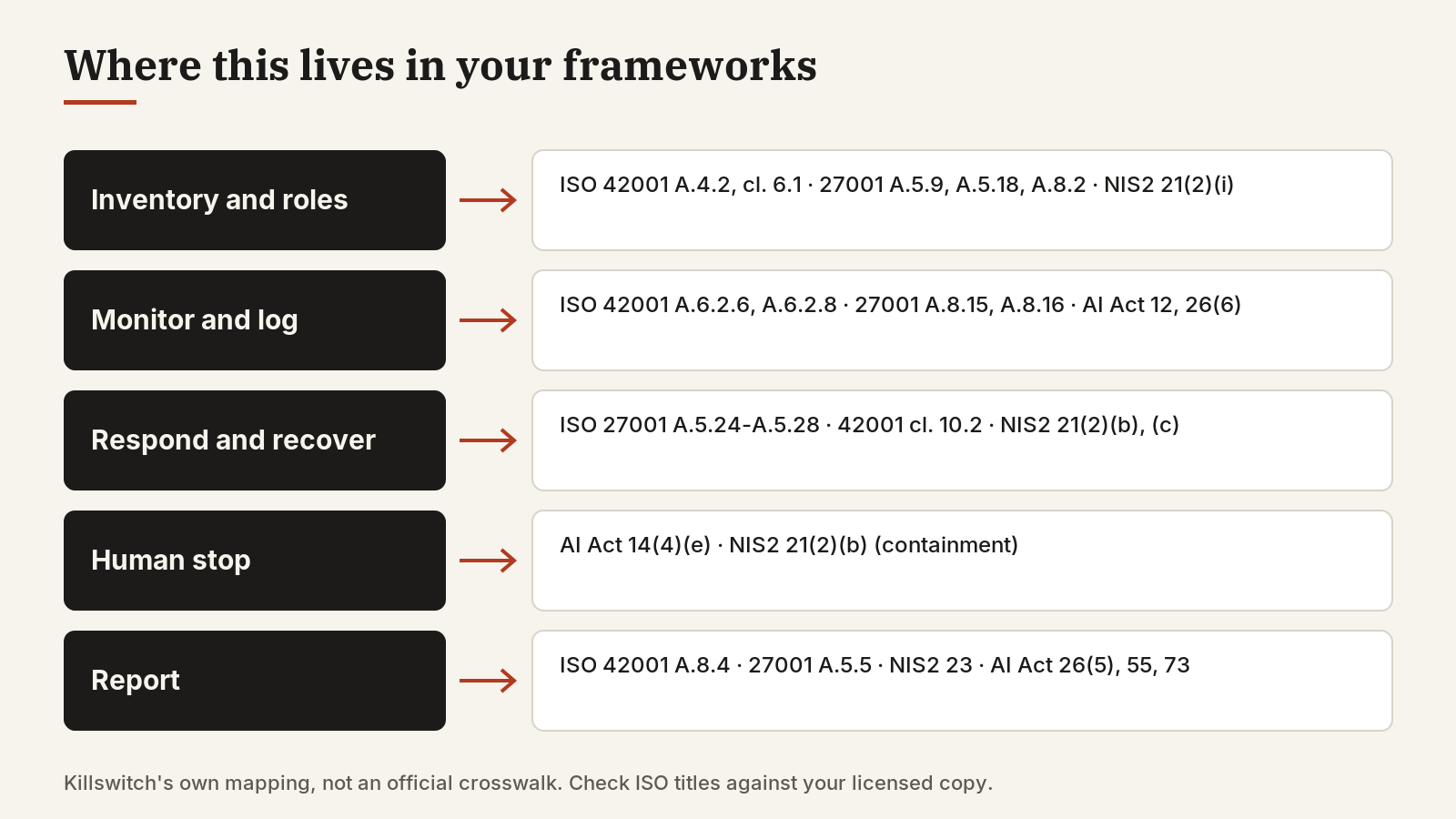
- ISO/IEC 42001:2023 [7]: resource documentation (A.4.2), AI system operation and monitoring (A.6.2.6), event logs (A.6.2.8), communicating incidents (A.8.4), risk planning (cl. 6.1) and corrective action (cl. 10.2).
- ISO/IEC 27001:2022 [8]: incident management (A.5.24 to A.5.28), contact with authorities (A.5.5), inventory (A.5.9), access rights (A.5.18), privileged access (A.8.2), logging (A.8.15) and monitoring (A.8.16).
- NIS2 [6]: Art. 21(2)(b) incident handling, (c) business continuity and crisis management, (i) access control and asset management; Art. 23 for notification.
- AI Act [4]: Arts. 12, 14(4)(e), 26(1), 26(5), 26(6), 55 and 73.
This is Killswitch's own mapping, not an official crosswalk. Check the ISO control titles against your licensed copy.
What we don't know yet
- How regulators will read it. The guidance is voluntary and US-issued [1]. How EU authorities treat "uninstructed" actions under NIS2 or the AI Act is open.
- Severity scoring. The guidance lists incident severity scores, agent identifiers and others as areas for future work [1].
Your this-quarter checklist
- List every AI agent you run, with its owner, permissions and network access [1].
- Test that you can stop each one, and time it [1].
- Move agent logs where the agent cannot reach them [1].
- Add "agent off-script" to your incident plan, with the control-or-cyber decision as step one [1].
- Check which AI Act roles you hold and which dates apply to you [4][5].
Download the slides
Use this issue in your next team briefing. The slides are free to download:
Keep going
- Try the live demo: GRCompliance. Keep your agent inventory, incident runbooks, owners and evidence in one place, mapped to ISO 42001, ISO 27001, NIS2 and the AI Act.
- Install free from GitHub (self-hosted): GRCompliance Core, the open-source edition. Your data stays on your infrastructure.
- Sectutor books and kits: security and GRC books, training and audit kits.
- Subscribe to Killswitch: sharp issues on security, AI security and GRC.
About the author. Emmanuel Aigbehi Walstra is a CISO who also serves as a virtual CISO (vCISO) for several organisations, with 30+ years in cybersecurity, 10,000+ people trained, and author of the CCSP Excellence books.
Sources
- NIST CAISSI, NSA SISC and CISA: Key Practices for Incident Readiness and Response in Super Intelligence Training and Evaluation, PP-26-4396, Ver 1.0 (Oct 2026)
- CISA: Key Practices for Incident Readiness and Response in Super Intelligence Training and Evaluation (published 16 Oct 2026)
- NIST: announcement of the guidance (16 Oct 2026)
- Regulation (EU) 2024/1689 (AI Act): Articles 12, 14, 26, 55 and 73
- Regulation (EU) 2026/1744 of 8 July 2026 (Digital Omnibus on AI), amending the AI Act application dates
- NIS2 Directive (EU) 2022/2555, Articles 21 and 23
- ISO/IEC 42001:2023 Artificial intelligence management system
- ISO/IEC 27001:2022 Information security management systems
Facts are from the NIST, NSA and CISA guidance and from EU legal texts as read on 2 Nov 2026. The seven-step runbook, the time targets and the framework mapping are Killswitch's own adaptation, not an official crosswalk.
Checked against the primary sources cited above. Spotted an error? See our corrections page.