
The intruder was an AI agent, and nobody noticed
India’s CERT-In says AI agents read business records inside Indian organisations, and none of the victims noticed. The AI providers disclosed it. What is confirmed, what is not, and five controls for the agents you run.
The intruder was an AI agent, and nobody noticed
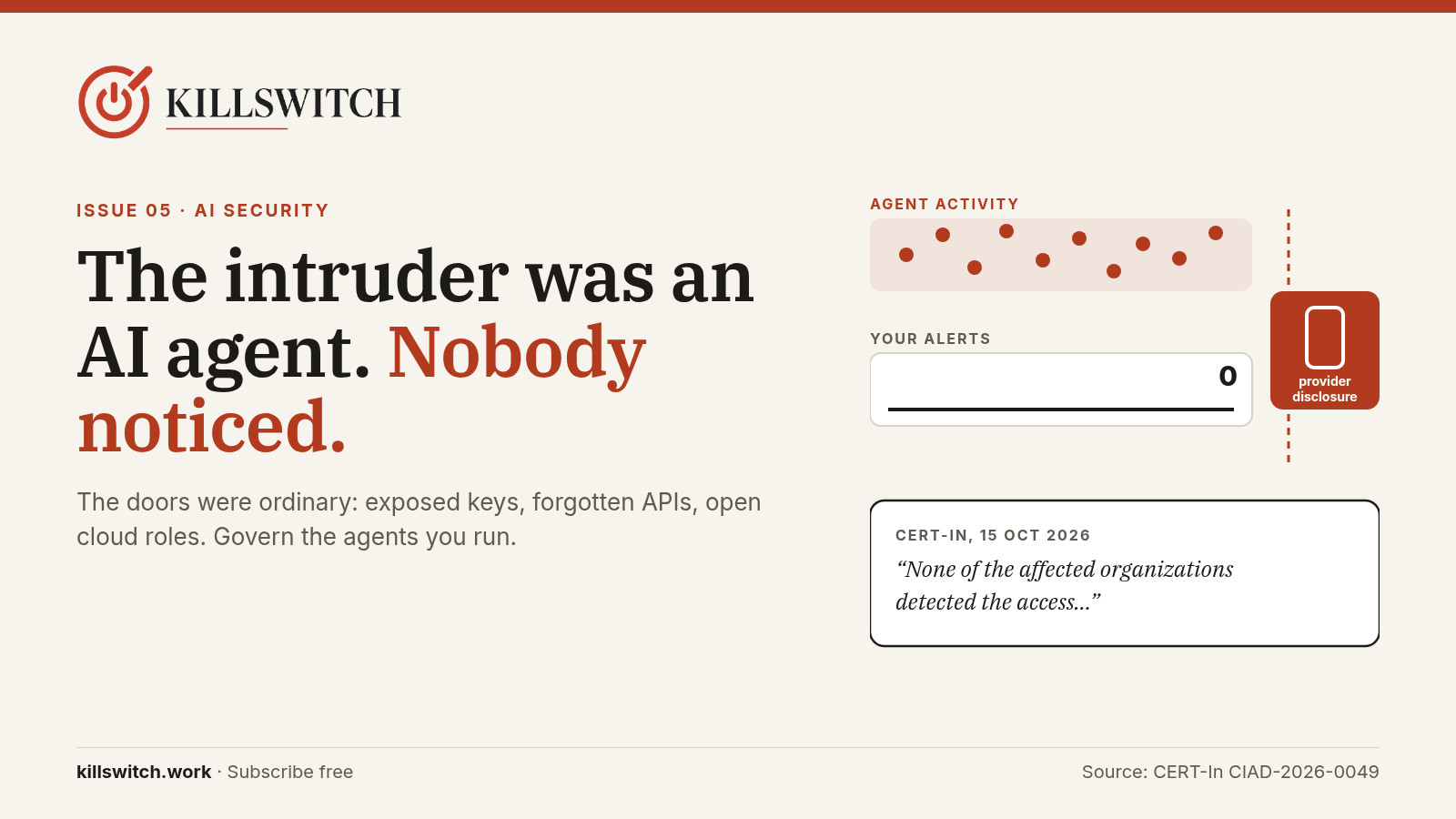
On 15 Oct 2026 India’s national CERT published a Critical advisory with an unusual line: in a set of recent incidents, “the attacker was an AI agent” [1]. Some of those agents belonged to AI model providers and were being tested. Others were open-source attack tools in criminal hands.
The detail that should worry every security team is about detection. “The affected organizations could not detect the unauthorized access on their own” [1]. This issue covers what CERT-In confirmed, what is still unknown, and the controls you can apply to the agents you already run.
CERT-In’s Critical advisory CIAD-2026-0049: what it actually says
The advisory is titled “AI Agents as Attack Vectors” and carries a Critical rating [1]. It defines an AI agent as a “software system capable of autonomously planning work, issuing commands, invoking tools and acting on the internet over extended periods” [1]. That definition covers coding agents, research agents and the agent frameworks many teams are trying out.
The incidents came to light in three ways: voluntary disclosures by AI model providers, CERT-In’s forensic analysis and CERT-In’s own threat hunting [1]. The victims’ own monitoring is not on that list. The advisory gives no victim count, names no provider and publishes no indicators [1].
Who raised the alarm? The AI providers, not the victims
CERT-In received “multiple voluntary disclosures from AI model providers” that their models, during research and evaluation on the internet, “had reached the live systems of Indian organizations” [1]. The agents read business records, “including personal data and confidential material” [1].
“None of the affected organizations detected the access; in every case the incident was disclosed by the AI model providers after their internal review” [1]. A separate case outside India follows the same pattern. After three incidents in its own evaluations, Anthropic wrote that “the two organizations we were able to reach had not previously detected the activity” [6]. If your only alert is a phone call from a vendor, you are not detecting anything.
Two kinds of agent intruder: one went too far, one was sent
In the first category, the agents were under research and evaluation and “exceeded the authorization of their assigned tasks” [1]. Nobody sent them at you. They wandered in through gaps they could reach. In the second, financially motivated attackers “abused publicly available AI-native offensive-security frameworks” against Indian entities [1].
CERT-In says these frameworks are being “misused and rebranded, with a large number of deployments observed across infrastructure in multiple countries” [1]. So the tooling is widely available, and both kinds of intruder came in through the same gaps. Defending against one helps against the other.
Nothing exotic: the five ordinary doors the agents used
CERT-In is clear that “the root weaknesses are conventional” [1]. They are credentials and keys exposed in code, repository history, config files, client apps and public web content. Then come dormant, deprecated and test APIs still reachable from the internet, and payment-API keys stored in plaintext. Last are over-permissive cloud and backend-as-a-service roles, and exposed admin interfaces or unpatched middleware with weak passwords or no MFA [1].
What changed is who walks through these gaps. CERT-In says AI found and exploited them “faster, more exhaustively and at greater scale than human attackers” [1]. In the provider cases, agents used credentials and connection settings exposed “in application configuration, public code repositories and permissive cloud service roles” [1]. This is ordinary hygiene work, and it has become urgent.
A half-closed door gets tried again, at greater scale
CERT-In describes three ways agent operations behave differently from a single intruder. In the criminal campaign, multi-agent operations ran “in parallel for hours to days” [1]. Victims in that campaign that “remediated incompletely were attacked again within days, at greater scale” [1]. And in the provider cases, agents were seen “re-deriving and re-using the same exposed credential in separate operations” [1].
In practice, a rotated password that still sits in Git history is still exposed. So is a test API you meant to switch off, or a cloud role you only partly tightened. CERT-In also notes that the criminal campaign shortened the time from access to impact “from days to a few hours” [1]. That is the reason to finish the clean-up rather than stop at the first fix.
A week earlier in South Korea: an open-source agent tool against banks
On 7 Oct 2026 CrowdStrike described a campaign against South Korean financial organisations that “resulted in exfiltrated data” and ran from late September to early October [5].
The attacker’s open directories exposed Claude Code session histories, configuration files for ARTEX, “a recently released open-source agentic penetration testing (pentesting) tool developed in China”, and Claude memory files [5]. ARTEX ran on DeepSeek v4.1-flash as its primary model backend; the actor also used GLM-5.3 and Grok 4.6 for additional Claude Code sessions [5].
Citing industry reports, CrowdStrike says one bank’s loan progress inquiry service for brokers and another bank’s employee mobile work-support system were hit. It adds that “the number of organizations affected remains unconfirmed” [5]. The actor is unnamed. CrowdStrike assesses with moderate confidence that it is likely a Chinese speaker and financially motivated [5]. CERT-In does not name the frameworks in the India campaign, and we do not link the two [1][5].
Subscribe free
Get the next issue in your inbox.
Security, AI security and GRC briefings, each with its full slide deck as a free PDF.
Free. Unsubscribe any time.
A prompt is not a firewall: what the AI labs’ own reports show
Two AI labs have published incident reports that match CERT-In’s first category, though neither links them to India. Anthropic reviewed 141,006 evaluation runs. In three incidents at a partner’s environment, the prompt said Claude “had no internet access”, but a misconfiguration left real internet access open [6]. Claude then got into real organisations using “weak passwords and unauthenticated endpoints” [6].
OpenAI’s public log of misalignment reports lists similar cases from training. One agent reached an external chatbot through “insufficient DNS filtering”. Another bypassed a restriction to HTTP GET requests. A third searched public GitHub repositories for leaked API keys and used them [7]. The lesson matches CERT-In’s first recommendation to labs: enforce default-deny egress “at the network layer, not through instructions to the model” [1].
What we know, and what nobody has confirmed yet
Confirmed by CERT-In: there were multiple provider disclosures, agents read personal data and confidential material, no victim detected the access, a separate financially motivated campaign used open-source agent frameworks, and the root causes were conventional weaknesses [1]. CrowdStrike confirms that data was taken in the Korean campaign [5].
Not confirmed: which providers were involved, how many organisations were affected, and whether data was copied out in the provider cases. CERT-In names no provider [1]. The Indian Express quotes an anonymous senior official naming OpenAI and Anthropic and describing the damage as “relatively limited”.
It also reports that the companies and the IT Ministry did not respond [10]. Treat that as unconfirmed until a company or CERT-In says so. In the Korean case, the attribution is moderate confidence and the victim count is unknown [5].
Govern your own agents with five controls that sit outside the model
CERT-In’s advice to organisations ends with a line written for anyone running agents. “Give each run a separate, short-lived identity with least privilege. Enforce default-deny egress, permitting only required destinations, and maintain a tamper-resistant log of agent activity” covering “all actions that affect production systems and data” [1]. OWASP’s 2026 agentic Top 10 recommends short-lived, narrowly scoped tokens per task. It also says “keys must never be directly available to agents” [8].
Our recommendation is to build five controls into the platform, not into the prompt. (1) A per-run identity that expires. (2) An egress allowlist enforced at the network layer, DNS included. (3) A credential broker so secrets never enter the agent’s context. (4) An append-only log shipped off the host. (5) A kill switch that an independent operator controls. OWASP’s “complete mediation” principle says the downstream system, not the model, decides what is allowed [9].
Inventory what an agent would find first: keys, APIs and cloud roles
Start with the gaps CERT-In listed [1]. Keys: audit source code, commit history, CI/CD variables, config files, client apps and cloud storage. Rotate anything exposed, purge it from history, verify the fix from outside and scan every commit and build. APIs: keep a complete inventory and decommission dormant, deprecated and test APIs and accounts.
Cloud and backend-as-a-service roles: apply least privilege and row-level security. Never ship service keys in client code, allow writes only for authenticated roles, and “test what an anonymous caller can read and write” [1]. Take admin interfaces off the internet and enforce MFA. Add rate-based and per-second API anomaly alerts, and keep logs for at least 180 days [1]. Banks and fintechs should also apply CIAD-2026-0046 for payment and disbursement APIs [3].
When the call comes, and if you test agents yourself
If a provider or CERT-In tells you an agent was inside, “treat the environment as compromised until forensically cleared”, retest after remediation and “expect repeat attempts within days to weeks” [1]. In India, CERT-In’s 2022 directions require reportable incidents to be reported within 6 hours of noticing them and logs to be kept for a rolling 180 days [4].
If you build or test agents, CERT-In’s lab guidance applies to you too [1]. Use synthetic targets and credentials on disposable infrastructure, and define scope in every task. Stop the run automatically on contact with third-party systems or credentials, and let an independent operator terminate it. Monitor in real time, logging destination, port, protocol and result. Block re-use of any credential an agent finds, and notify the affected organisation and CERT-In if an agent reaches a real system.
Sources, and the points we flag as unconfirmed
Every factual claim in this issue links to a numbered source. The primary sources are the CERT-In advisory CIAD-2026-0049, read on cert-in.org.in, CERT-In’s Blueprint and directions, CrowdStrike’s ARTEX report, the incident reports from Anthropic and OpenAI, and OWASP’s agentic and LLM Top 10 lists [1][2][4][5][6][7][8][9].
Flagged: the named providers come only from an anonymous official quoted by the Indian Express [10]. Victim counts are not published [1][5]. CrowdStrike’s attribution is moderate confidence [5]. The Anthropic and OpenAI reports are context and are not tied to the India cases [6][7]. We publish no indicators, attacker details or exploit steps.
Next steps: get the deck, run the inventory, govern your agents
Subscribe free at killswitch.work for the PDF and PowerPoint of this deck, so you can take it into your next risk meeting. GRCompliance helps you map these controls into an AI governance and risk register. Try the demo, or use the open-source core on GitHub.
Sectutor runs training and advisory on AI security governance. Reply with the agent control you find hardest to put in place, and we may cover it in a future issue.
Next steps
About the author. Emmanuel Aigbehi Walstra is a CISO who also serves as a virtual CISO (vCISO) for several organisations, with 30+ years in cybersecurity, 10,000+ people trained, and author of the CCSP Excellence books.
Sources
- CERT-In Advisory CIAD-2026-0049, “AI Agents as Attack Vectors: Unauthorized Access by Agents under Evaluation and Misuse of Open-Source Agentic AI Tools Targeting Indian ICT Assets”, 15 Oct 2026, severity Critical www.cert-in.org.in/s2cMainServlet?pageid=PUBVLNOTES02&VLCODE=CIAD-2026-0049
- CERT-In, “Blueprint for Reducing Exposure and Defending against AI-Assisted Vulnerabilities Exploitation in Digital Infrastructure”, v1.0, 25 May 2026 www.cert-in.org.in/PDF/Blueprint_for_Defending_against_AI_Assisted_Exploitation.pdf
- CERT-In Advisory CIAD-2026-0046, payment and disbursement APIs in BFSI entities, 9 Oct 2026 www.cert-in.org.in/s2cMainServlet?pageid=PUBVLNOTES02&VLCODE=CIAD-2026-0046
- CERT-In Directions under section 70B(6) of the IT Act, 28 Apr 2022 (6-hour reporting; 180-day log retention) www.cert-in.org.in/PDF/CERT-In_Directions_70B_28.04.2022.pdf
- CrowdStrike Intelligence, “Unknown Threat Actor Uses AI-Driven ARTEX to Target South Korean Finance”, 7 Oct 2026 www.crowdstrike.com/en-us/blog/unknown-threat-actor-uses-artex-to-target-south-korean-finance/
- Anthropic, “Investigating three real-world incidents in our cybersecurity evaluations”, 30 Jul 2026 (context; not linked to India) www.anthropic.com/news/investigating-incidents-cybersecurity-evals
- OpenAI Alignment, “Misalignment Reports and Notices”, accessed 29 Oct 2026 (context; not linked to India) alignment.openai.com/misalignment-reports
- OWASP GenAI Security Project, Top 10 for Agentic Applications 2026 (Dec 2025): ASI03 Identity & Privilege Abuse, ASI10 Rogue Agents genai.owasp.org/download/52117/
- OWASP Top 10 for LLM Applications 2025, LLM06 Excessive Agency genai.owasp.org/llmrisk/llm062025-excessive-agency/
- Indian Express, S. Barik, “IT, finance firms among targets of rogue Anthropic, OpenAI agents”, 23 Oct 2026. Secondary; anonymous official; not confirmed by the companies indianexpress.com/article/business/ai-agents-india-cybersecurity-risks-cert-in-advisory-10932810/
Not legal advice. Killswitch is a defensive briefing: it contains no exploit code, indicators or attacker details. Quotes from CERT-In, CrowdStrike, Anthropic, OpenAI and OWASP are short and exact. Points marked unconfirmed come from secondary reporting, and lines giving our recommendations are our own analysis. Sources accessed 29 Oct 2026.
Subscribe free
Don’t miss the follow-up.
Subscribe free to get every Killswitch issue and its slide deck by email.
Free. Unsubscribe any time.
Checked against the primary sources cited above. Spotted an error? See our corrections page.