
Password1, Twelve Years Later: The Test Account Nobody Removed
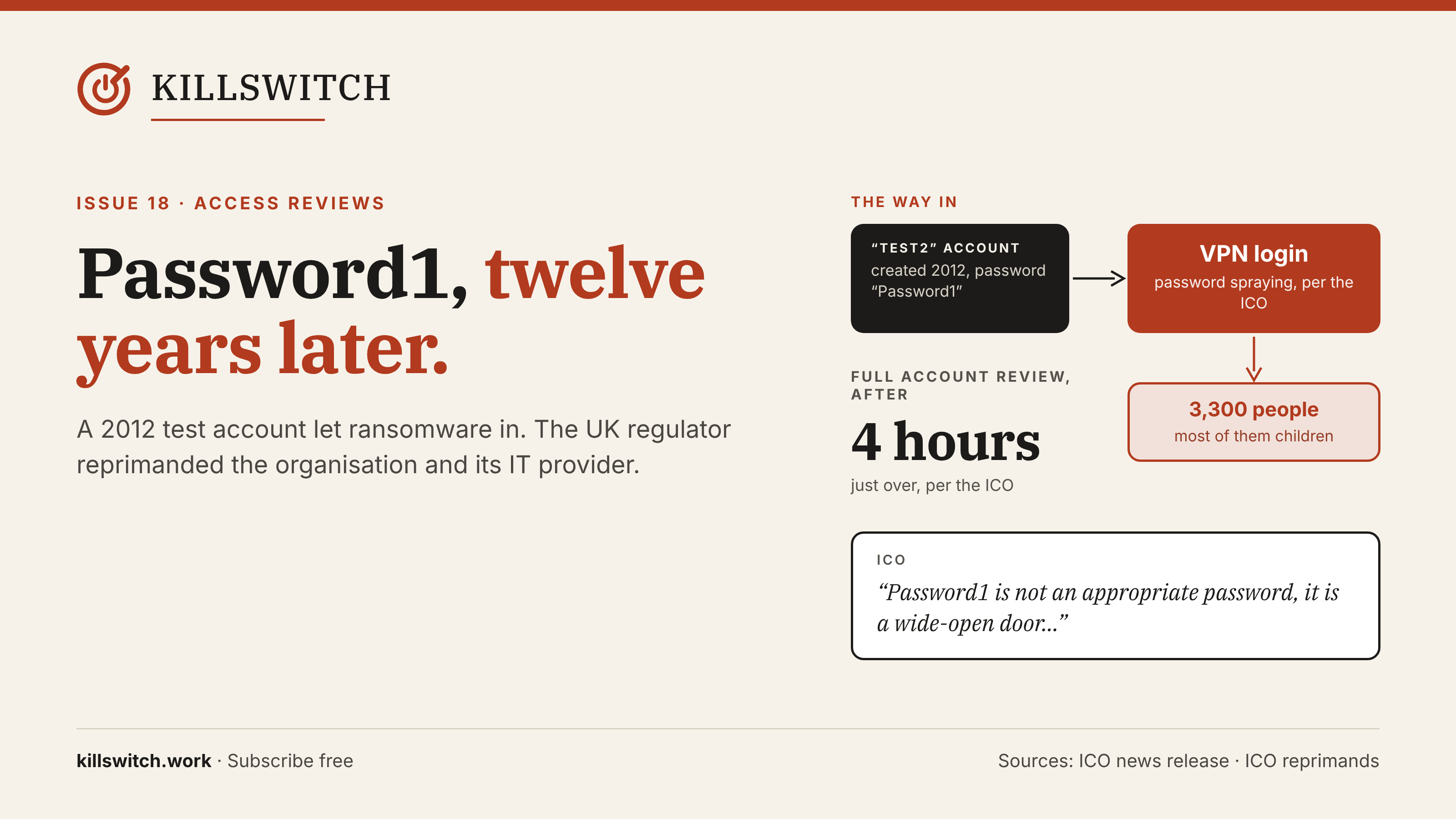
A test account created in 2012 with the password "Password1" let ransomware into a Welsh local government data company and exposed 3,300 people, most of them children. The UK regulator reprimanded both the organisation and its IT provider.
Facts as of 18 Nov 2026.
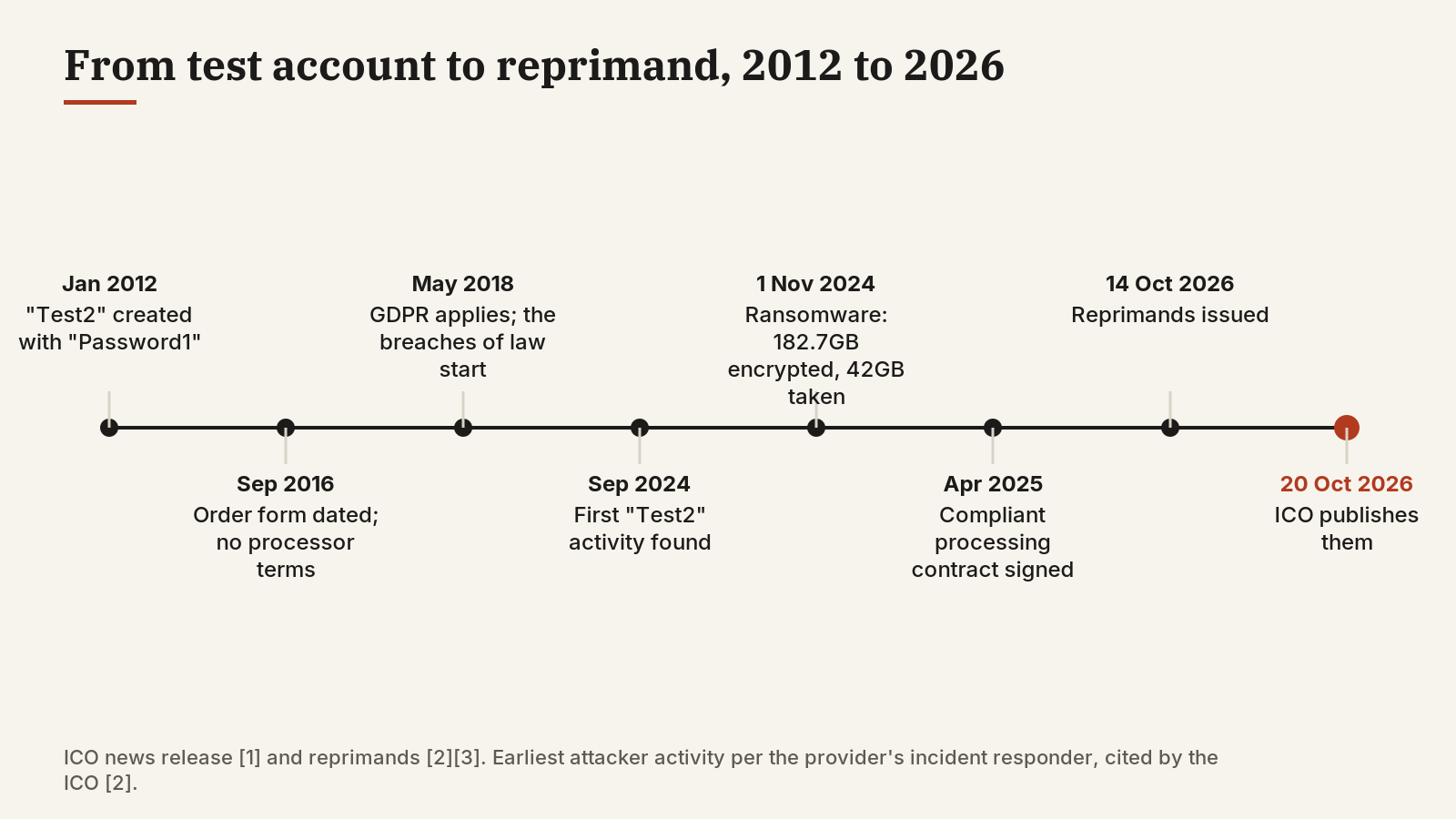
In January 2012, an IT provider set up a test account called "Test2" in a customer's network and gave it the password "Password1" [2]. Twelve and a half years later, attackers used it to get in, and on 1 November 2024 they deployed ransomware [2][3]. They took 42GB of data and encrypted 182.7GB [1]. The personal information of 3,300 people was taken, most of them children [1].
On 20 October 2026, the UK's data protection regulator, the ICO, published reprimands to both organisations: Ogi Networks Limited, the IT provider, and the Local Government Data Unit – Wales, known as Data Cymru, the customer [1]. These are reprimands, not fines [1][2][3]. Its Head of Investigations, David Doodson, put the case in one line: "Password1 is not an appropriate password, it is a wide-open door to nefarious actors." [1]
At a glance
- Who. Data Cymru is a Welsh local government company that helps councils and others use data. It acted as a processor for other organisations, with Ogi Networks as its sub-processor [3]. Ogi Networks has provided Data Cymru's managed IT since 2012 [2]. Data Cymru's functions moved to the Welsh Local Government Association on 1 April 2026 [3].
- What was taken. Data from two projects supporting children and families [1]: 3,300 people, most of them children [1][3].
- Way in. The "Test2" account, its password "Password1", and a VPN [1][2].
- The findings. Both breached UK GDPR Article 32(1)(b) and (d): security of processing, and regularly testing that security. Data Cymru also breached Article 28(4), because its contract with Ogi Networks lacked the terms the law requires for a sub-processor [1][2][3].
- How long. The breaches of law began on 25 May 2018, when the GDPR began to apply. The ICO says they went on for six and a half years without being identified [2][3].
- The outcome. Reprimands dated 14 October 2026 [2][3][4][5]. Ogi Networks did not dispute the findings, and Data Cymru accepted them [2][3].
How they got in
The ICO's account draws on the incident responder Ogi Networks hired after the attack [2]:
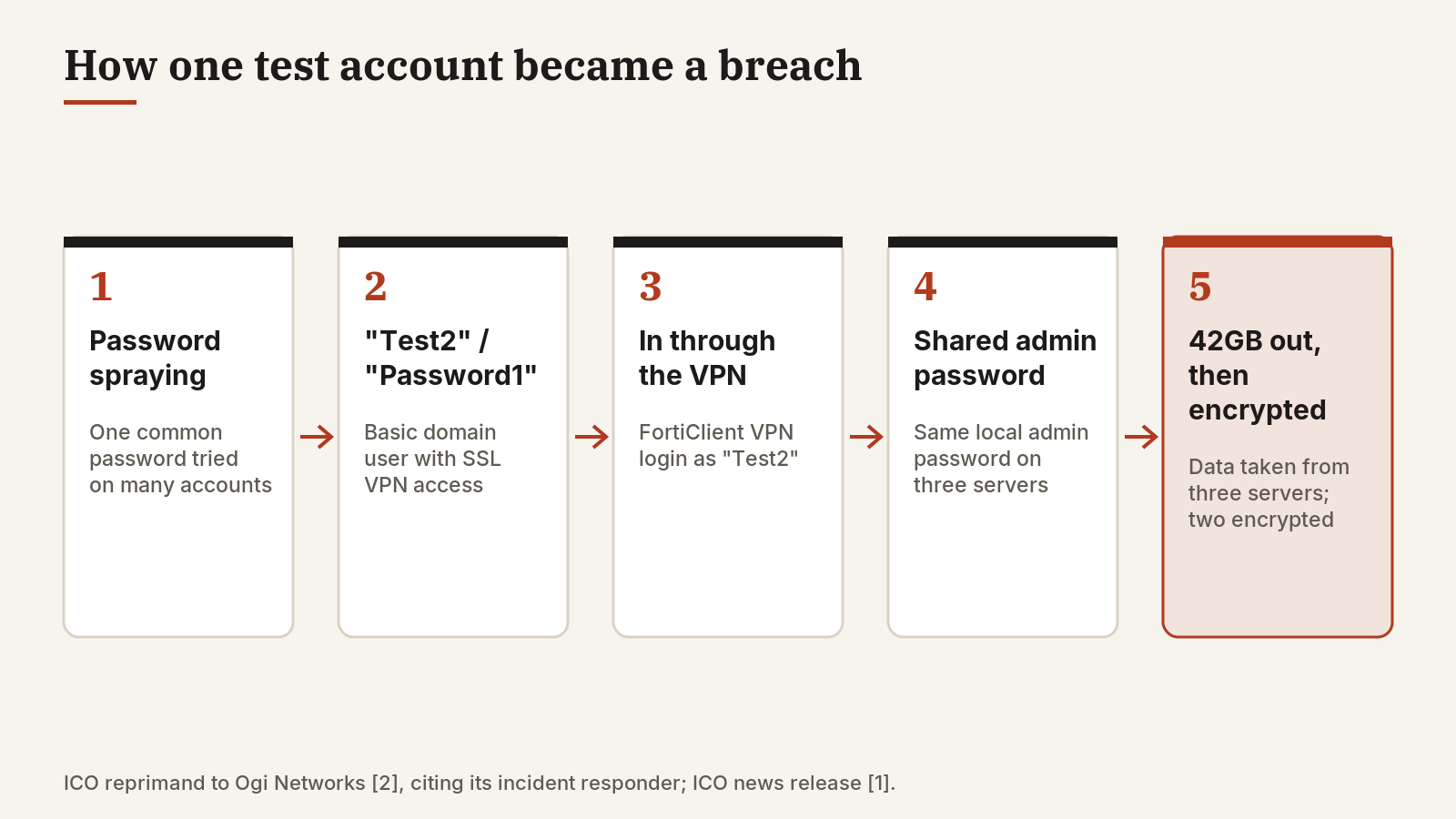
"Test2" was a basic domain user with no admin rights, but it was allowed on the SSL VPN [2]. The responder found that the initial access "appeared to be via a FortiClient VPN connection under the username 'Test2'", that the password was likely guessed in a password-spraying attack, and that activity on the account went back to 20 September 2024, six weeks before the ransomware [2]. A second test account, "testtest", created in 2015, also showed suspicious activity [2].
Once inside, the attackers did not need more passwords. The domain controller, the file server and the SQL server all used the same local administrator password, so hashes taken from one could be used on the others [2]. Ogi Networks told the ICO it had never reviewed those local admin accounts after setting them up in January 2012 [2].
Why the password policy didn't catch it
Data Cymru did have a strong password policy, set by Group Policy: 15 characters, with complexity rules [3]. It did not help. The ICO explains that "Test2" predated that policy and, "due to its lack of use, had not logged into the domain", so its password "was never updated to meet the GPO-secured password requirements" [3]. Passwords were also set not to expire [3].
Ogi Networks had a password policy too, in line with National Cyber Security Centre (NCSC) guidance. But it covered only Ogi's own accounts, could not be enforced in a customer's network, and did not exist when "Test2" was created [2].
That is the trap. A policy that applies at the next password change does nothing for an account that never changes its password. Only a review of the accounts themselves finds it.
Whose job was it?
The ICO did not blame one side. "The responsibility for these failures did not sit with one organisation alone," it said. Ogi Networks created the account, and Data Cymru "retained overall control of its network, including the ability to instruct ONL to create or remove accounts" [1].
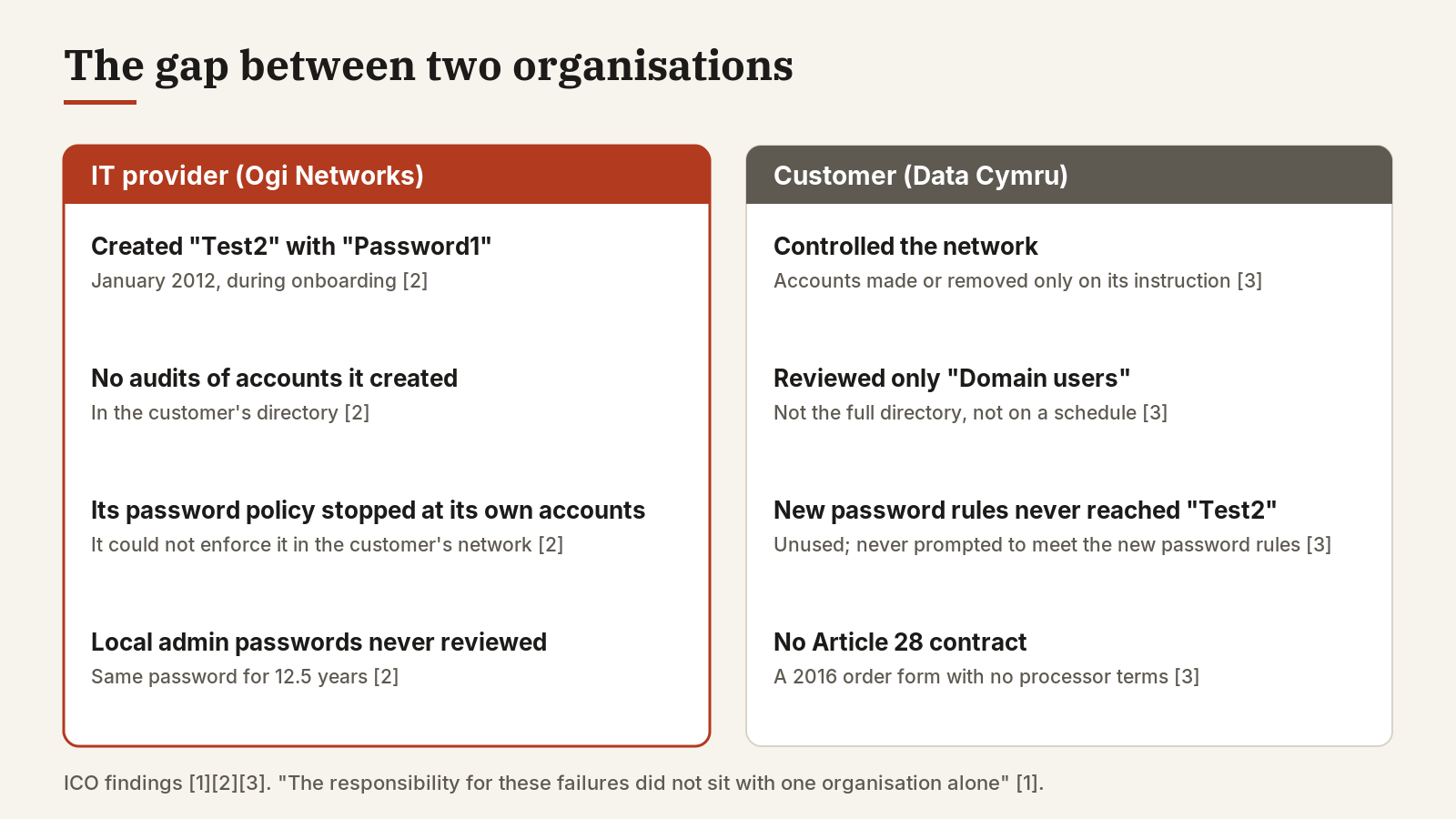
Two details stand out. Data Cymru's account reviews asked only for the members of the "Domain users" group, not the full directory, and were not on a schedule; it could not say when the last one took place [3]. And the only contract was a 2016 order form for "Managed Hosted IT Services – AD Rights Management", with nothing on how that service would be delivered, monitored or audited [3]. Data Cymru told the ICO the order form was overlooked when it reviewed its contracts for the GDPR, and that at the time it saw Ogi Networks as an IT infrastructure provider, not a sub-processor [3]. The ICO found that this gap "directly contributed to the Incident" [3].
The cheapest fact in the case: after the attack, on 8 November 2024, the two organisations reviewed every account in the directory together. It took "just over four hours" and found eight unused accounts, one with admin rights [3].
Could this be you?
Four questions, drawn from the reprimands [2][3]. If you answer "not sure" to any of them, you have the same exposure:
- Does your account review cover the whole directory (every user, service, test and admin account), or a list someone exported from one group?
- Would a new password policy reach an account that never logs in?
- Do any local administrator accounts share a password across servers?
- Does your contract with your IT provider say who removes accounts, and how you check they did?
What to do now
The ICO lists six lessons [1]. They are not new, which is the point: for account management, the reprimands note that the CIS Controls, the NCSC's Cyber Essentials and a 2022 joint advisory on managed service providers already covered the account and password lessons before the attack, and the ICO's own guidance on processor contracts covered the last one [2][3].
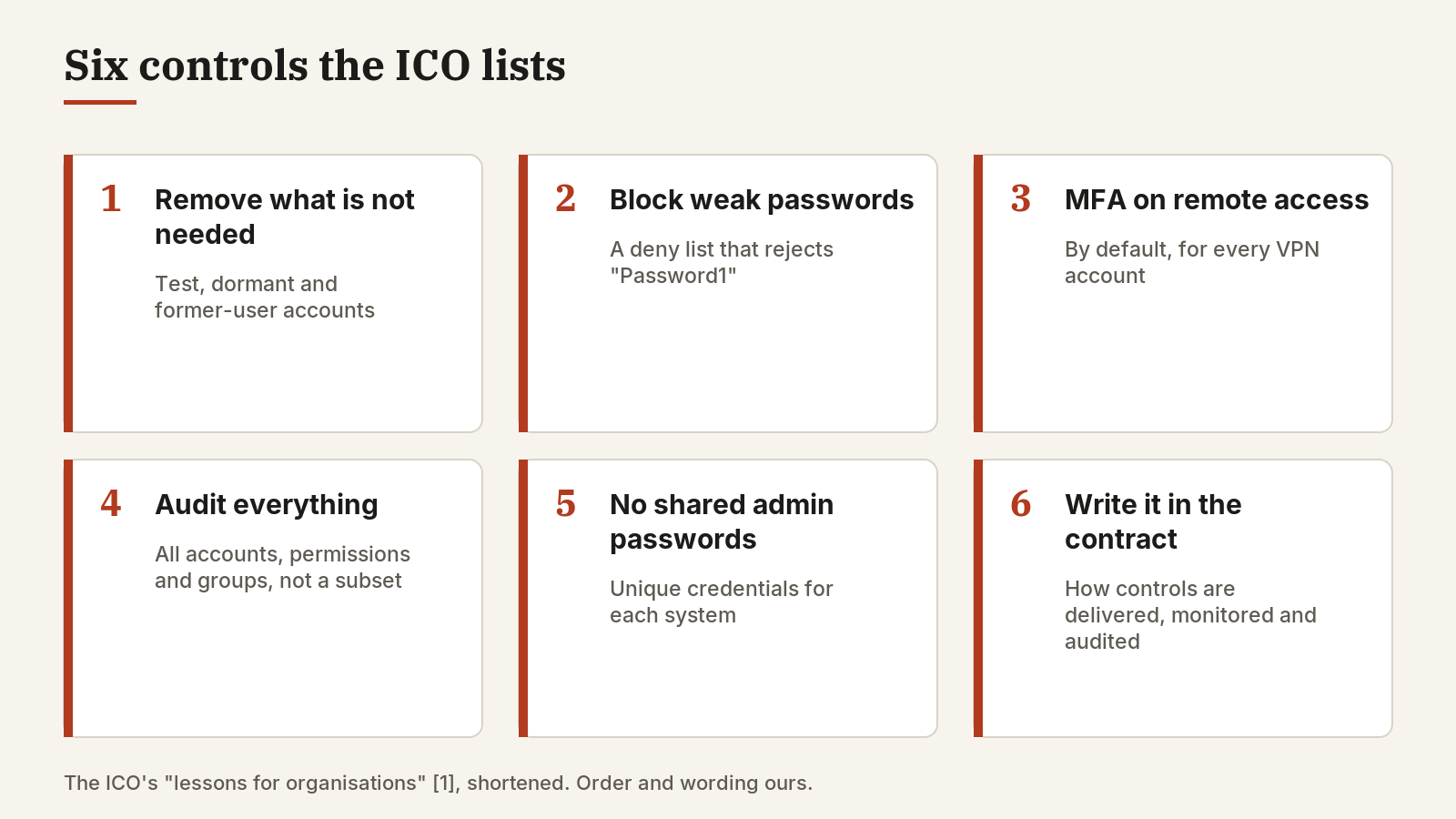
Both organisations have since done the obvious things. Ogi Networks now prompts customers to review their active accounts and recommends removals, and moved the VPN to Microsoft Entra ID with MFA [1][2]. Data Cymru signed a compliant processing contract on 30 April 2025, introduced periodic account reviews and turned on MFA for all SSL VPN access [1][3].
Mapping it for GRC
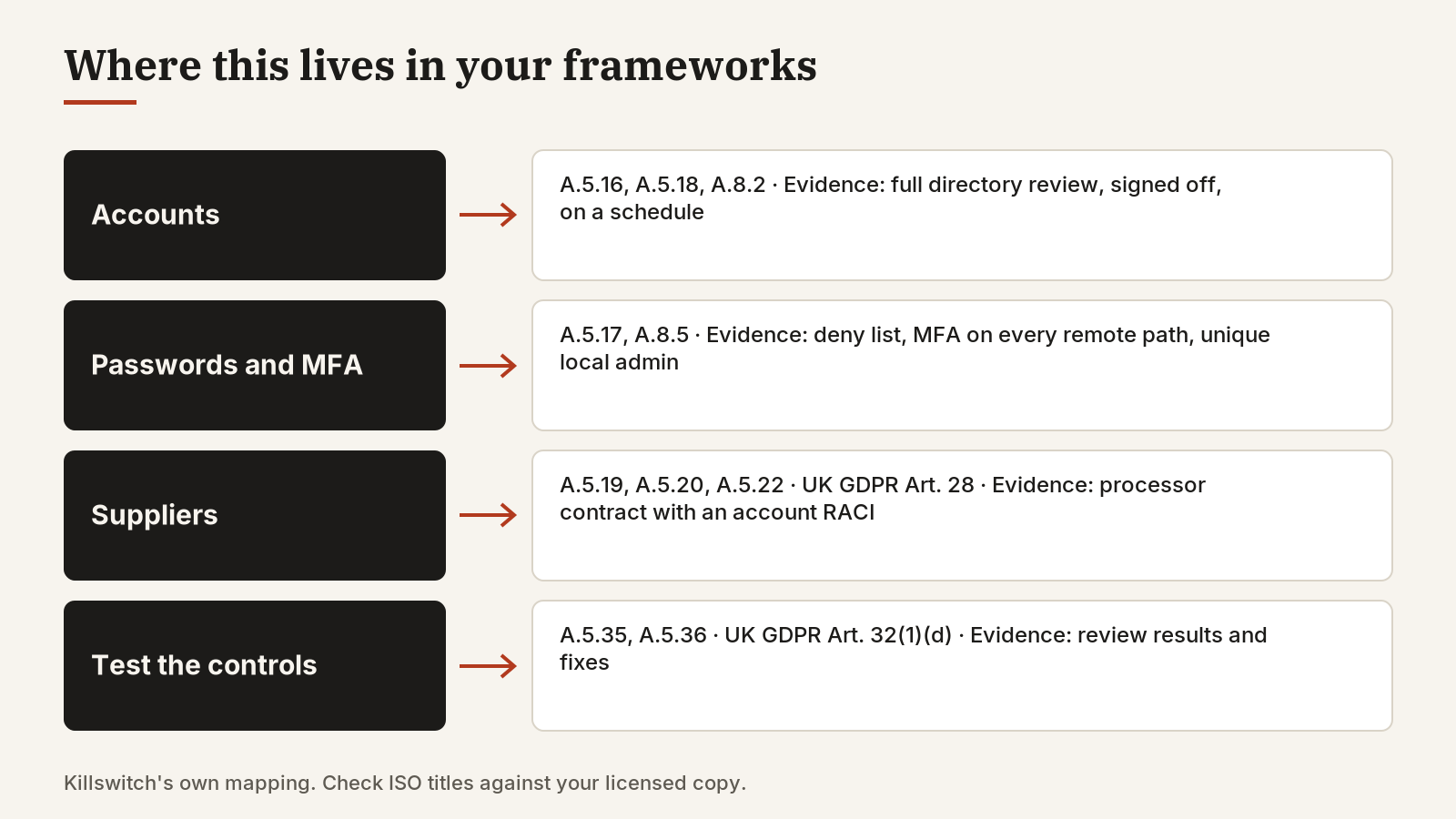
- UK GDPR [1][2][3]: Article 32(1)(b) and (d) applies to the controller and to every processor, so an IT provider can be reprimanded in its own right, as Ogi Networks was. Article 28(4) puts the burden on the processor that brings in a sub-processor to pass the same data protection terms down by contract. The EU GDPR has the same articles.
- ISO/IEC 27001:2022 [6]: identity management (A.5.16), authentication information (A.5.17) and access rights (A.5.18) for the account and password failures; privileged access (A.8.2) and secure authentication (A.8.5) for shared local admin passwords and VPN MFA; supplier relationships, agreements and monitoring (A.5.19, A.5.20, A.5.22) for the contract gap; and independent and compliance reviews (A.5.35, A.5.36) for testing that it all works. This is our mapping; check the control titles against your licensed copy.
- NIS2 [7]: this case is in the UK and NIS2 does not apply to it. For EU entities in scope, the same failures sit under Art. 21(2)(d), supply chain security, (i), access control, and (j), multi-factor authentication. Our mapping.
Lessons and a tabletop
The case is not about a clever attacker. It is about a gap between two organisations, each of which could reasonably think the other was watching the accounts. That gap is common wherever IT is outsourced.
A 30-minute tabletop with your IT provider:
- Export every account in your directory now. How many are test, service or former-user accounts, and who owns each one?
- Which of them can reach the VPN or other remote access, and which have MFA?
- Who is allowed to create and remove accounts, and where is that written down?
- When did someone last check that the provider removed what it was asked to remove?
What we don't know yet
- Who the attackers were. The ICO names no group and no ransom demand.
- Whether data has been published. As of the reprimand, there was "no evidence of personal data being published to date", and the regional organised crime unit and the NCSC were monitoring the dark web [3].
- The redacted parts. Some paragraphs of both reprimands are blank in the published versions, including details of the data and its context [2][3].
- The live pages. The ICO's website refused our requests on 10 November, so we read the news release and both reprimands from Internet Archive copies made between 20 and 23 October [1][2][3]. If the ICO has changed them since, we have not seen it.
Your checklist for this week
- Export the full directory, not one group, and review every account with its owner.
- Disable test accounts and any account that has not logged in for months.
- Turn on a banned-password list and check it rejects "Password1".
- Put MFA on every remote access path, and remove any account that can bypass it.
- Give each server's local admin account a unique password.
- Add an account RACI to your IT provider contract, and check the processor terms are in it.
Download the slides
Use this issue in your next team briefing. The slides are free to download:
Keep going
- Try the live demo: GRCompliance. Keep an access-review register and supplier contracts in one place, link the evidence, and map controls to ISO 27001 and UK GDPR.
- Install free from GitHub (self-hosted): GRCompliance Core, the open-source edition. Your data stays on your infrastructure.
- Sectutor books and kits: security and GRC books, training and audit kits.
- Subscribe to Killswitch: sharp issues on security, AI security and GRC.
About the author. Emmanuel Aigbehi Walstra is a CISO who also serves as a virtual CISO (vCISO) for several organisations, with 30+ years in cybersecurity, 10,000+ people trained, and author of the CCSP Excellence books.
Sources
- ICO: "'Password1' is not an appropriate password": Two Welsh organisations reprimanded after cyber-attack exposed children's information (20 Oct 2026; read via the Internet Archive copy of 23 Oct 2026)
- ICO: Reprimand to Ogi Networks Limited, Articles 32(1)(b) and (d) UK GDPR (dated 14 Oct 2026; PDF read via the Internet Archive copy of 22 Oct 2026)
- ICO: Reprimand to the Local Government Data Unit – Wales (Data Cymru), Articles 28(4), 32(1)(b) and (d) UK GDPR (dated 14 Oct 2026; PDF read via the Internet Archive copy of 20 Oct 2026)
- ICO: Enforcement action, Ogi Networks Limited (14 Oct 2026; read via the Internet Archive copy of 20 Oct 2026)
- ICO: Enforcement action, Local Government Data Unit – Wales (14 Oct 2026; read via the Internet Archive copy of 20 Oct 2026)
- ISO/IEC 27001:2022 Information security management systems
- NIS2 Directive (EU) 2022/2555, Article 21
Facts are from the ICO's news release and its two reprimands, dated 14 Oct 2026 and published 20 Oct 2026. The ICO's site refused our requests on 10 Nov 2026, so all three were read from Internet Archive copies. The framework mapping, the self-test and the tabletop are Killswitch's own.
Checked against the primary sources cited above. Spotted an error? See our corrections page.