
MFA Was a Second Door: The SonicWall SSLVPN Path That Skipped SAML
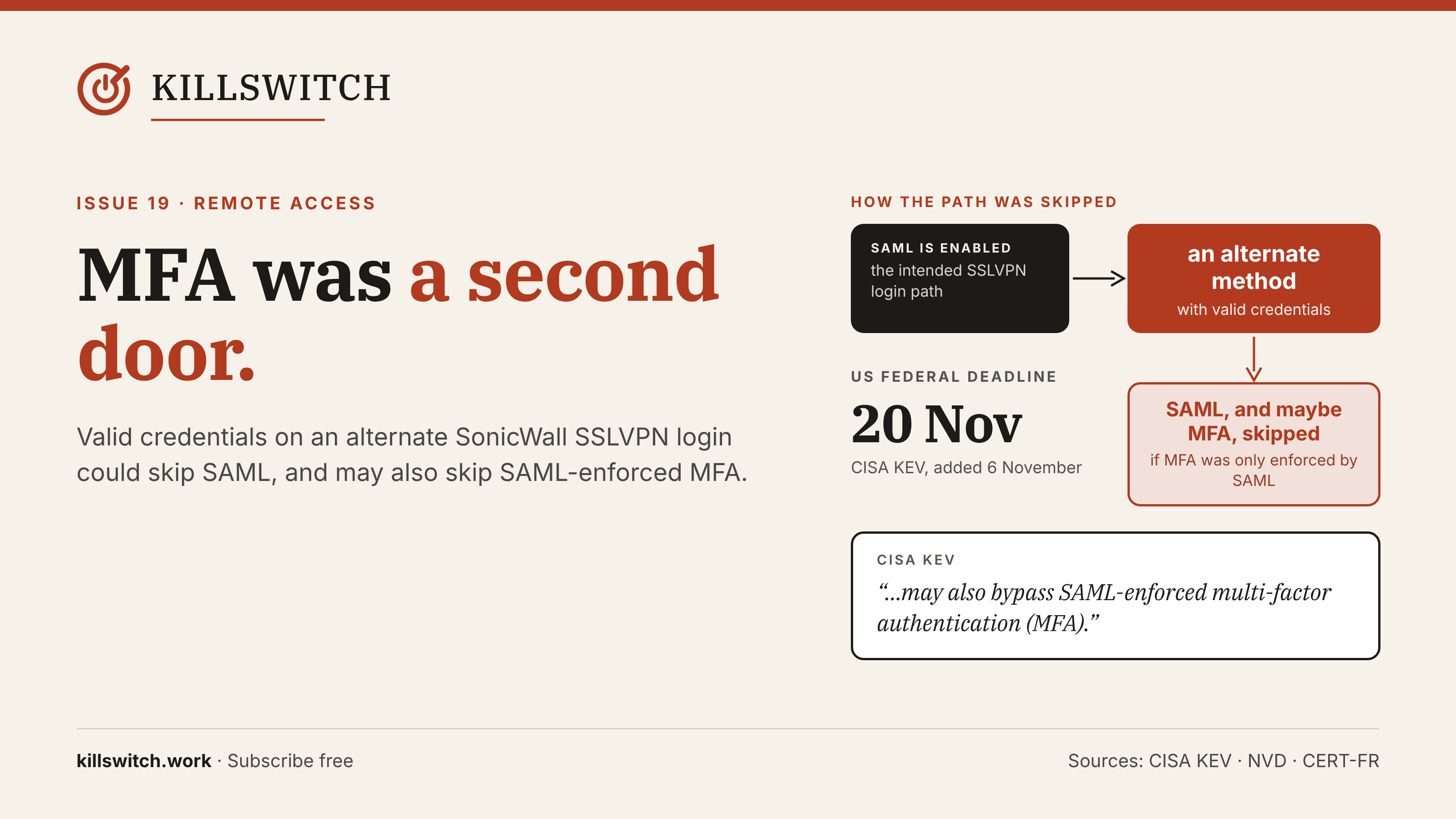
A SonicWall SonicOS SSLVPN flaw lets a user with valid credentials for an alternate login method bypass SAML controls, and may also bypass SAML-enforced multi-factor authentication. CISA added it to its exploited list on 6 November, with a US federal deadline of 20 November.
Facts as of 20 Nov 2026.
"SAML is on" and "MFA is on" are two of the most reassuring sentences a CISO can hear about a remote-access gateway. For some SonicWall SonicOS SSLVPN deployments, they were not the same as "SAML and MFA are the only way in."
CISA's Known Exploited Vulnerabilities (KEV) catalog describes CVE-2026-19868 as a "Use of Single-factor Authentication" flaw in SonicWall SonicOS SSLVPN: a user who has valid credentials for an alternate authentication method may bypass SAML authentication controls, and successful exploitation "may also bypass SAML-enforced multi-factor authentication (MFA)" [2][3]. On 6 November, CISA added the CVE to KEV, based on evidence of active exploitation, with a US federal deadline of 20 November [1][2]. Forensic triage is not required for this entry [2].
At a glance
- What it is. An authentication-enforcement flaw in SonicWall SonicOS SSLVPN, tracked as CVE-2026-19868 [2][3][5]. The CISA, NVD and SonicWall descriptions concern SSLVPN cases that use SAML, and an alternate authentication method for which the user has valid credentials [2][3][5]. SonicWall says the flaw affects SSLVPN only if SAML is enabled for SSLVPN logins [5].
- How bad. SonicWall scores it CVSS 3.1 7.1 (High), with privileges required [5]. NVD shows CISA's secondary score of 7.5 (High), which rates it as needing no privileges [3].
- What an attacker needs. Valid credentials for an alternate authentication method, not a break of SAML itself [2][3][5]. Actor, scale and a complete list of alternate methods are not public [1][2][5].
- Exploited. CISA added it to KEV on 6 November, based on evidence of active exploitation [1][2]. SonicWall says its PSIRT "has investigated a report indicating potential exploitation" and urges customers to upgrade [5]. Known ransomware use is listed as "Unknown" [2].
- Fixed. SonicWall's advisory lists SonicOS 7.3.4-7013 and higher (Gen7) and 8.2.3-8015 and higher (Gen8) as fixed. Affected: 7.3.3-7015 and older (Gen7) and 8.2.2-8015 and older (Gen8) [5]. CERT-FR, citing the same bulletin, lists the same fixed releases [4].
Timeline
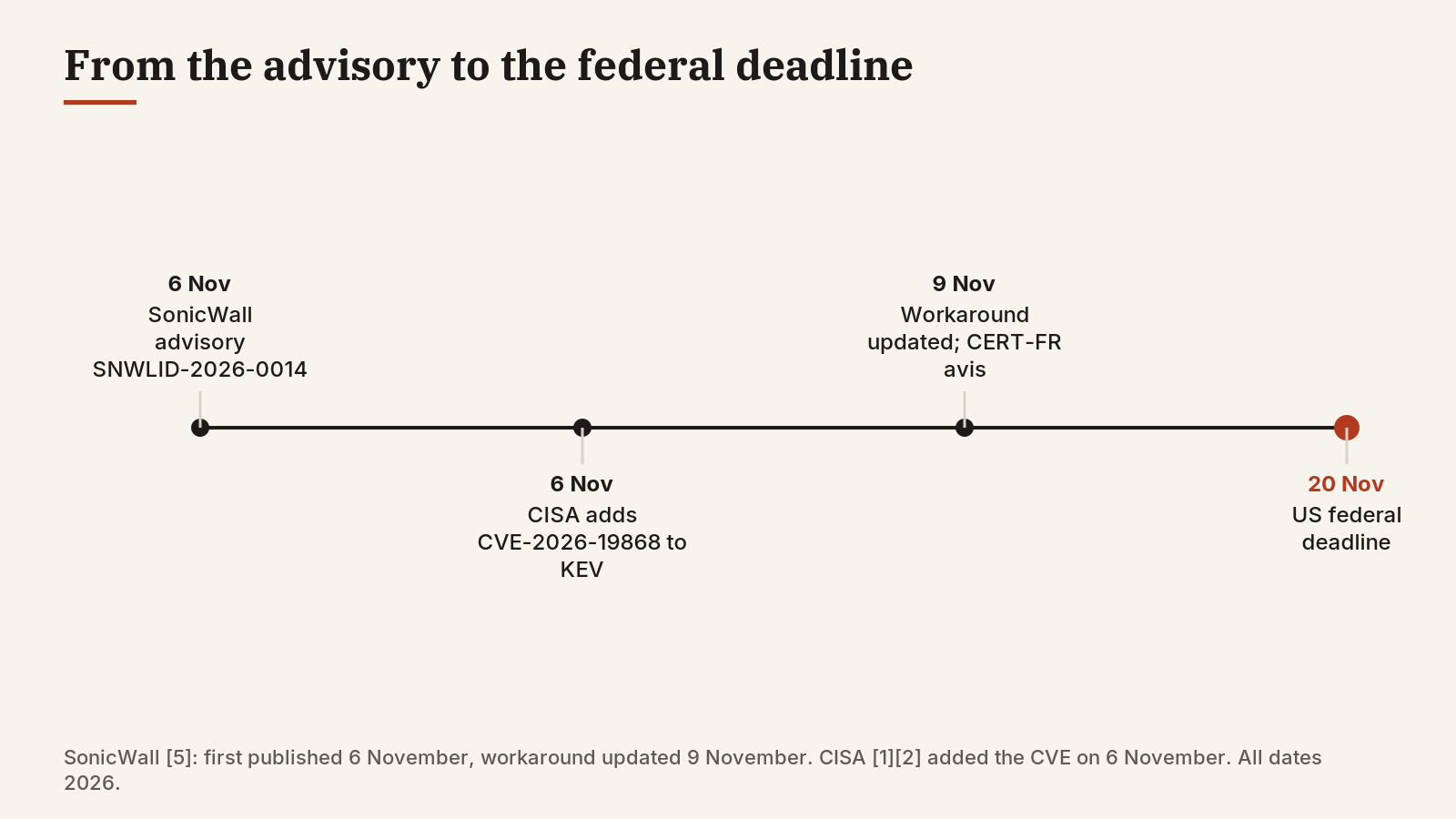
SonicWall published advisory SNWLID-2026-0014 on 6 November and updated the workaround on 9 November [5]. CISA added the CVE to KEV on 6 November [1][2]. CERT-FR published its avis on 9 November [4]. The federal deadline is 20 November [2].
How it works
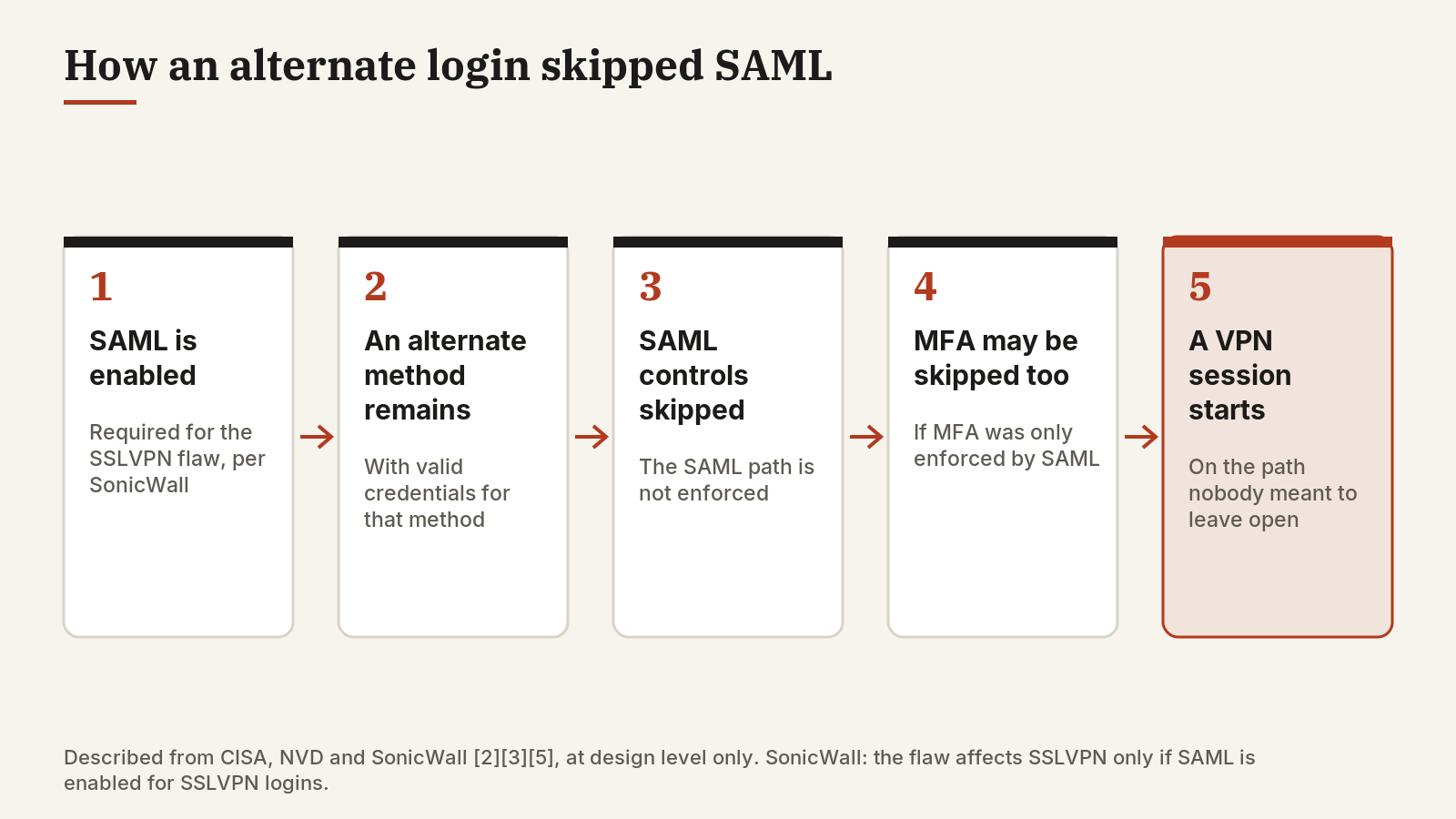
We describe the control failure, not how to use it. SonicWall says the flaw affects SSLVPN only if SAML is enabled for SSLVPN logins [5]. The intended path is SAML, often with MFA attached to it. An alternate authentication method was still able to succeed with valid credentials, and that success skipped the SAML controls [2][3][5]. If MFA was only enforced as part of SAML, it may have been skipped as well [2][3][5].
That is an inventory problem as much as a patch problem. A method you no longer mean to offer, or never quite turned off, is enough.
Am I affected?
SonicWall says the flaw affects SSLVPN only if SAML is enabled for SSLVPN logins [5]. You are in scope if you run SonicOS 7.3.3-7015 or older (Gen7) or 8.2.2-8015 or older (Gen8), with SAML enabled for SSLVPN, and an alternate authentication method can still succeed [2][3][5]. CERT-FR's avis covers multiple SonicOS vulnerabilities and points to the same bulletin for the fixes [4].
What to do now
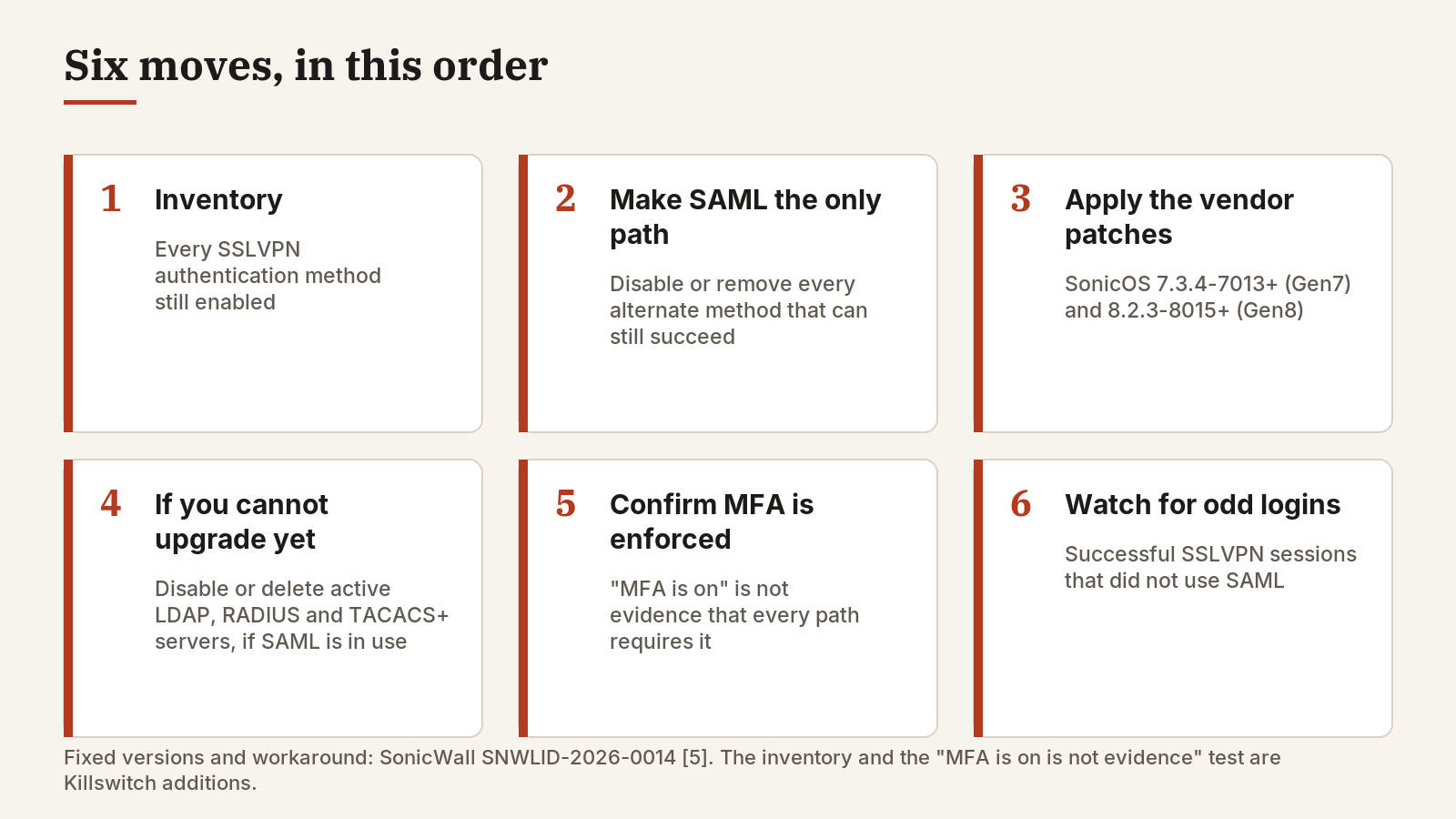
- Inventory every SSLVPN authentication method still enabled. If SAML, with MFA, is the intended path, disable or remove every alternate method that can still succeed. "MFA is on" is not evidence that MFA is enforced on every path.
- Apply the patches in SonicWall advisory SNWLID-2026-0014 [5]. SonicWall lists SonicOS 7.3.4-7013 and higher (Gen7) and 8.2.3-8015 and higher (Gen8) as fixed [5]. CERT-FR cites the same fixed releases [4].
- If you can't upgrade yet, SonicWall's workaround is to disable or delete any active LDAP, RADIUS and TACACS+ authentication servers on the firewall when SAML is in use [5].
- Review recent SSLVPN successes that did not use SAML. CISA is not requiring a forensic-triage flag for this CVE [2], but an unexpected non-SAML login is still worth a look.
- If an MSP runs the firewall, ask them which methods are enabled, which patch they applied, and what they found in the logs.
Mapping it for GRC
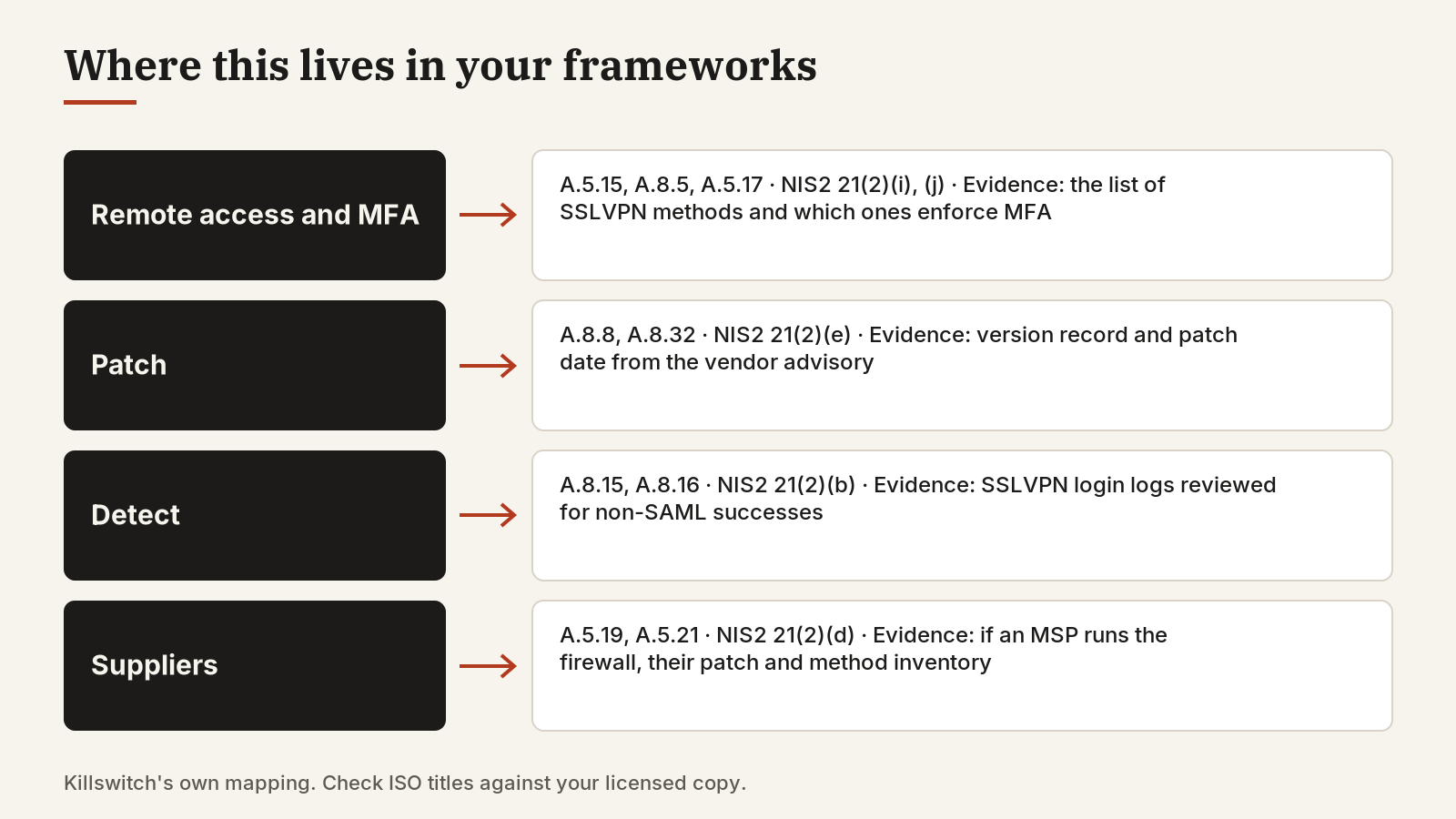
- ISO/IEC 27001:2022 [6]: access control (A.5.15) and secure authentication (A.8.5), which is where "MFA is attached to one path, not to every path" belongs; authentication information (A.5.17); technical vulnerability management (A.8.8) and change management (A.8.32) for the upgrade; logging and monitoring (A.8.15, A.8.16) for the login review; supplier relationships (A.5.19) and managing ICT in the supply chain (A.5.21) if an MSP runs the appliance. This is our mapping; check the control titles against your licensed copy.
- NIS2 [7]: if you are an essential or important entity, the anchors are Art. 21(2)(i), access control, and (j), multi-factor or continuous authentication, for the path inventory; (e), vulnerability handling, for the upgrade; (b), incident handling, if you find unexpected logins; and (d), supply chain security, if a provider runs the gateway. Any notification duty under Art. 23 applies only if an incident is significant [7].
Lessons and a tabletop
The lesson is not "another edge VPN was unpatched." It is that enabling SAML and MFA does not, by itself, retire every other way in. An unused or forgotten alternate method is enough.
A 20-minute tabletop for your network or MSP team:
- List every remote-access path (SSLVPN, other VPNs, jump hosts, cloud consoles). For each, which authentication methods are still enabled?
- If MFA is "on," is it enforced on every method, or only on the one you meant to use?
- Who is allowed to add a method back, and would you notice?
- If an MSP owns the appliance, where is the method inventory and the patch evidence?
What we don't know yet
- Who was attacked, and by whom. CISA has not named a victim, actor or scale [1][2]. Known ransomware use is "Unknown" [2].
- A complete list of alternate methods. SonicWall names LDAP, RADIUS and TACACS+ as the workaround targets if you cannot upgrade, not as a complete list of alternate methods [5]. CISA and NVD say "an alternate authentication method" and do not list them [2][3].
Your checklist for this week
- Inventory every SSLVPN authentication method on each SonicWall you or your MSP run [2][3][5].
- If SAML and MFA are the intended path, disable every alternate method that can still succeed.
- Apply the patches in SonicWall advisory SNWLID-2026-0014: SonicOS 7.3.4-7013 and higher (Gen7) and 8.2.3-8015 and higher (Gen8) [5].
- If you cannot upgrade yet, disable or delete any active LDAP, RADIUS and TACACS+ authentication servers when SAML is in use [5].
- Review SSLVPN logs for successful logins that did not use SAML.
- Keep a short record of the methods you disabled, the patch or workaround you applied, and who signed it off.
Download the slides
Use this issue in your next team briefing. The slides are free to download:
Keep going
- Try the live demo: GRCompliance. Keep an inventory of remote-access authentication methods and their evidence, and map the controls to ISO 27001 and NIS2.
- Install free from GitHub (self-hosted): GRCompliance Core, the open-source edition. Your data stays on your infrastructure.
- Sectutor books and kits: security and GRC books, training and audit kits.
- Subscribe to Killswitch: sharp issues on security, AI security and GRC.
About the author. Emmanuel Aigbehi Walstra is a CISO who also serves as a virtual CISO (vCISO) for several organisations, with 30+ years in cybersecurity, 10,000+ people trained, and author of the CCSP Excellence books.
Sources
- CISA: CISA Adds One Known Exploited Vulnerability to Catalog (6 Nov 2026)
- CISA: Known Exploited Vulnerabilities Catalog, CVE-2026-19868 (added 6 Nov 2026, due 20 Nov 2026)
- NIST NVD: CVE-2026-19868 (published 6 Nov 2026)
- CERT-FR: Avis CERTFR-2026-AVI-1483, Multiples vulnérabilités dans Sonicwall SonicOS (9 Nov 2026)
- SonicWall: Security advisory SNWLID-2026-0014 (published 6 Nov 2026, updated 9 Nov 2026)
- ISO/IEC 27001:2022 Information security management systems
- NIS2 Directive (EU) 2022/2555, Articles 21 and 23
Facts are from CISA's 6 November alert and KEV entry, the NVD record, CERT-FR's 9 November avis, and SonicWall advisory SNWLID-2026-0014 (published 6 November, updated 9 November), as published by 20 Nov 2026. The framework mapping, the inventory control and the tabletop are Killswitch's own.
Checked against the primary sources cited above. Spotted an error? See our corrections page.