
Your Newsletter Vendor Was the Database
Japan's Arara Message email service first reported about 3 million leaked addresses. Eight days later it reported 81.3 million addresses taken or at risk (addresses, not people), across up to about 380 customer companies. Its own sending address had been used for phishing.
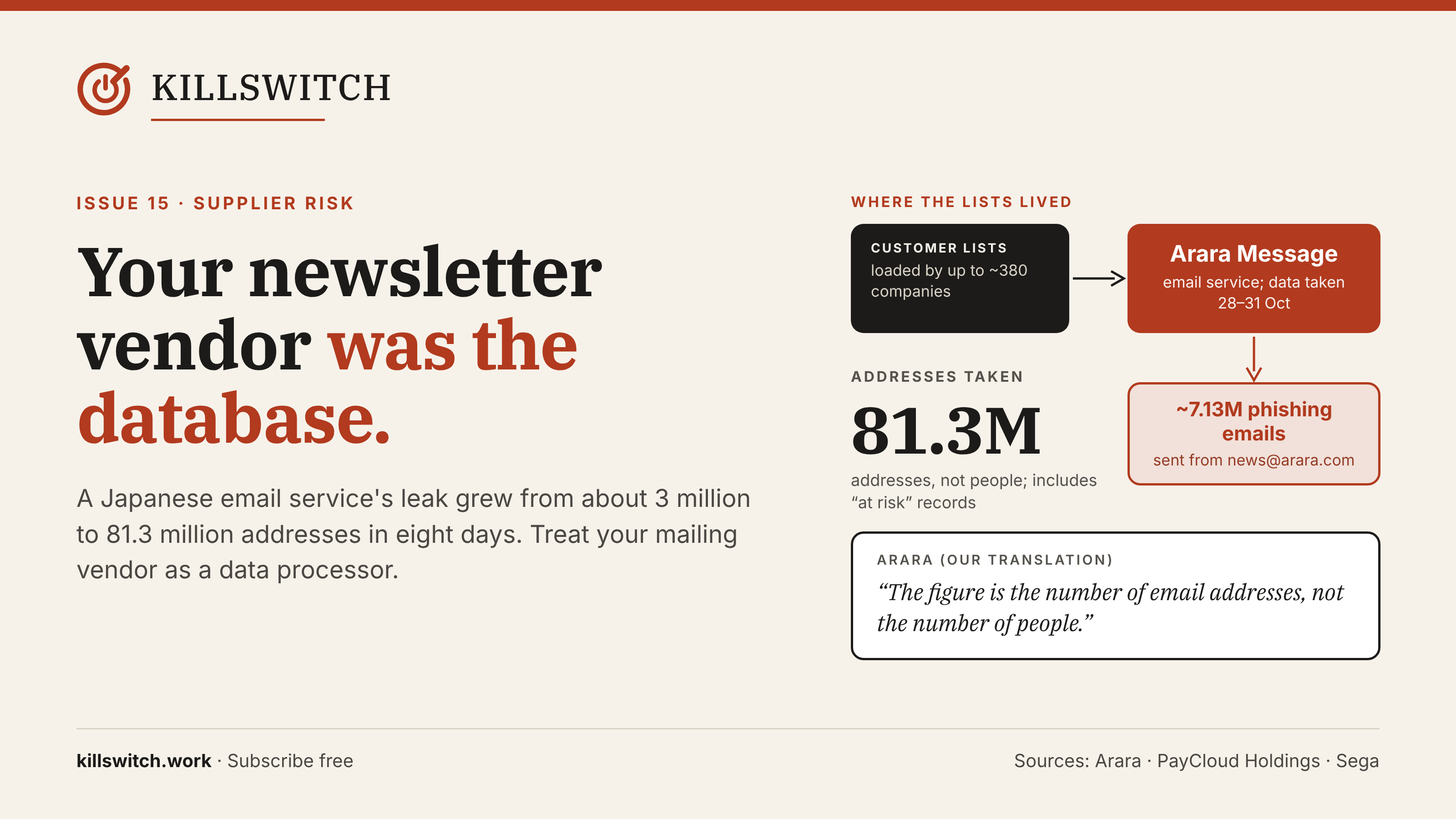
Facts as of 16 Nov 2026.
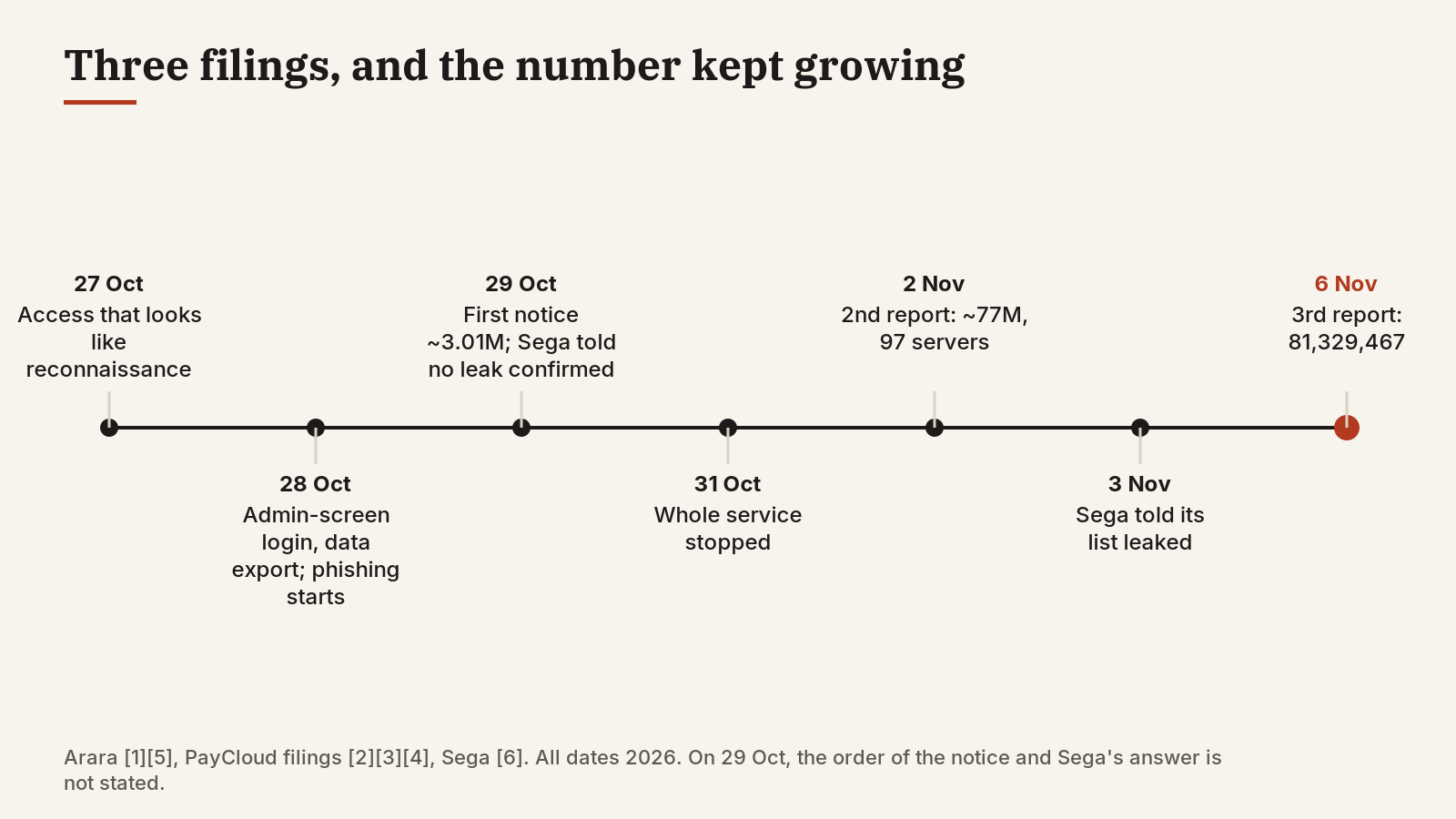
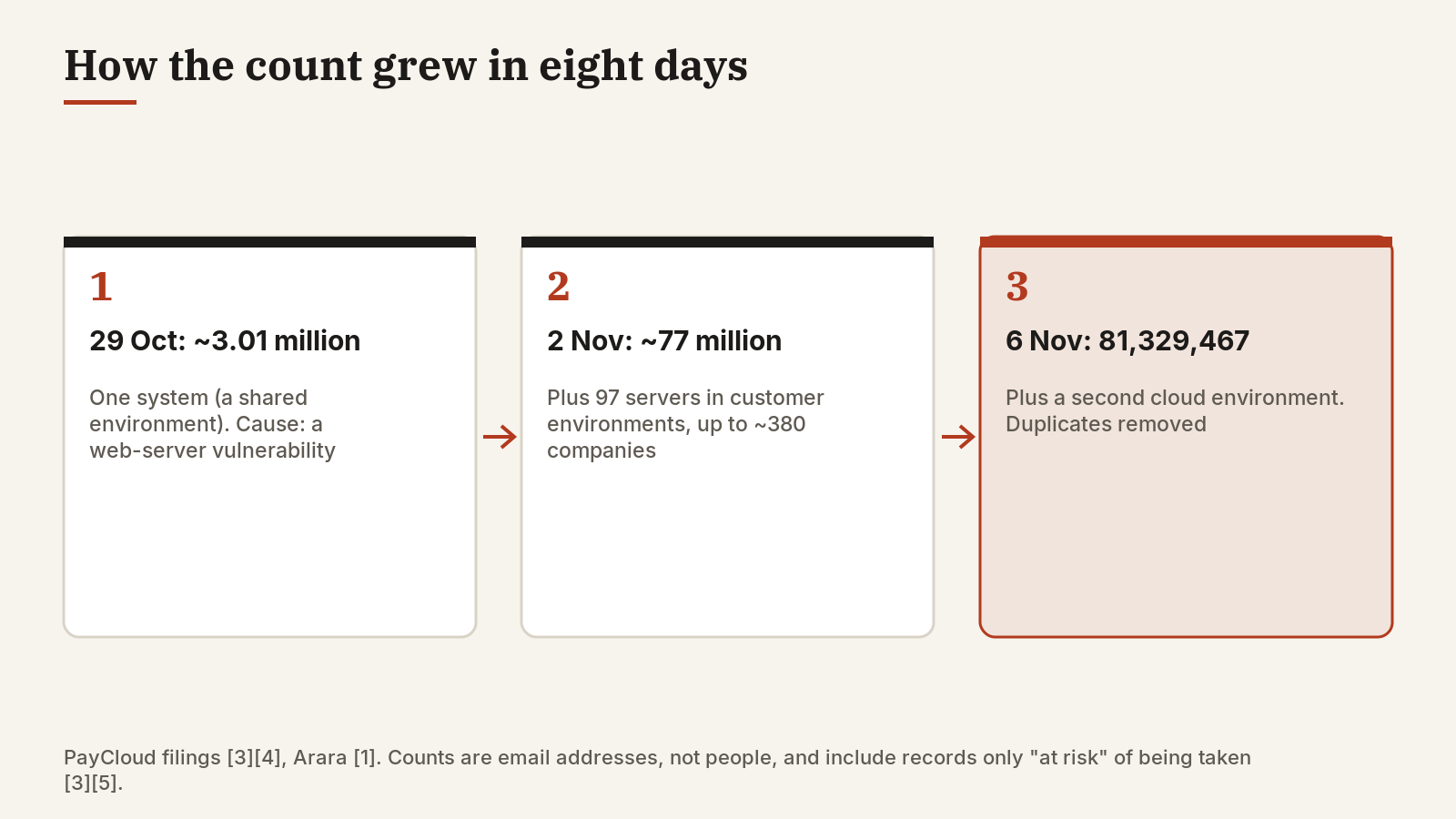
Most organisations do not think of the company that sends their newsletter as a database. Arara's customers have just learned otherwise. On 29 October, Arara Inc., which runs the Japanese email-distribution service Arara Message, said about 3.01 million email addresses had been taken from one system after a web-server vulnerability was exploited [1][2]. By its parent company's third filing on 6 November, the count of addresses taken, with duplicates removed, was 81,329,467 [4]. Up to about 380 customer companies are affected, an estimate still being checked [5].
Two points before the number travels any further. It counts email addresses, not people: the filings say so in as many words [3][4]. And it includes addresses only "at risk of having been taken" (our translation) [3][5], which PayCloud's 2 November filing says was judged from the volume of records read [3].
What happened
The first notice, on 29 October, described one system, about 3.01 million addresses held by the customers using it, and one cause: "a web-server vulnerability exploited by a third party" (our translation) [1][2]. It added that no other unauthorised access had been found so far [1].
The second report, filed on 2 November by Arara's parent, PayCloud Holdings, changed almost every line [3]:
- Scope. As well as the shared environment, the attacker reached 97 servers in customer environments. Arara says the attacker got into one server of the service and, between 28 and 31 October, used it to get into many of the service's servers and copy database contents [3].
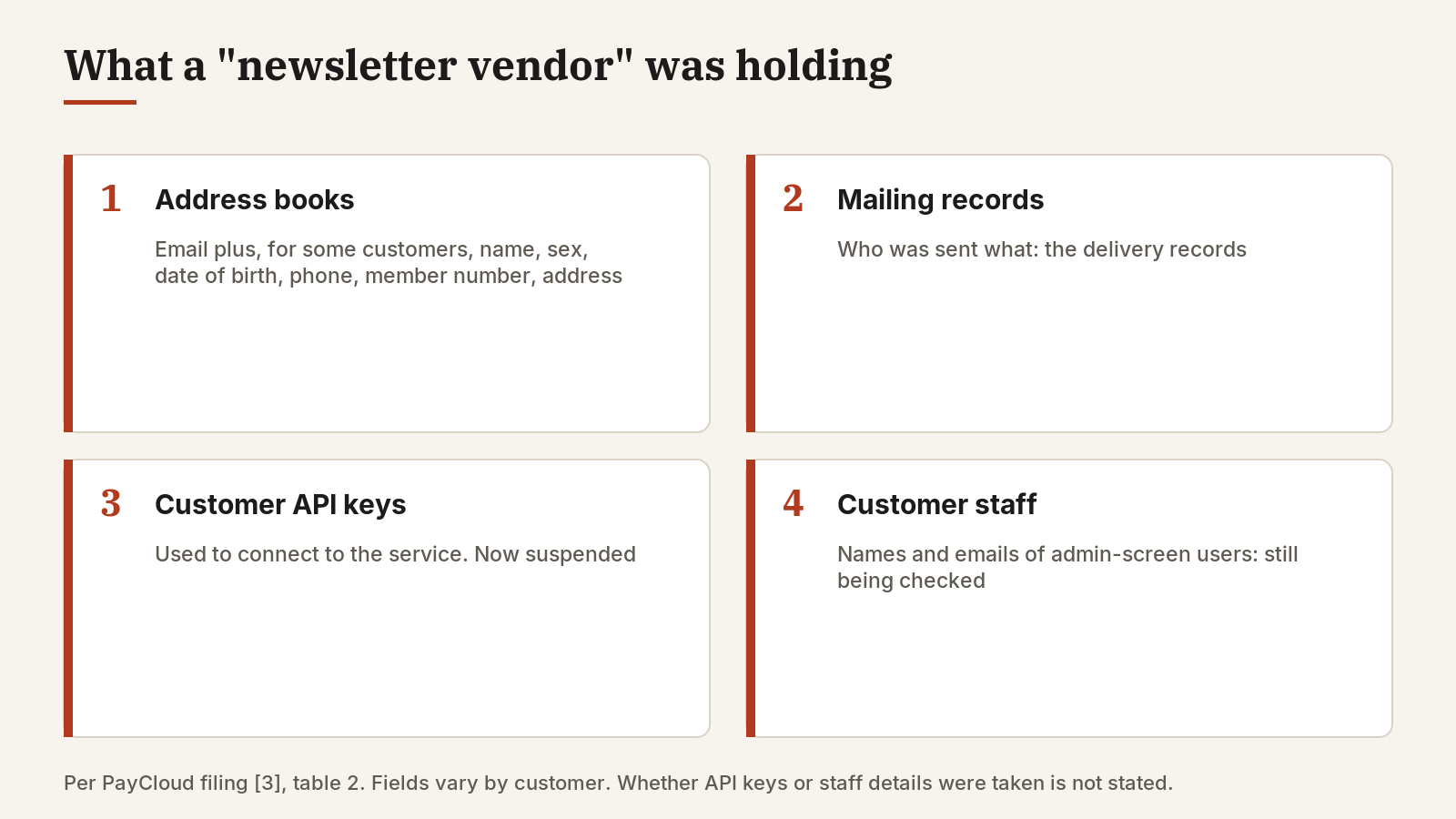
- Data. Addresses plus, depending on the customer, the member details customers had loaded: name, sex, date of birth, phone, member number, postal address, and the delivery records [3].
- Cause. "The web-server vulnerability and problems in the system environment" (our translation) [3]. In the shared environment, the attacker logged in to the admin screen without authorisation and used its data-export function [3].
- Service. Arara stopped all of Arara Message on 31 October. No restart date has been set [3][5].
The third report, on 6 November, added a separate cloud environment from which 3,249,492 addresses had been taken with misused credentials during the same 28 to 31 October window, and gave the de-duplicated total of 81,329,467 [4]. Of those, 47,044,380 came with member details and 34,285,087 were addresses only; that split is still being checked [4]. The shared-environment count was revised down from 3,386,187 to 2,842,400 [4]. The intrusion route and its start date are still under investigation with outside specialists [3][5].
Arara reported the incident to the police on 29 October, and to Japan's Personal Information Protection Commission, JIPDEC and the regional bureau of the Ministry of Internal Affairs and Communications in several stages between 29 October and 6 November [4][5]. The service does not hold card numbers [3][5].
The vendor's own address sent the phishing
While the data was being copied, the service itself was used against its owners. Between 28 and 30 October, parts of Arara Message were misused to send up to about 7.13 million emails pretending to be from credit-card companies, from the address news@arara.com [3][5]. Arara says those emails went to addresses the attacker brought in from outside [3], and that neither the messages nor those addresses are counted in the 81.3 million [5].
That matters for anyone who uses a sending service. A trusted sending address is a target in its own right. If your vendor's platform can be made to send mail, your customers can receive phishing that passes the checks they have learned to trust.
What one customer saw
Sega uses Arara for some of its newsletters. Its notice of 9 November is a clear view from the customer side [6]:
- 29 October. As part of its own checks, Sega asked Arara whether its newsletter mailing was safe, and was told no leak had been confirmed [6]. Sega does not say whether this came before or after Arara's first notice that day.
- 1 November. After Arara announced the unauthorised access, Sega asked again [6].
- 3 November. Arara emailed Sega that addresses Sega had used for mailings had been taken [6].
- 9 November. Sega published: 2,196,044 addresses, 92,273 of them with mailing-related information, from eleven newsletters sent between July and October [6]. Names, dates of birth, addresses, phone numbers, card details and passwords were not in the leaked data, and no misuse had been confirmed [6]. Sega has paused mailings through Arara [6].
Sega's case shows the first control. Sega says the leaked data did not include names, birth dates, addresses, phone numbers, card details or passwords; the mailing-related information is still being checked [6]. What a customer never loaded cannot be lost. Customers that had loaded full member profiles lost those too: 47,044,380 of the addresses came with member details, a split still being checked [4].
What a mailing vendor really holds
The 2 November filing lists what the service records [3]. As well as the address books, it holds the API keys customers use to connect, and the names and email addresses of customer staff who use the admin screen [3]. The filing says the API keys are suspended and that the staff details are still being checked; it does not say whether either was taken [3]. When the service restarts, Arara will ask every customer to reset admin passwords and API keys [3].
So the question for your supplier register is not "do we use an email tool?" It is "which personal data, credentials and staff accounts have we given this vendor, and what would we have to do if they lost all three?"
Five controls for your mailing vendor
These are Killswitch's own recommendations, drawn from this case.
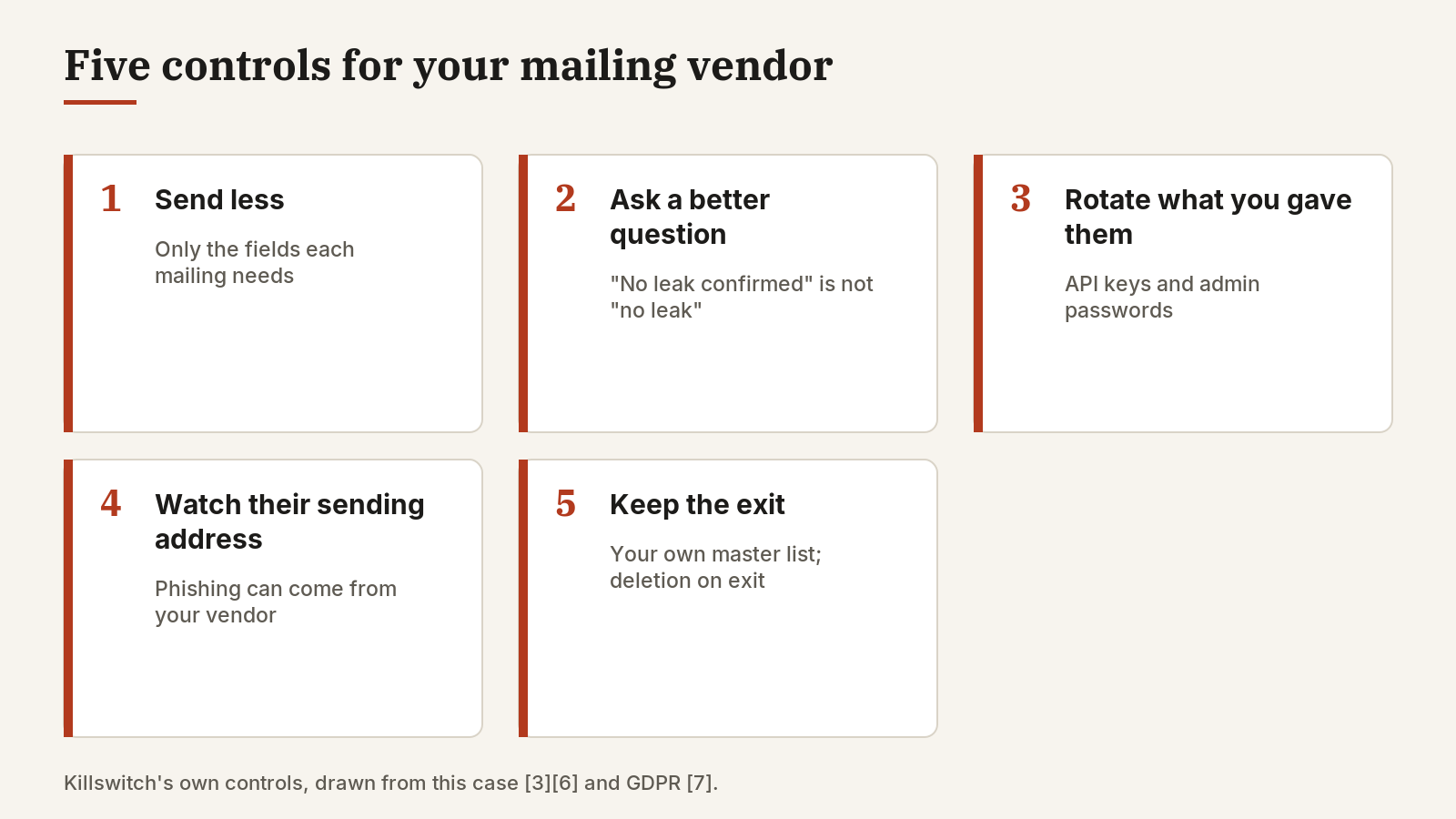
- Send less. Give the vendor only the fields each mailing needs. Under GDPR this is data minimisation (Art. 5(1)(c)) [7]. The leaked Sega data did not include names or birth dates, which shows the difference [6].
- Ask a better question, and write it into the contract. Under GDPR a processor must tell the controller about a personal-data breach "without undue delay after becoming aware of" it (Art. 33(2)) and help it meet its own duties (Art. 28(3)(f)) [7]. "No leak has been confirmed" on day one is an answer to a different question. Ask what systems were affected, what is still under investigation, and when the next update will come.
- Rotate what you gave them. Treat the vendor's API keys and admin passwords as exposed the day the vendor reports an incident, and rotate them then. Do not wait for its restart [3].
- Watch their sending address. Know which domains and addresses send in your name, and tell your customers what your real mail looks like. Sega has warned its customers about mail pretending to be Sega or Arara [6].
- Keep the exit. Keep your own master list outside the vendor, so you can stop the service without losing your audience, and have the contract require deletion or return of the data at the end (Art. 28(3)(g)) [7].
Mapping it for GRC
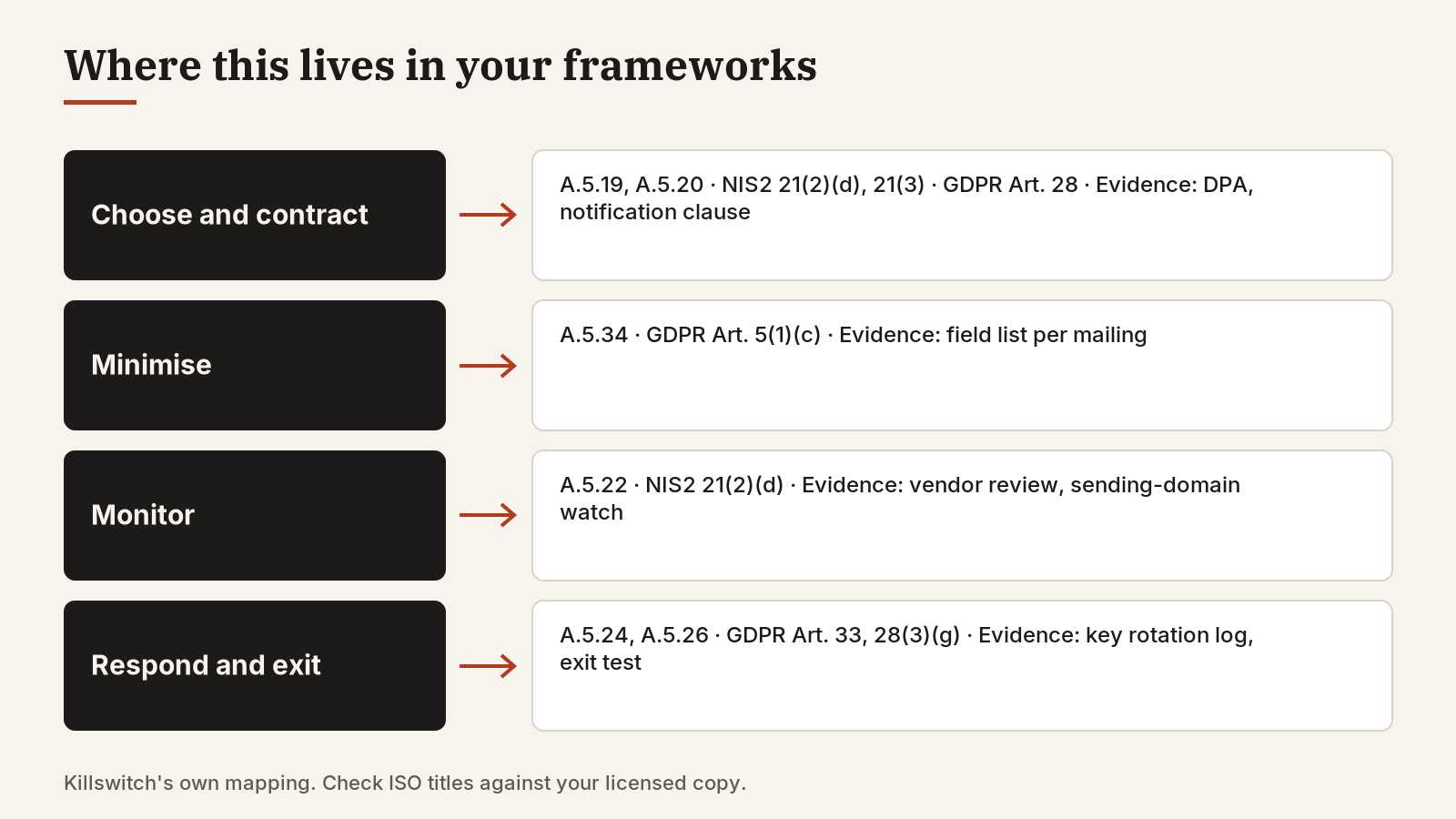
- ISO/IEC 27001:2022 [9]: information security in supplier relationships and in supplier agreements (A.5.19, A.5.20); monitoring of supplier services (A.5.22); privacy and protection of personal data (A.5.34); incident planning and response (A.5.24, A.5.26). This is our mapping; check the control titles against your licensed copy.
- NIS2 [8]: if you are an essential or important entity, supply chain security, "including security-related aspects concerning the relationships between each entity and its direct suppliers or service providers", is Art. 21(2)(d). Art. 21(3) asks you to take into account the vulnerabilities specific to each direct supplier [8].
- GDPR [7]: processor contracts (Art. 28), including help with breach duties (28(3)(f)) and deletion or return at the end (28(3)(g)); the processor's duty to notify you (Art. 33(2)); and your own 72-hour clock to the supervisory authority, where feasible, once you are aware (Art. 33(1)). Arara is a Japanese company reporting under Japanese law; GDPR is here as the yardstick for your own contracts, not a claim about Arara's duties.
What we don't know yet
- The route in. The first notice blamed a web-server vulnerability; the second added "problems in the system environment" [1][3]. How the attacker got in, and when it started, is still under investigation [3][5].
- The final count. 81,329,467 is addresses, not people [4], and includes records only "at risk" [3][5]. The split between address-only and full records is still being checked [4]. "Up to about 380 companies" is an estimate [5].
- Credentials and staff details. Whether customer API keys or admin-user details were taken is not stated [3].
- Misuse. Sega reports no misuse of its leaked data so far [6]. Other customers' notices may differ.
Your checklist for this week
- List every service that sends email in your name, and what personal data, keys and staff accounts each one holds.
- For each, check the field list against what the mailings actually use, and cut the rest.
- Check the processor contract: a breach-notification clause with content, not only a deadline, and deletion or return on exit.
- Make sure you can rotate the vendor's API keys and admin passwords in an hour, and record that you tested it.
- Keep your own master list, and write down how you would stop the vendor tomorrow.
Download the slides
Use this issue in your next team briefing. The slides are free to download:
Keep going
- Try the live demo: GRCompliance. Keep a register of suppliers and the personal data each one holds, link the contract and the evidence, and map controls to ISO 27001, NIS2 and GDPR.
- Install free from GitHub (self-hosted): GRCompliance Core, the open-source edition. Your data stays on your infrastructure.
- Sectutor books and kits: security and GRC books, training and audit kits.
- Subscribe to Killswitch: sharp issues on security, AI security and GRC.
About the author. Emmanuel Aigbehi Walstra is a CISO who also serves as a virtual CISO (vCISO) for several organisations, with 30+ years in cybersecurity, 10,000+ people trained, and author of the CCSP Excellence books.
Sources
- Arara Inc.: Information leak and service suspension due to unauthorised access to Arara Message (first notice, 29 Oct 2026, Japanese)
- PayCloud Holdings (TSE 4015): Unauthorised access to Arara Message, information leak and service suspension, 1st report (TDnet filing, 29 Oct 2026, Japanese)
- PayCloud Holdings (TSE 4015): Unauthorised access to Arara Message, information leak and service suspension, 2nd report (TDnet filing, 2 Nov 2026, Japanese)
- PayCloud Holdings (TSE 4015): Unauthorised access to Arara Message, information leak and service suspension, 3rd report (TDnet filing, 6 Nov 2026, Japanese)
- Arara Inc.: Apology and next steps regarding unauthorised access to Arara Message (6 Nov 2026, Japanese)
- Sega: Apology and notice on a personal-information leak caused by unauthorised access to a contractor (9 Nov 2026, Japanese)
- GDPR, Regulation (EU) 2016/679, Articles 5, 28 and 33 (EUR-Lex)
- NIS2 Directive (EU) 2022/2555, Article 21 (EUR-Lex)
- ISO/IEC 27001:2022 Information security management systems
Facts are from Arara's notices, PayCloud Holdings' filings of 29 October, 2 and 6 November, and Sega's notice of 9 November, as published by 10 Nov 2026. The sources are in Japanese; quotes and figures are our translation. The controls and the framework mapping are Killswitch's own.
Checked against the primary sources cited above. Spotted an error? See our corrections page.