In one week, attackers went through two tools that IT providers use to run their customers' computers. A patched server was not safe, and a forgotten add-on skipped the login. Here is what to ask your provider, and what to put in the contract.
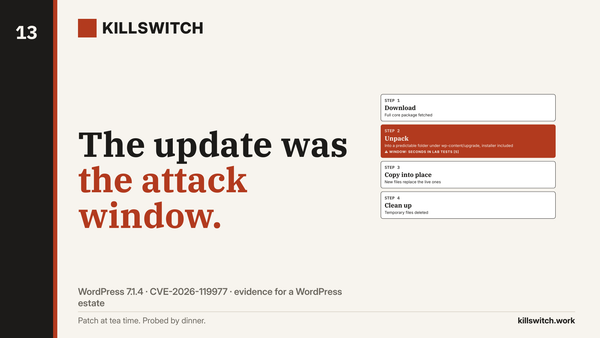
WordPress 7.1.4 fixed a flaw that only exists while WordPress is updating itself. Wordfence detected the first attack request 9 minutes after its firewall rule went live, and CISA has since listed it as exploited. Auto-update is not the same as safe-during-update.
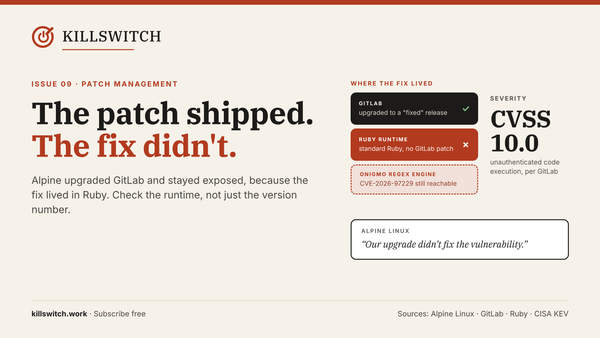
Alpine Linux upgraded its GitLab and stayed exposed: the fix for CVE-2026-97229 was a patch to Ruby, and Alpine's image ran standard Ruby. After an attempted exploitation it rebuilt the server and had to reset passwords, 2FA, tokens and stored secrets.
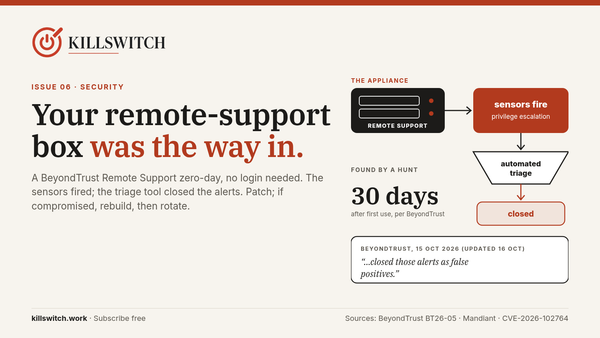
A suspected China-nexus actor used a BeyondTrust Remote Support zero-day (CVE-2026-102764) for a month before a hunt found it. The sensors fired in real time, but an automated triage tool closed the alerts. Why a remote-support box is a credential broker, and what to do this week.
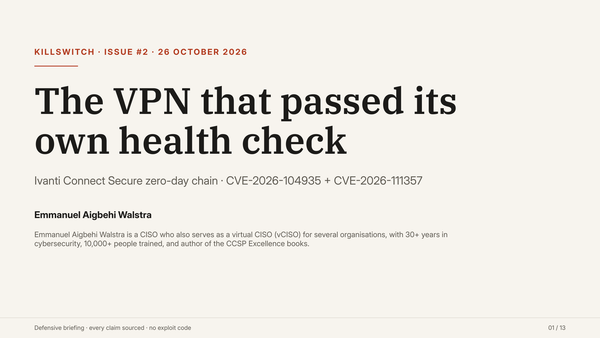
Ivanti Connect Secure zero-day chain (CVE-2026-104935 + CVE-2026-111357): root on a fully patched VPN appliance, no web shell, no file changes, and a clean integrity check.
Two critical flaws in the PHP engine let one unauthenticated web request run code on the server. Updating WordPress or a plugin won’t fix them. Updating PHP will.