
Your remote-support box was the way in
A suspected China-nexus actor used a BeyondTrust Remote Support zero-day (CVE-2026-102764) for a month before a hunt found it. The sensors fired in real time, but an automated triage tool closed the alerts. Why a remote-support box is a credential broker, and what to do this week.
Your remote-support box was the way in
On 15 Oct 2026 BeyondTrust disclosed CVE-2026-102764, a critical flaw in its Remote Support product, and said an espionage actor had already used it as a zero-day [1][2]. Mandiant, which tracks the actor as ARMORY CASTLE (formerly UNC5221) and calls it a suspected PRC-nexus espionage actor, published its investigation the same day [3]. CISA added the flaw to its Known Exploited Vulnerabilities (KEV) catalog on 16 Oct [4][5].
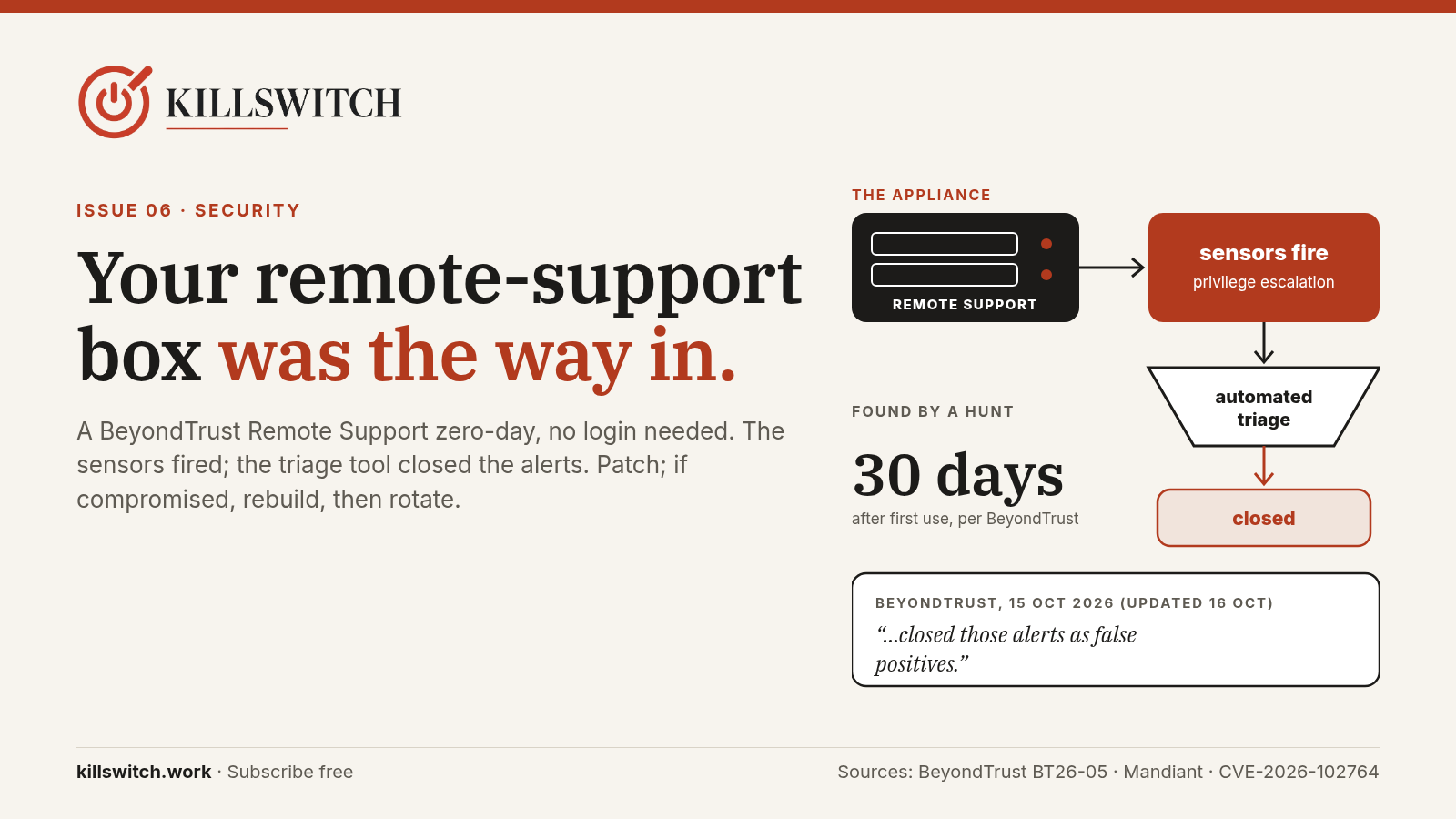
This issue looks past the single bug. A remote-support appliance stores and brokers privileged credentials for the whole estate, so whoever controls it can reach whatever it reaches [2]. And the intrusion got past an alerting pipeline: the sensors fired, but an automated triage tool closed the alerts as false positives [2]. Below: what is confirmed, what is not, and what to do this week.
The flaw in one view: no login, no click, full appliance
BeyondTrust’s advisory BT26-05 describes “Improper Origin Validation in an Internal Messaging Component” (CWE-290): internal components did not adequately validate where the messages they received came from, which could let a remote attacker perform file operations on the appliance [1]. Mandiant says successful exploitation “results in the arbitrary upload of files” [3]. It needs no privileges and no user interaction. BeyondTrust scores it 9.3 under CVSS v4, and NVD lists a CVSS v3.1 score of 9.8 [1][6].
Affected: Remote Support, all versions up to and including 26.2.3 [1]. The fix is the BT26-05-RS patch for versions 24.3.1 to 26.2.3; anything older must upgrade first [1][4]. BeyondTrust applied the patch to all SaaS customers [1]. Privileged Remote Access (PRA) shares the affected code: BeyondTrust’s testing found no way to exploit it there, but it released a PRA patch as a precaution [2]. BeyondTrust is withholding technical details for now [2], and so are we.
Thirty days inside before a hunt found it
Exploitation began on 29 Aug 2026, against one BeyondTrust-hosted Remote Support instance and one self-hosted appliance [2]. Nothing was found until 28 Sep. A different vendor’s zero-day had become public on 27 Sep, which set off a hunt, and BeyondTrust’s threat hunters found the hosted case and contained it 27 minutes after the compromise was identified [2]. About seven hours later its Product Security team had reproduced the entry vector in a lab [2].
Mandiant shared findings from the self-hosted victim on 30 Sep [2]. BeyondTrust released the patch on 8 Oct, and its advisory says all SaaS customers were patched as of 9 Oct [1][2]. Public disclosure came on 15 Oct and the KEV listing on 16 Oct, with a KEV due date of 19 Oct [5]. As of its 16 Oct update, BeyondTrust knew of only those two affected customers and had seen no actor activity since August [2].
Why this box matters: it brokers the keys to the estate
BeyondTrust puts it plainly: a remote access appliance “stores and brokers privileged credentials across an estate, which makes it a credential source and a map of who connects to what” [2]. Its Jump Items are the individual systems an operator can open a remote session to [3]. Once the actor had root, Mandiant says, it had “access to every credential the appliance stored or brokered” [3].
So the risk is bigger than the box. BeyondTrust calls edge and remote-access appliances this actor’s “preferred entry points” [2]. Our recommendation: treat a remote-support tool as a privileged-access system in your risk register, with an owner, an internet-exposure review and a log path, not as a help-desk utility.
What the actor did once it was in
Mandiant describes the sequence [3]. A file was uploaded through the flaw. About 11 minutes later a web shell, which Mandiant names SAWFLY, appeared in the appliance’s web root. A copy of the system shell, set to run as root, gave the actor root access.
The actor tried to dump the appliance’s credential vault with BeyondTrust’s own tooling, then deleted that tool’s log. A boot-time script re-applied passwordless root through a configuration template, so the access survived reboots and configuration resets [3].
Then it used the product as designed [3]. Logged in to the admin portal with an administrator account, the actor raised the account’s Jump Item and Team permissions from No Access to Administrator.
It opened support sessions to internal endpoints and used the built-in file transfer to take documents such as software inventories. A custom tunneler, which Mandiant names BARECLAW, was reached through a rule the actor added to the appliance’s own reverse proxy [3]. We publish no commands, paths or indicators.
The sensors fired. The triage tool closed the alerts.
BeyondTrust’s own monitoring saw the intrusion as it happened: “Our sensors fired in real time when the actor escalated privileges, but the built-in triage tool in our third-party detection platform closed those alerts as false positives” [2]. What found it a month later was a hunt led by threat intelligence, looking for what an attacker does on a system rather than at a vendor’s verdict on an alert [2].
BeyondTrust says it is working with the vendor so that automated triage tools cannot close high-severity signals on their own, and that it now re-checks external verdicts before closing them [2]. Its two lessons: “Treat a triage verdict as one input and keep the alerts it closes in scope for your hunts”, and run a hunting program that starts from threat intelligence and works on its own schedule [2].
Logs that live on the box die with the box
The actor “routinely deleted appliance logs and endpoint artifacts”, Mandiant says [3]. BeyondTrust warns that evidence kept only on the appliance may not survive, and what remains “cannot be implicitly trusted” [2]. Its advice: forward appliance syslog and session events to your SIEM in near real time, because “off-box copies are often the only record left” [2].
Mandiant adds a reverse proxy or WAF with full URI logging in front of the appliance, to keep a record of request paths the appliance cannot alter, and SIEM retention that covers a multi-month exposure window [3]. One signal to alert on: a gap in log forwarding. Mandiant says an interruption bounded by a single session is “a strong indicator of log tampering” [3].
Subscribe free
Get the next issue in your inbox.
Security, AI security and GRC briefings, each with its full slide deck as a free PDF.
Free. Unsubscribe any time.
Persistence built to outlast your clean-up
Two of the actor’s techniques were designed to survive routine clean-up [3]. The boot-time script restored passwordless root on every start, so a reboot or configuration reset put it back. The tunnel listened only inside the appliance and was reached through the new reverse-proxy rule, so it stayed “completely hidden from external network scans” [3].
That is why Mandiant’s rule for appliances with confirmed or unknown compromise status is “Rebuild rather than clean”: customers cannot audit the appliance host file system, and host-level persistence survives reboot and configuration reset [3]. Restore only a configuration backup dated before the exposure window, issue a new TLS certificate, and redeploy Jump Clients, Jumpoints and the representative console from the rebuilt appliance [3].
The fourth KEV entry in under two years
This is the fourth BeyondTrust Remote Support or Privileged Remote Access flaw in CISA’s KEV catalog since December 2024: CVE-2024-12356 (added 19 Dec 2024), CVE-2024-12686 (13 Jan 2025), CVE-2026-1731 (13 Feb 2026) and CVE-2026-102764 (16 Oct 2026) [5]. KEV marks CVE-2026-1731 as known to be used in ransomware campaigns. For the new flaw it says unknown [5].
The pattern matters more than the vendor. Mandiant warns that ARMORY CASTLE has historically moved from selective zero-day use to broad, opportunistic exploitation once a flaw becomes public [3], and BeyondTrust says the same [2]. Our recommendation: if your remote-access tool is reachable from the internet, plan for the next flaw now. Limit exposure, keep logs off the box, and know how many hours a patch takes you.
This week: patch, shrink, ship the logs, hunt
Patch first. Self-hosted Remote Support on 24.3.1 to 26.2.3 needs the BT26-05-RS patch from the /appliance interface unless it is subscribed to automatic updates; older versions must upgrade, then patch [1][3]. Mandiant notes that upgrading closes the vulnerability but does not remediate prior exposure, and that any appliance reachable from the internet on a vulnerable version during the exploitation window should be treated as potentially compromised until it has been reviewed [3].
Shrink exposure: restrict the /login and /appliance admin interfaces to trusted networks, so only the representative console, customer portal and Jump Client traffic face the internet, and allow outbound traffic only to the destinations the appliance needs [2][3][4].
CISA also asks owners of affected self-hosted appliances to run network and memory forensics [4]. Ship logs off the box [2]. Hunt for behaviour: unrecognised admin sessions from residential broadband or commercial VPN addresses, new script files in web directories, changes to Jump Item or Team permissions, and gaps in log forwarding [2][3][4].
If you find anything, the order matters
CISA’s sequence for a compromised appliance: isolate it, take a snapshot or image, forward its logs and collect WAF and proxy logs, investigate, then rebuild from a known-good state and patch [4]. Mandiant adds: preserve before acting, block traffic at the perimeter firewall rather than in /appliance so the configuration stays intact for review, and disable rather than delete accounts so the audit trail survives [3].
Only then rotate. Mandiant says to rotate credentials only after the appliance has been patched or rebuilt, because rotating earlier exposes the new credentials to an attacker who still controls it [3]. Rotate everything the appliance stored or injected, in dependency order, end active support sessions, and review new MFA registrations on privileged accounts [3][4]. Every endpoint touched in a support session during the window is in scope for downstream hunting [3].
Fix the process, not just the appliance
Four controls carry over to any remote-access or edge tool. This list is our recommendation, built from the sources. Automated triage may not close high-severity alerts on its own [2]. Alerts that triage closed stay in scope for hunting [2]. Appliance logs stream off the box, with multi-month retention [2][3]. Privileged credentials sit in an external vault and are injected into sessions, not stored on the appliance [3].
For governance, add remote-support and privileged-access tools to your third-party and privileged-access register, each with a named owner, an internet-exposure review, a patch deadline and a log-retention control. Mandiant also recommends SAML single sign-on with phishing-resistant MFA for all /login users, and No Access as the default Jump Item role [3].
What is confirmed, and what is not
Confirmed: zero-day exploitation from 29 Aug 2026 [2]; two affected customers known to BeyondTrust as of 16 Oct [2]; a patch for 24.3.1 to 26.2.3, and SaaS patched [1]; the KEV listing on 16 Oct [5]. CISA says threat actors are actively exploiting the flaw to gain initial access, establish persistence, escalate privileges and move laterally [4].
Not confirmed: attribution is an assessment. BeyondTrust gives it “moderate to high confidence” and Mandiant calls the actor suspected PRC-nexus [2][3]. BeyondTrust believes the actor uses AI to model products and develop exploit chains, but says it has no “forensic proof” [2].
No source we read reports broad exploitation after disclosure; both BeyondTrust and Mandiant warn to expect it [2][3]. PRA exploitation was not shown in testing [2]. The third-party detection vendor is not named [2]. Patch dates differ by a day: released 8 Oct, SaaS patched as of 9 Oct [1][2].
Sources, and the points we flag
Every factual claim in this issue links to a numbered primary source: BeyondTrust’s advisory and incident blog, Mandiant’s investigation, CISA’s alert and KEV catalog, NVD, and the Canadian Centre for Cyber Security’s alert [1][2][3][4][5][6][7]. Sources were accessed on 29 Oct 2026.
Flagged: only two victims are confirmed; attribution and the AI-tooling claim are assessments; broad exploitation is warned of, not reported; KEV lists ransomware use as unknown [2][3][5]. The Canadian Centre for Cyber Security’s alert text says the flaw affects all versions, while its own table and BeyondTrust’s advisory say 26.2.3 and earlier; we follow the advisory [1][7]. We publish no exploit details, commands, file paths or indicators of compromise.
Next steps: get the deck, check your appliance, fix the triage rule
Subscribe free at killswitch.work to get the PDF and PowerPoint of this deck for your next risk or change meeting. GRCompliance can track remote-access tools, owners and log-retention controls in your risk register. Try the demo, or install the open-source core yourself from GitHub.
Sectutor has security books and kits for teams. Reply and tell us whether your triage tooling can close a high-severity alert without a human. We may cover the answers in a future issue.
Next steps
About the author. Emmanuel Aigbehi Walstra is a CISO who also serves as a virtual CISO (vCISO) for several organisations, with 30+ years in cybersecurity, 10,000+ people trained, and author of the CCSP Excellence books.
Sources
- BeyondTrust Security Advisory BT26-05 (CVE-2026-102764), issued 15 Oct 2026 www.beyondtrust.com/trust-center/security-advisories/bt26-05
- BeyondTrust Security Team, “ARMORY CASTLE and BT26-05: What Security Teams Need to Know”, 15 Oct 2026, updated 16 Oct 2026 www.beyondtrust.com/blog/entry/bt26-05
- Mandiant / Google Threat Intelligence Group, “ARMORY CASTLE Exploits BeyondTrust”, 15 Oct 2026 cloud.google.com/blog/topics/threat-intelligence/armory-castle-exploits-beyondtrust/
- CISA alert, “CISA Urges Patching Critical Vulnerability in BeyondTrust Remote Support”, 16 Oct 2026 www.cisa.gov/news-events/alerts/2026/10/16/cisa-urges-patching-critical-vulnerability-beyondtrust-remote-support
- CISA Known Exploited Vulnerabilities catalog: CVE-2026-102764 (added 16 Oct 2026) and earlier BeyondTrust RS/PRA entries www.cisa.gov/known-exploited-vulnerabilities-catalog
- NIST National Vulnerability Database, CVE-2026-102764 nvd.nist.gov/vuln/detail/CVE-2026-102764
- Canadian Centre for Cyber Security, Alert AL26-025, 16 Oct 2026 www.cyber.gc.ca/en/alerts-advisories/al26-025-critical-vulnerability-impacting-beyondtrust-remote-support-cve-2026-102764
Not legal advice. Killswitch is a defensive briefing: it contains no exploit code, commands, file paths or indicators of compromise. Quotes from BeyondTrust and Mandiant are short and exact. Points marked unconfirmed are assessments or open questions in the sources, and lines giving our recommendations are our own analysis. Sources accessed 29 Oct 2026.
Subscribe free
Don’t miss the follow-up.
Subscribe free to get every Killswitch issue and its slide deck by email.
Free. Unsubscribe any time.
Checked against the primary sources cited above. Spotted an error? See our corrections page.