
The Patch Shipped. The Fix Didn't.
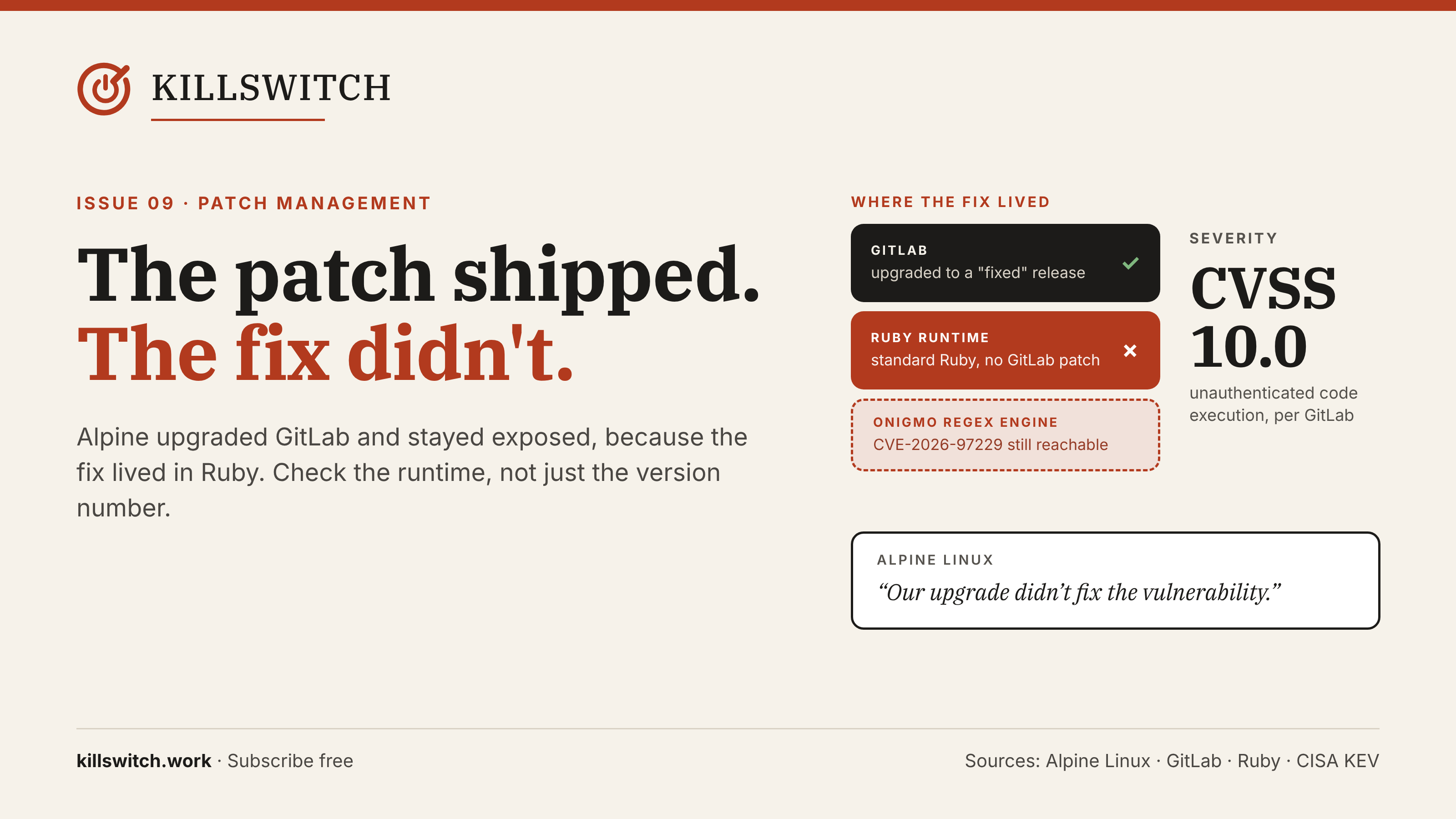
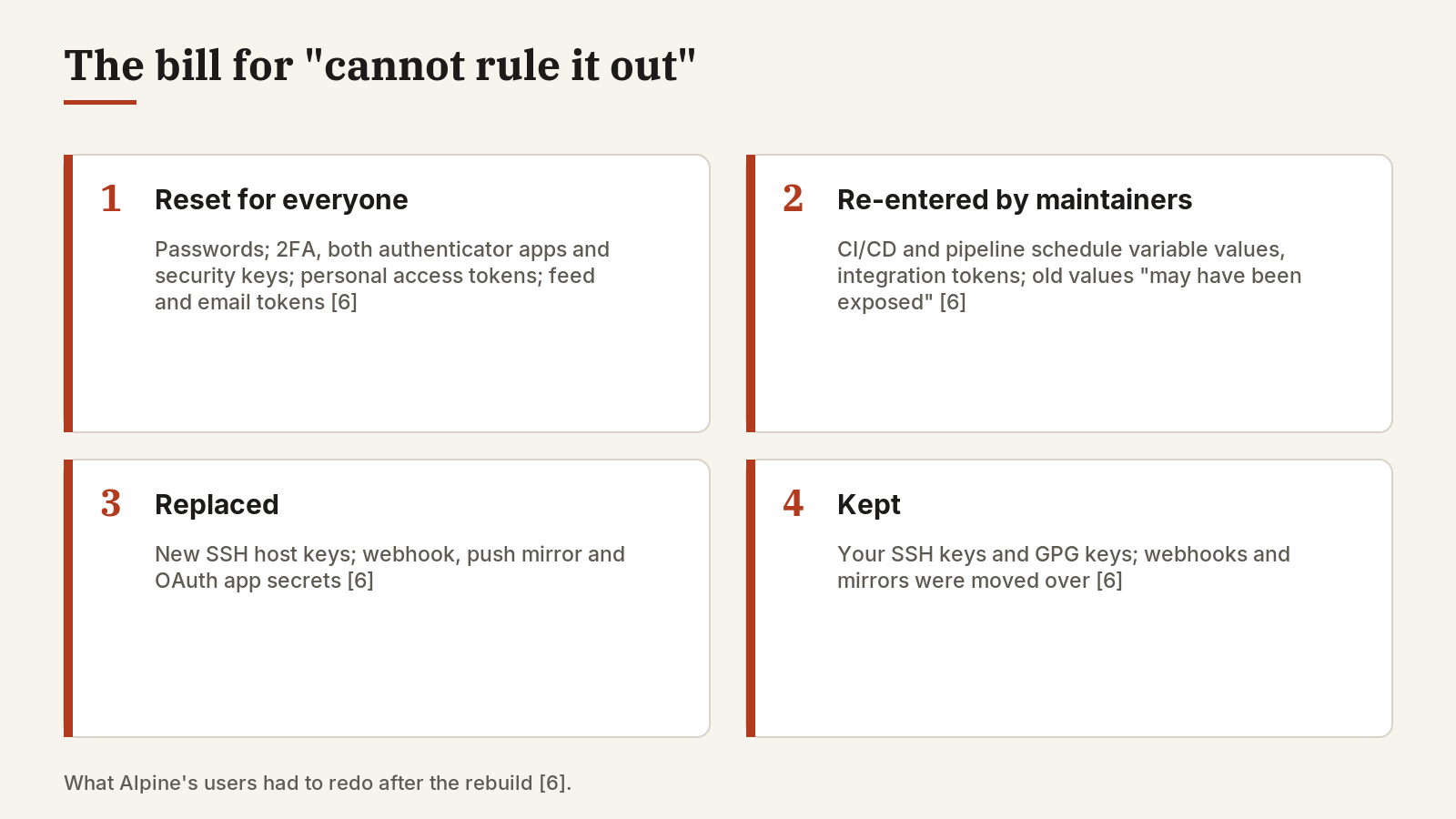
Alpine Linux upgraded its GitLab and stayed exposed: the fix for CVE-2026-97229 was a patch to Ruby, and Alpine's image ran standard Ruby. After an attempted exploitation it rebuilt the server and had to reset passwords, 2FA, tokens and stored secrets.
Facts as of 5 Nov 2026.
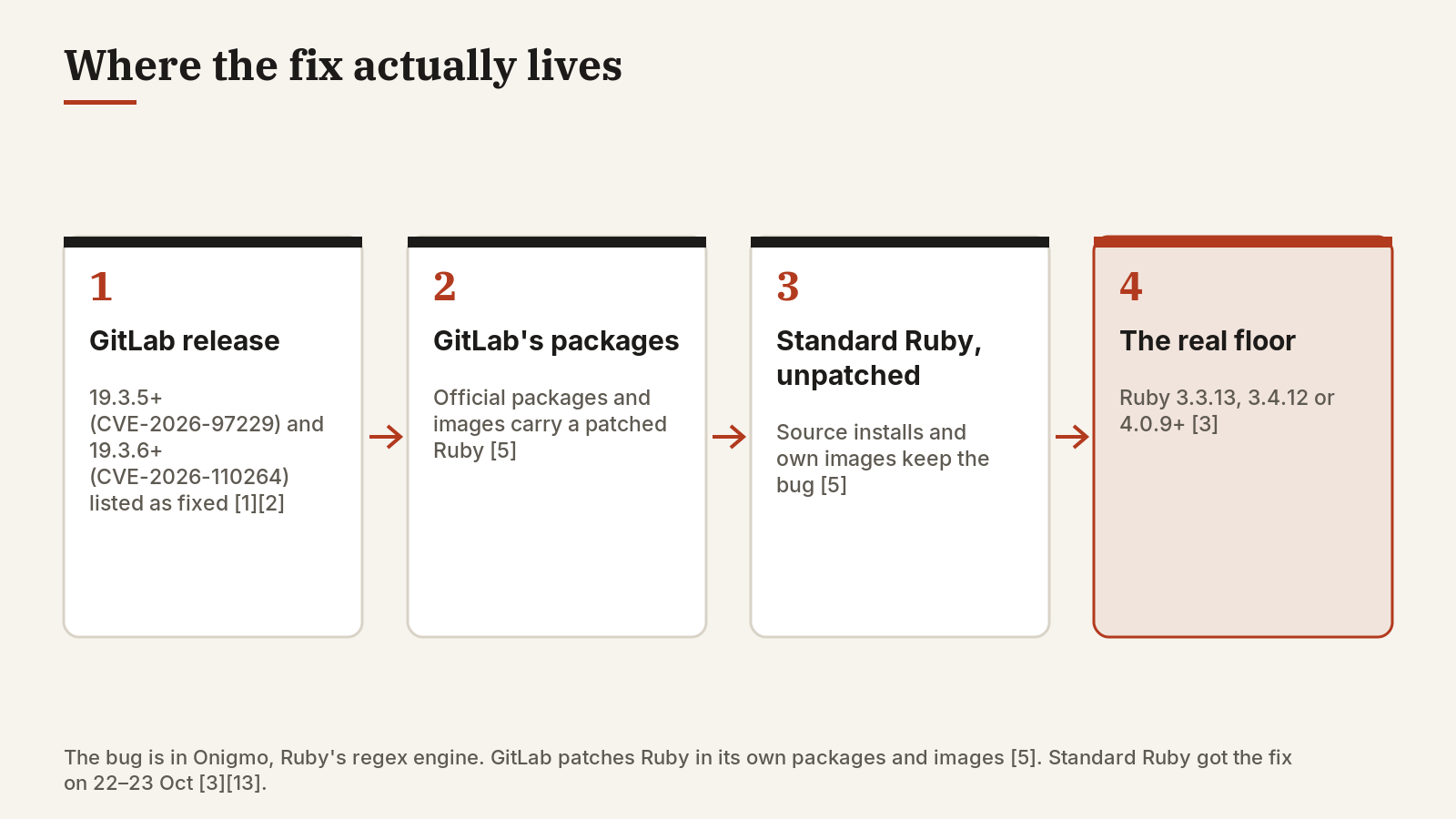
Alpine Linux upgraded its GitLab to a release that GitLab lists as fixed for CVE-2026-97229, and it was still exposed. In Alpine's words: “Our upgrade didn’t fix the vulnerability” [5]. The fix was not in GitLab's own code. It was a patch to Ruby that GitLab applies only in its official packages, and Alpine's image used standard Ruby [5].
CVE-2026-97229 is rated CVSS 10.0. GitLab says it could let an unauthenticated user run code on the server through a crafted regular expression in a CI/CD configuration [1][8]. The underlying bug is in Onigmo, the regular expression engine built into Ruby [3][5].
What happened at Alpine
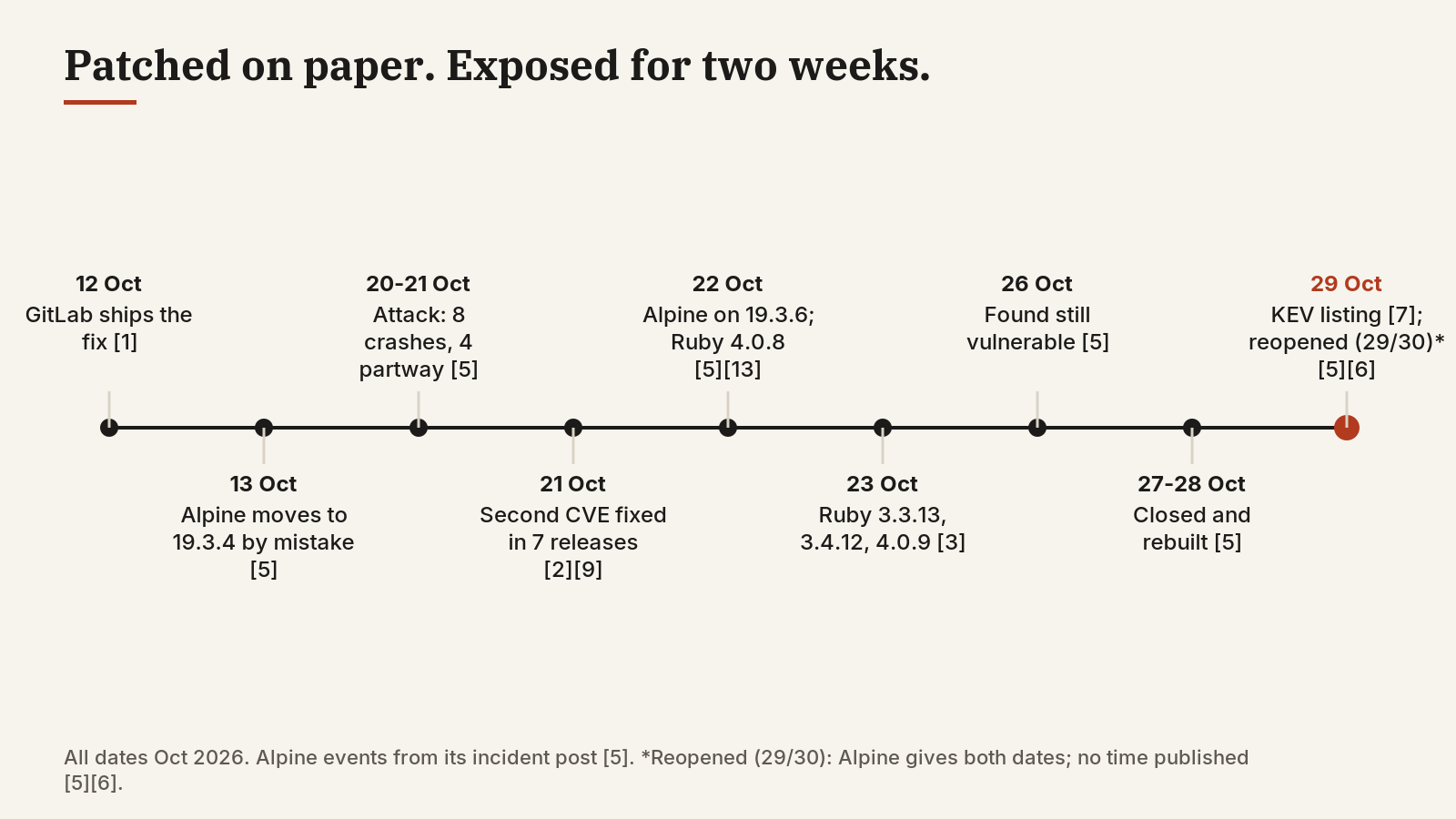
- 12 Oct: GitLab released 19.4.2, 19.3.5 and 19.2.8 with the fix, and six threat detections for self-managed customers [1]. An archived copy from the morning of 12 October names 19.3.4 as the fixed 19.3 release; by that evening the post named 19.3.5, with a note citing a merge-request bug in 19.3.4 [1][15][16].
- 13 Oct: Alpine upgraded to 19.3.4 "instead of 19.3.5 (which had the fix) by mistake" [5].
- 20 and 21 Oct: a newly registered account sent crafted CI configurations. GitLab worker processes crashed 8 times; in 4 of those the attacker got partway and failed at the next step [5].
- 21 Oct: GitLab released 19.5.1, 19.4.3, 19.3.6, 19.2.9, 19.1.9, 19.0.10 and 18.11.13 for a second regex flaw, CVE-2026-110264, also CVSS 10.0, affecting all versions from 7.0 [2][3][9]. CERT-EU advised updating as soon as possible and running a compromise assessment [10].
- 22 Oct: Alpine upgraded to 19.3.6. It did not fix the vulnerability, because the image ran standard Ruby [5]. Ruby 4.0.8 shipped the same day [13].
- 23 Oct: Ruby released 4.0.9, 3.4.12 and 3.3.13 [3][4][14].
- 26 to 28 Oct: Alpine found the instance still vulnerable, closed it, rebuilt it from scratch and replaced GitLab's secret keys [5].
- 29 Oct: CISA added CVE-2026-97229 to its Known Exploited Vulnerabilities catalog, with a due date of 1 November, which has now passed; known ransomware use is listed as "Unknown" [7].
- *Reopened (29/30): Alpine reopened GitLab on 19.3.7 with Ruby 3.3.13 [5][6]. *Alpine gives both dates; no time published.
Alpine says it "found no evidence that it succeeded, but we cannot rule it out, so we treated the instance as compromised" [5]. It also says its packages and 21 October releases were verified against records outside GitLab and were not tampered with, and that its signing keys have never been stored on the GitLab server [5].
The Ruby layer
Ruby's advisory maps the GitLab CVEs to Onigmo bugs. CVE-2026-97229 is an integer overflow in the size of a compiled pattern, first fixed in Ruby 4.0.8; CVE-2026-110264 is an overflow of internal IDs in a pattern with many repeats.
Ruby 4.0.9, 3.4.12 and 3.3.13 contain the fixes for all four CVEs [3]. Ruby says the bugs are reached only when an application compiles a regular expression from a string an attacker controls, and that "Regexp.timeout does not protect" against them [3].
Ruby 3.2 reached end of life on 1 April 2026 and is not in Ruby's fix list [3][17]. If anything you run still uses it, there is no patch to wait for.
CISA's catalog entry adds that "other products can potentially be affected by the same underlying Ruby/Onigmo" issue [7]. GitLab is the headline. Any Ruby app that compiles user-supplied patterns is in scope.
The bill for "cannot rule it out"
Rebuilding meant every user had to set things up again [6].
Why this matters if you don't run Alpine
Your patch record says "GitLab upgraded". That is true, and it can still be wrong. If you build your own image or run from source, the version number tells you what GitLab fixed, not what your runtime contains. The evidence you need is the Ruby version inside the running image.
Mapping it for GRC
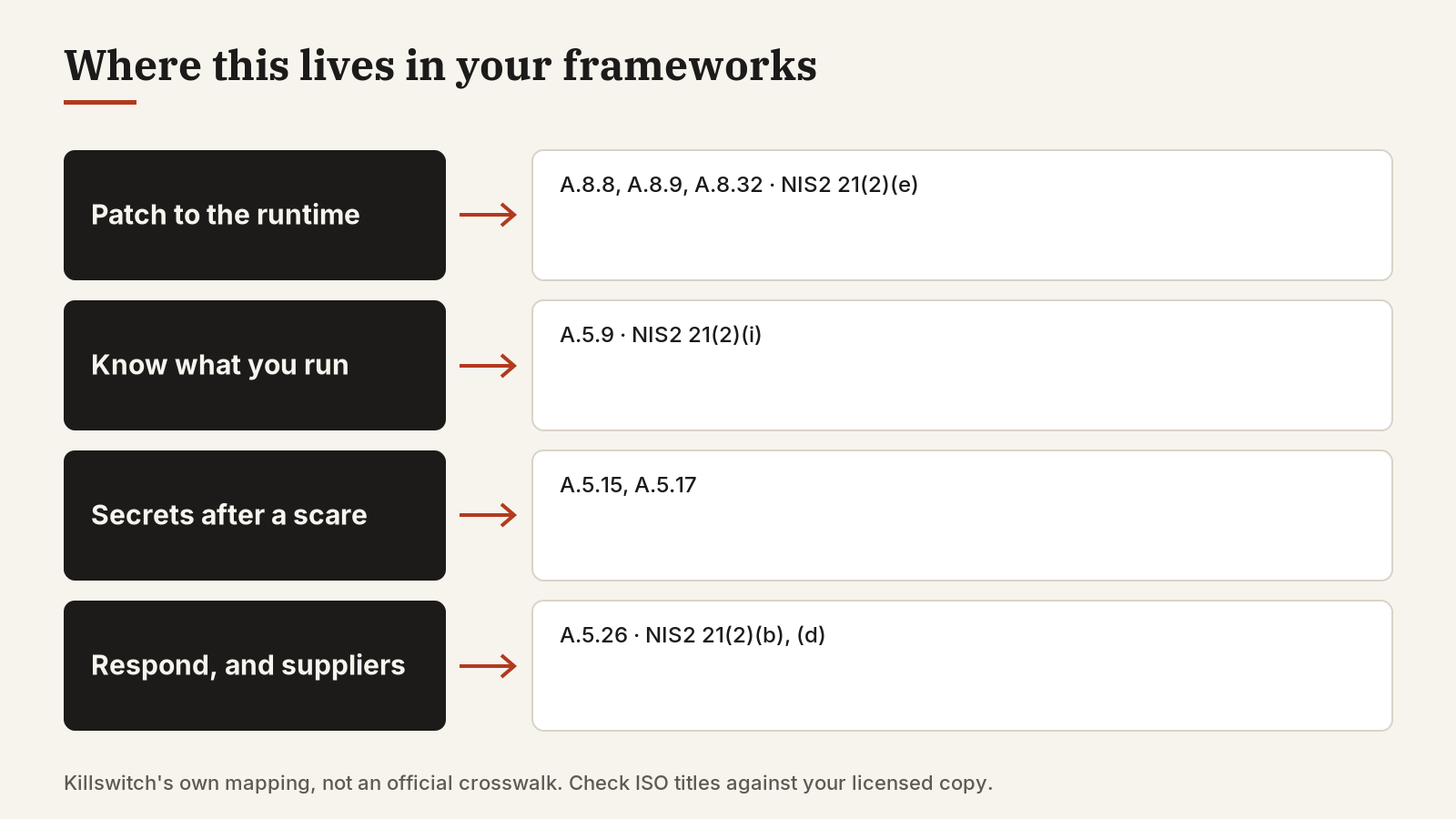
- ISO/IEC 27001:2022 [11]: management of technical vulnerabilities (A.8.8), configuration management (A.8.9) and change management (A.8.32) are the primary home. Inventory (A.5.9), access control (A.5.15), authentication information (A.5.17) and response to incidents (A.5.26) cover the rest. Check the control titles against your licensed copy.
- NIS2 [12]: Art. 21(2)(e) security in acquisition, development and maintenance, "including vulnerability handling and disclosure", is the primary home. Art. 21(2)(b) incident handling, (d) supply chain security and (i) asset management also apply.
This is Killswitch's own mapping, not an official crosswalk.
What we don't know yet
- Why the first post named 19.3.4. An archived copy from the morning of 12 October names 19.3.4 and dates the release 8 October; by that evening the post named 19.3.5 [15][16]. GitLab's note cites only a merge-request bug in 19.3.4 [1][16].
- Whether the attack succeeded. Alpine cannot rule it out, and some logs are gone [5].
- The exact reopening date. Alpine gives 29 and 30 October [5][6].
Your this-week checklist
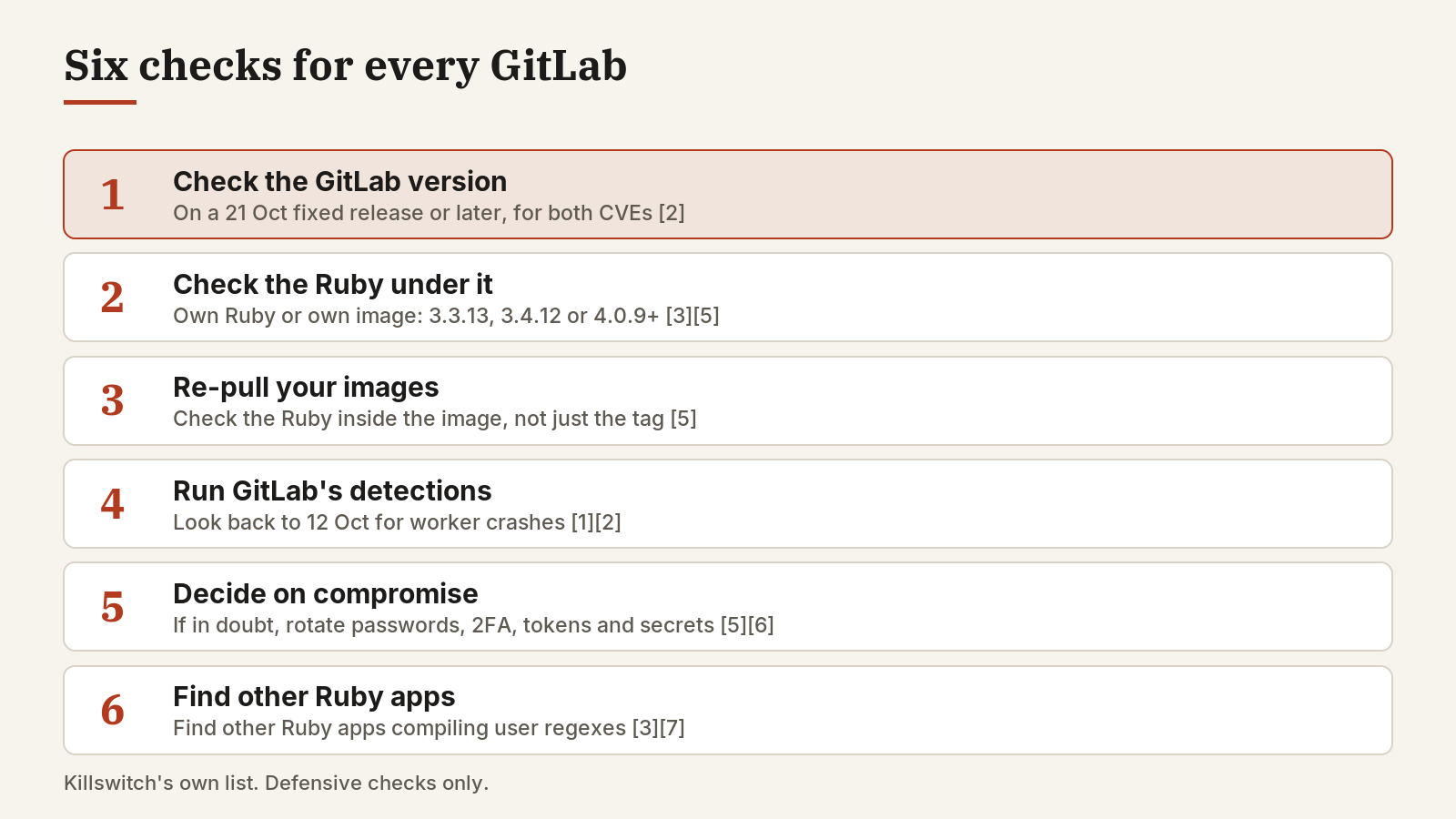
- Check every GitLab is on a 21 October fixed release or later [2].
- If you run your own Ruby or your own image, check it is Ruby 3.3.13, 3.4.12 or 4.0.9 or later. 4.0.8 fixed this CVE, but 4.0.9 contains the fixes for all four CVEs [3].
- Re-pull container images and check the Ruby inside, not just the tag [5].
- Run GitLab's threat detections and look back to 12 October [1][2].
- If the crashes match, treat the instance as compromised and rotate passwords, 2FA, tokens and stored secrets [5][6].
- Search your estate for other Ruby apps that compile user-supplied regular expressions [3][7].
Download the slides
Use this issue in your next team briefing. The slides are free to download:
Keep going
- Try the live demo: GRCompliance. Keep your asset inventory, patch records and incident controls, owners and evidence in one place, mapped to ISO 27001 and NIS2.
- Install free from GitHub (self-hosted): GRCompliance Core, the open-source edition. Your data stays on your infrastructure.
- Sectutor books and kits: security and GRC books, training and audit kits.
- Subscribe to Killswitch: sharp issues on security, AI security and GRC.
About the author. Emmanuel Aigbehi Walstra is a CISO who also serves as a virtual CISO (vCISO) for several organisations, with 30+ years in cybersecurity, 10,000+ people trained, and author of the CCSP Excellence books.
Sources
- GitLab: Critical Patch Release 19.4.2, 19.3.5, 19.2.8 (12 Oct 2026)
- GitLab: Critical Patch Release 19.5.1, 19.4.3, 19.3.6, 19.2.9, 19.1.9, 19.0.10, 18.11.13 (21 Oct 2026)
- Ruby: Regexp compilation fixes related to GitLab's CVE-2026-89078, CVE-2026-93577, CVE-2026-97229 and CVE-2026-110264 (23 Oct 2026)
- Ruby: Ruby 3.3.13 Released (23 Oct 2026)
- Alpine Linux: GitLab security incident: attempted exploitation of CVE-2026-97229 (28 Oct 2026, updated 30 Oct)
- Alpine Linux: GitLab is back: what you need to do (30 Oct 2026)
- CISA: Known Exploited Vulnerabilities Catalog, CVE-2026-97229 (added 29 Oct 2026)
- NVD: CVE-2026-97229
- NVD: CVE-2026-110264
- CERT-EU Security Advisory 2026-019: Critical Vulnerability in GitLab Community and Enterprise Editions (22 Oct 2026)
- ISO/IEC 27001:2022 Information security management systems
- NIS2 Directive (EU) 2022/2555, Article 21
- Ruby: Ruby 4.0.8 Released (22 Oct 2026)
- Ruby: Ruby 4.0.9 Released (23 Oct 2026)
- Wayback Machine: GitLab 12 Oct patch post, earlier capture on 12 Oct 2026 (names 19.3.4)
- Wayback Machine: the same post, later capture on 12 Oct 2026 (names 19.3.5)
- Ruby: Ruby Maintenance Branches (Ruby 3.2 end of life 1 Apr 2026)
Facts are from GitLab, Ruby, Alpine Linux, CISA, NVD and CERT-EU publications as read on 5 Nov 2026. No exploit detail is given. The checks and the framework mapping are Killswitch's own, not an official crosswalk.
Checked against the primary sources cited above. Spotted an error? See our corrections page.