
The Update Was the Attack Window
WordPress 7.1.4 fixed a flaw that only exists while WordPress is updating itself. Wordfence detected the first attack request 9 minutes after its firewall rule went live, and CISA has since listed it as exploited. Auto-update is not the same as safe-during-update.
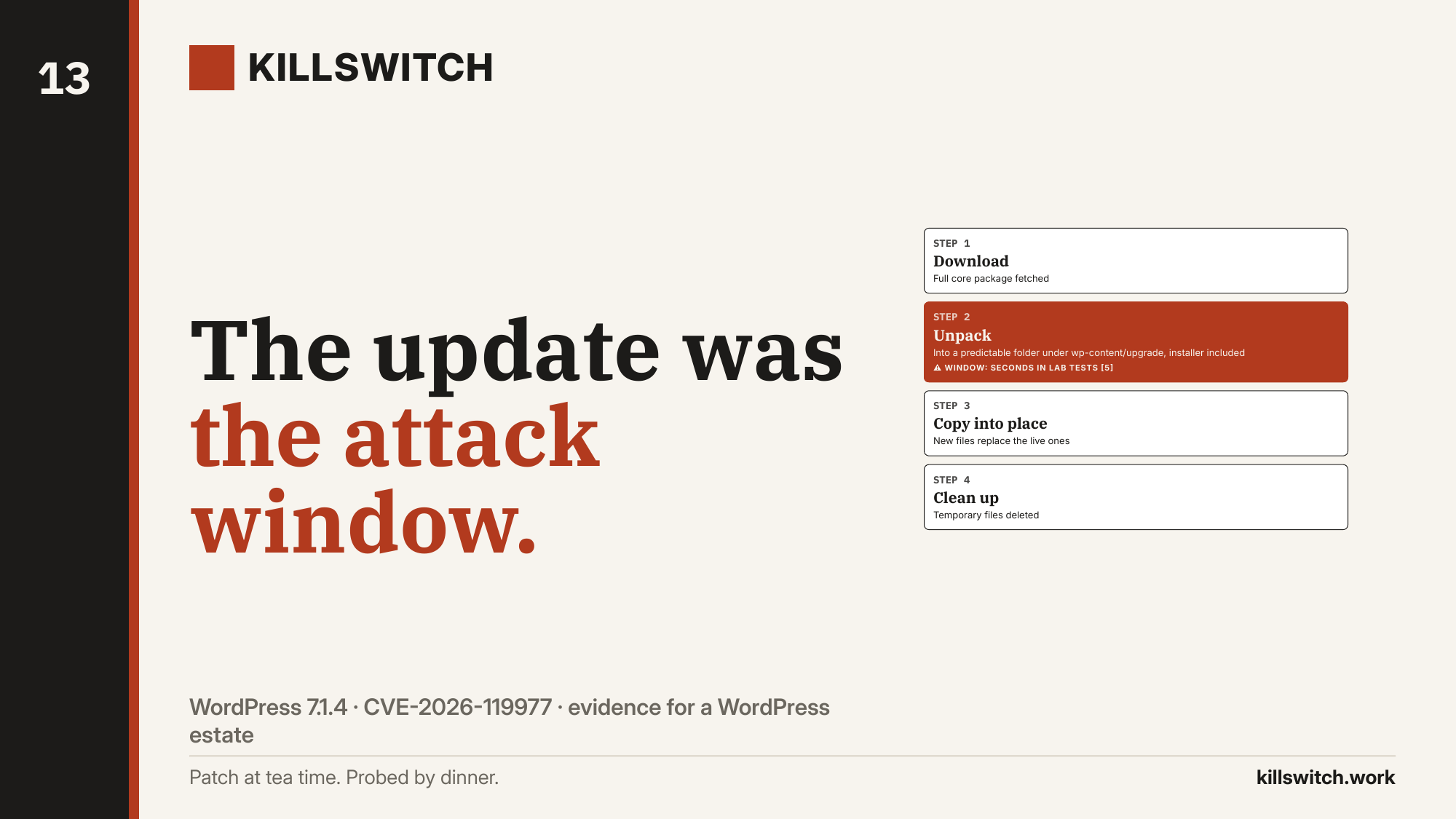
WordPress 7.1.4 fixed a flaw that only exists while WordPress is updating itself. Wordfence detected the first attack request 9 minutes after its firewall rule went live, and CISA has since listed it as exploited. Auto-update is not the same as safe-during-update. Here is the evidence a CISO should hold for a WordPress estate.
Facts as of 7 Nov 2026.
On 28 October WordPress shipped 7.1.4, a security release with 22 fixes, and told site owners to "update your sites immediately" [1]. Many of the 22 need a logged-in Contributor, Author or Editor.
One item is different: "A race condition during core updates that could lead to remote code execution", reported by Umut Bayram [1][3]. It needs no account. Wordfence, which assigned it CVE-2026-119977, scores it CVSS 3.1 8.1 (High) and says it affects unpatched releases of every branch from 4.7 to 7.1.3 [4][6].
The unusual part is where the flaw lives. It isn't in a plugin, a theme or the PHP runtime. It exists only for the few seconds in which WordPress is updating itself. For a CISO, that turns a routine question, "are we patched?", into a sharper one: "what was exposed while we were patching, and can we prove it?"
What happened, in order
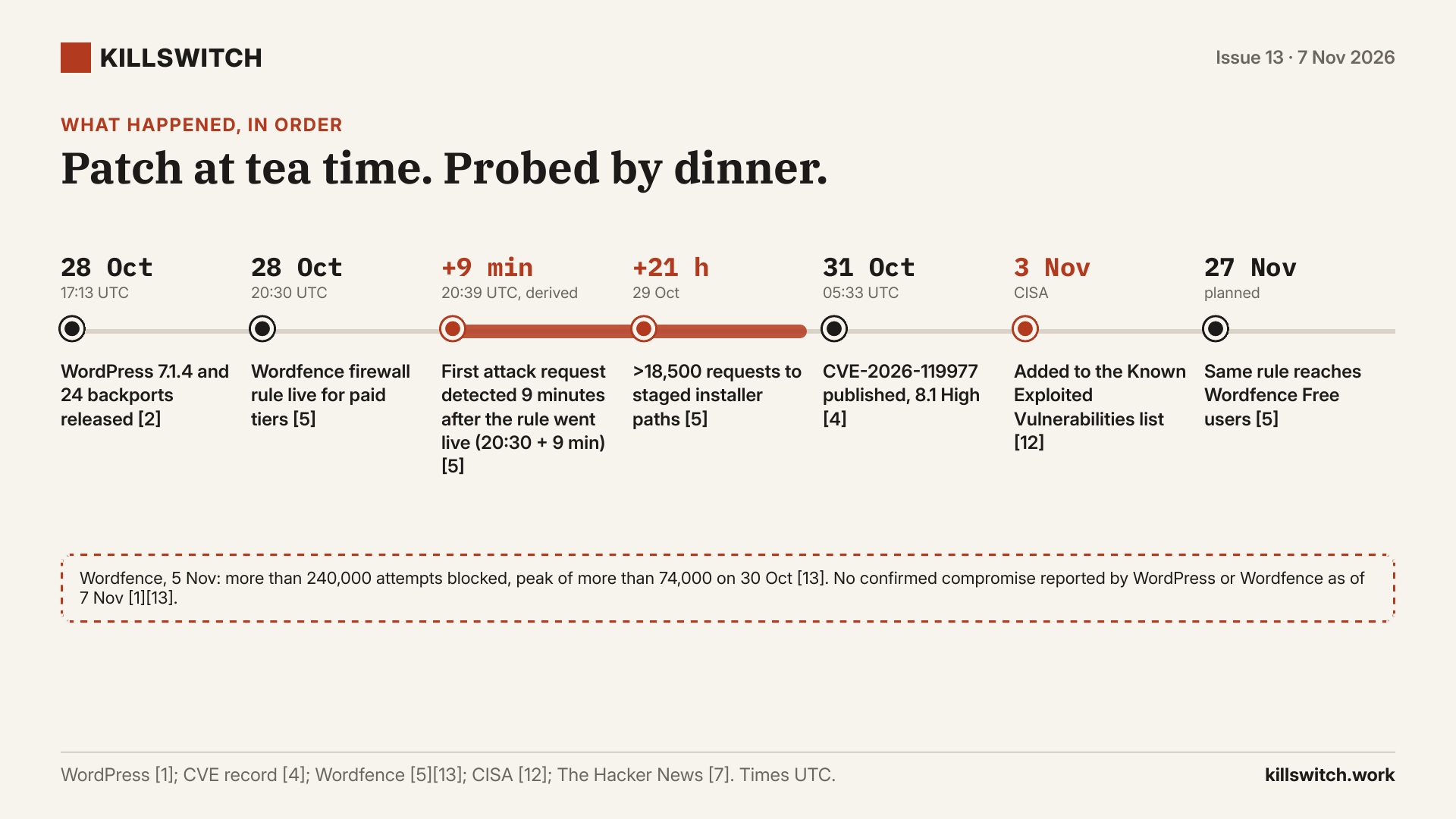
Wordfence deployed a blocking firewall rule at 20:30 UTC on 28 October, about three hours after WordPress announced the release at 17:13 UTC [2][5]. "The first match for our new firewall rule arrived nine minutes after deployment," it says, and "During the first 21 hours, we recorded more than 18,500 requests targeting staged setup-config.php installer paths" [5].
Two of the largest sources "repeatedly polled small groups of sites for roughly 14.5 hours, behavior consistent with trying to catch the brief upgrade window" [5]. The Hacker News later reported that Wordfence blocked 62,969 attacks in 24 hours [7]. We could not find that figure in Wordfence's own post, so treat it as reported, not confirmed.
Wordfence's 5 November update puts the total at more than 240,000 blocked attempts, peaking on 30 October with more than 74,000 in a single day [13]. It adds: "The large number of blocked requests does not mean that a large number of sites have been successfully exploited" [13].
On 3 November CISA added the flaw to its Known Exploited Vulnerabilities list, the US government's list of flaws seen exploited in real attacks, with a due date of 6 November for US federal agencies [12]. The entry does not say whether any attempt succeeded. As of 7 Nov 2026, neither WordPress nor Wordfence had reported a confirmed successful compromise, and we found no public report of one [1][13].
The CVE came last. The record was published on 31 October, three days after the patch [4], and CISA listed the flaw as exploited on 3 November [12]. The WordPress advisory still showed "No known CVE" when we checked on 7 November [3]. If your vulnerability process starts from a CVE feed, this one arrived after the attackers did.
How a routine update becomes a way in
Wordfence describes the mechanism. During a core update that uses a complete package, affected versions "unpack the new files into a predictable directory beneath wp-content/upgrade".
That temporary copy "includes the WordPress installer", and "Because the staging directory is web-accessible on many servers, an unauthenticated attacker who requests the installer at precisely the right moment can interact with the staged WordPress copy and progress to PHP code execution" [5]. We don't go further than that. There is no exploit detail in this issue.
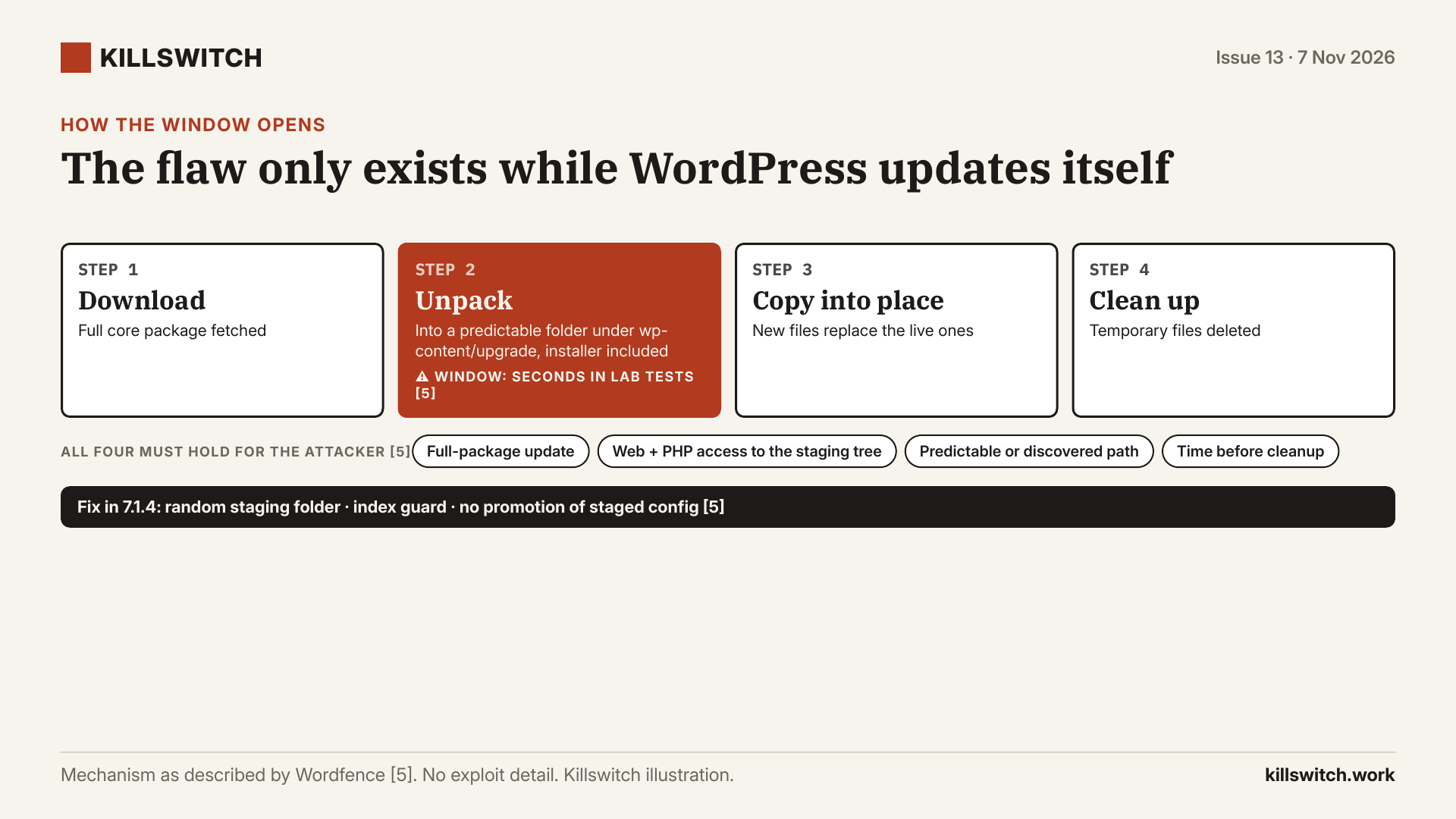
Wordfence lists four conditions: a full-package update containing the installer files, public web and PHP access to the staging tree, a predictable or discovered staging path, and enough time before WordPress cleans up [5]. "In lab environments, the vulnerable staging directory normally remained available for only seconds" [5].
That is why the attackers poll: a one-off request is unlikely to land, but "repeated automated polling can improve an attacker's chances" [5]. The fix randomises the staging directory, adds an index guard and prevents "unsafe promotion of staged configuration data", and it was backported to every branch down to 4.7 [5][1].
This is not a rerun of PHP2Shell [11]. That issue was about a flaw under your website, in the PHP engine, which a WordPress update couldn't fix. This one is the reverse.
The flaw is in WordPress's own update path, and the window opens exactly when you do the right thing. It also differs from Killswitch Issue 09, The Patch Shipped. The Fix Didn't, where a bundled runtime left the version scanner wrong; here the exposure is the update itself.
Two severities for one bug
WordPress's own advisory rates the issue Low [3]. Wordfence, as the CNA, rates it 8.1 High, with high attack complexity [4][6]. Both can be defended. The race is hard to win, but winning it means code execution on the server.
The problem is your patch policy. If your SLA keys off the vendor's rating, this was a "Low". If it keys off the CVE record, it was a "High" that only existed after 31 October. Neither tells you that attackers were polling within hours.
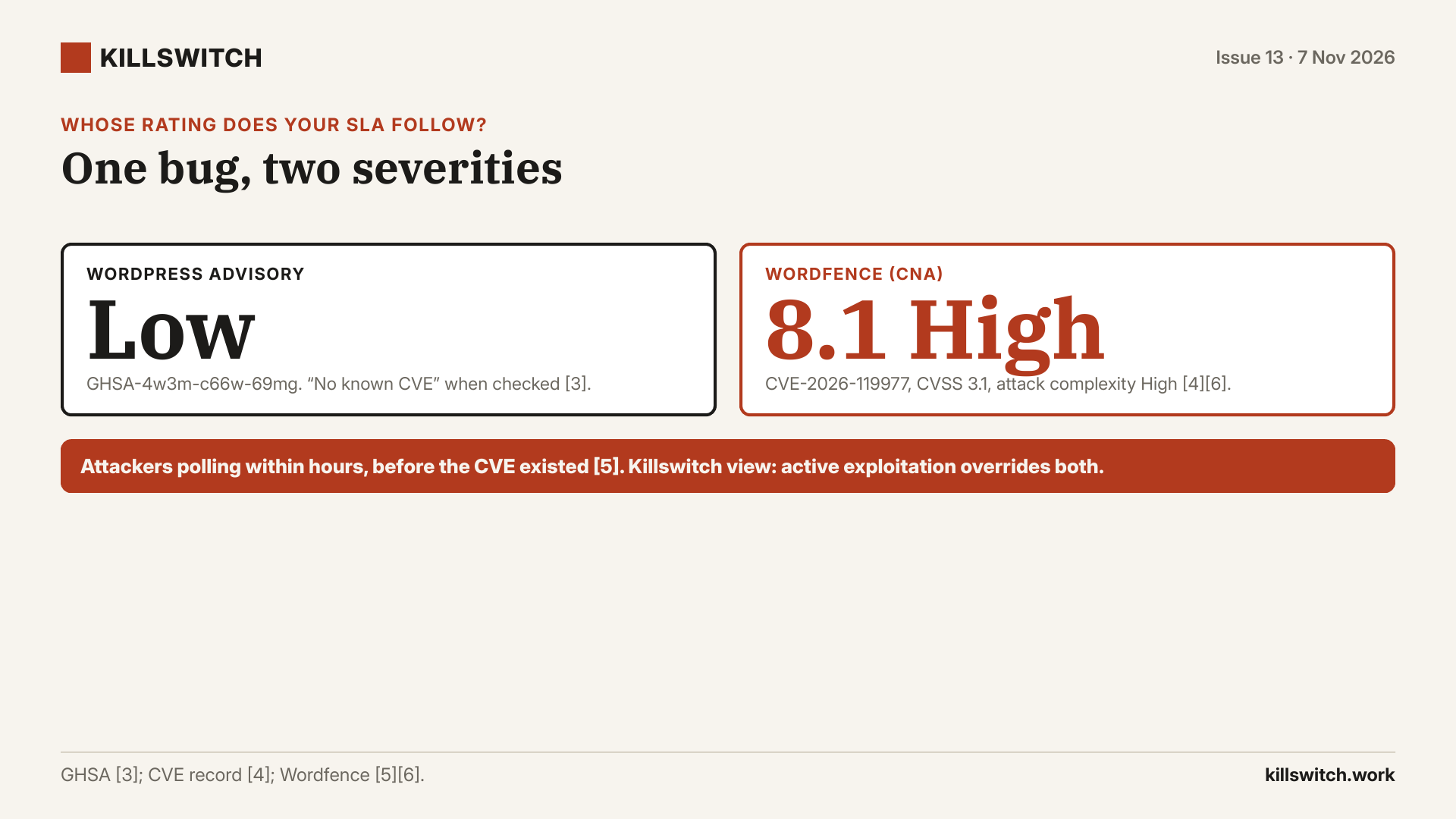
Our view is that a policy should name which severity source wins, and should let active exploitation reports override both. That is a Killswitch recommendation, not a WordPress or Wordfence one.
Auto-update is not the same as safe-during-update
WordPress's documentation says that "By default, automatic updates of WordPress are enabled on most sites" and that minor releases such as security releases update in the background [8]. Since 5.6, new installations also auto-update major releases by default, while older installations keep the previous behaviour unless someone changes it [8]. Wordfence expects "Most WordPress sites" to get 7.1.4 that way, but "strongly recommend[s] checking your site rather than assuming the update completed" [5].
Two things follow. First, auto-update is the right default, and this flaw is not an argument to turn it off. The fix itself arrives through it. Second, the update that installs the fix is still unpacked by the old, unpatched code. Wordfence confirmed this on 5 November: "updating from a vulnerable version to the patched version will run the vulnerable upgrade process one last time" [13].
It still recommends updating as soon as possible, because that window lasts only as long as the update itself [13]. A web-server rule that denies public access to PHP files under wp-content/upgrade, put in place before the update, closes that last window without waiting on the race. Wordfence now suggests the same precaution [13]. WordPress only needs filesystem access to that folder, not web access. Test the rule on your own stack.
Wordfence's own guidance adds a firewall caveat. The exploit "directly requests a staged PHP file without first loading WordPress", so its plugin firewall needs Extended Protection to see it [5]. Paid customers got the rule on 28 October. Free users get it on 27 November, after the standard 30-day delay [5][13]. Until then, Wordfence Free is not a control for this flaw.
The evidence a CISO should hold for a WordPress estate
Most organisations run more WordPress than IT knows about: the marketing site, campaign microsites, a careers page and agency-hosted landing pages. For this flaw, and for the next one, these six pieces of evidence answer the board's question better than "we auto-update".
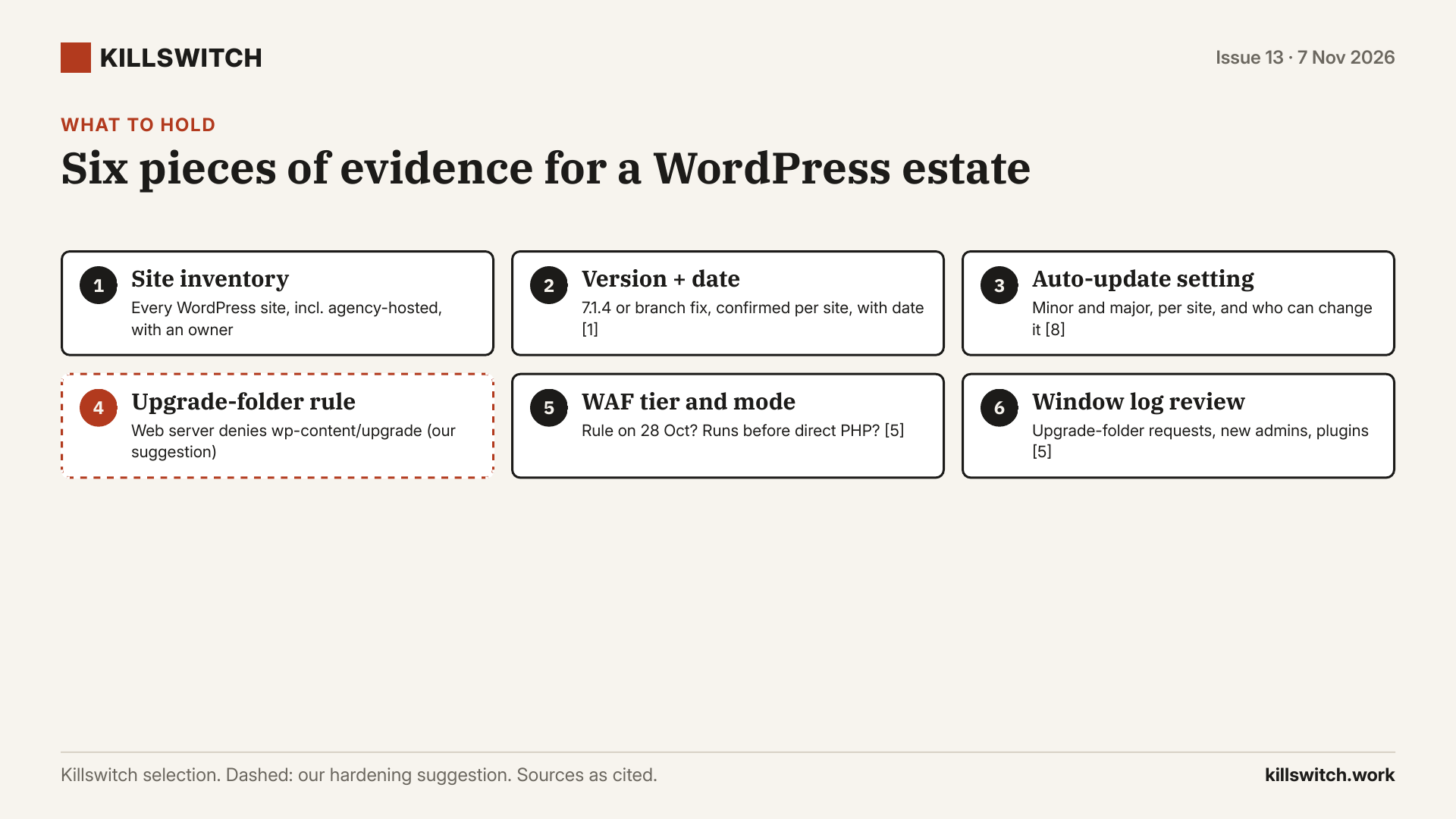
- An inventory of every WordPress site, including those hosted by agencies and vendors, with an owner for each. You can't confirm a version on a site you don't know about.
- The running version per site, with the date it was confirmed. That means 7.1.4 or the fixed release for its branch, such as 7.0.8 or 6.9.11 [1]. A screenshot of an update email is not proof.
- The auto-update setting per site, for minor and major releases, and who is allowed to change it [8].
- The web-server rule for the upgrade folder, as configuration you can show, not just intent.
- WAF tier and mode. Which sites had the rule on 28 October, and whether the firewall runs before direct PHP requests [5].
- A log review for the exposure window on any site that was unpatched: requests to PHP files under wp-content/upgrade, unfamiliar administrator accounts, unexpected plugins or PHP files you didn't place there. These are the signs Wordfence lists [5]. Its 5 November update adds a check for leftover files or folders in wp-content/upgrade [13].
Sites on WordPress 4.6 or earlier get no security updates at all [1]. They belong on a separate list with a retirement date.
Mapping it to your frameworks
These mappings are Killswitch's own, not an official crosswalk.
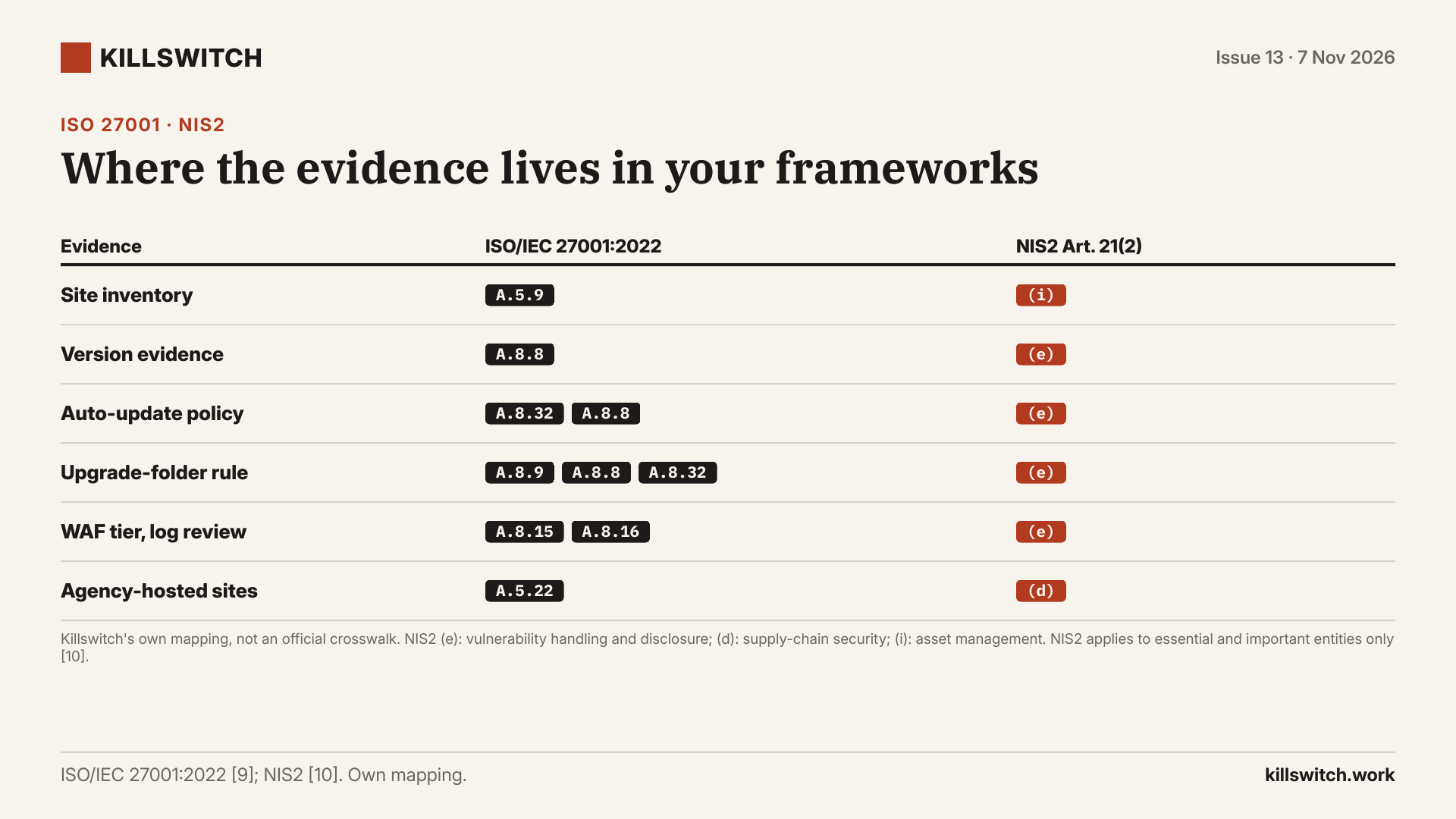
- ISO/IEC 27001:2022 [9]: A.5.9 (inventory of information and other associated assets) covers the site list. A.8.8 (management of technical vulnerabilities) covers version evidence and the severity rule. A.8.9 (configuration management) covers the upgrade-folder rule, with A.8.8 and A.8.32. A.8.32 (change management) covers how auto-updates are allowed and recorded. A.8.15 (logging) and A.8.16 (monitoring activities) cover the window review. A.5.22 (monitoring, review and change management of supplier services) covers agency-hosted sites.
- NIS2 Art. 21(2)(e) [10] names "vulnerability handling and disclosure" within security in acquisition, development and maintenance. It covers version evidence, the update policy and the upgrade-folder rule. Art. 21(2)(i) covers "asset management", so it holds the site inventory. Art. 21(2)(d) covers supply-chain security for sites that third parties run for you. These apply only if you are an essential or important entity.
What we don't know yet
As of 7 Nov 2026, neither WordPress nor Wordfence had reported a confirmed successful compromise, and we found no public report of one [1][13]. CISA's listing confirms exploitation activity but does not say whether any attempt succeeded [12]. Nobody has said publicly who is behind the polling. The 62,969 figure comes from press reporting of Wordfence, not from Wordfence's own posts [7].
We haven't confirmed how often the background security updates that most sites receive use the full package that the attack needs. WordPress prefers partial packages for same-branch updates where offered; we haven't confirmed whether those include the installer. That affects how much of your estate was really exposed. Facts are as of 7 Nov 2026.
Your next-week checklist
- Pull a list of every WordPress site you own or pay for, including agency-hosted ones.
- Confirm each one runs 7.1.4 or its branch's fixed release, and record the date.
- Deny web access to wp-content/upgrade at the web server, and test that updates still work.
- For any site that was unpatched after 28 Oct, review requests under wp-content/upgrade, admin accounts and plugins.
- Write down which severity source your patch SLA follows, and add an active-exploitation override.
What matters this week, what can wait
Here is what matters in the coming week, 7 to 13 November, for anyone running WordPress or the servers under it. Our test is simple: it matters if attackers are already using it (it is on the Known Exploited Vulnerabilities list, KEV for short: the US government's list of flaws seen exploited in real attacks, kept by CISA, the US Cybersecurity and Infrastructure Security Agency), if a legal deadline that applies to you lands within about 30 days, or if it changes what an auditor will ask you now.
Dates below are CISA's "due dates", the patch deadline it sets for US federal agencies; they are a useful clock for everyone else too. KEV entries as of 7 Nov 2026 [12].
Matters this week
- WordPress core, this issue's flaw. CVE-2026-119977 was added to KEV on 3 November with a due date of 6 November, now passed, and CISA asks agencies for forensic triage on it [12] (a CVE is the public ID number for a known flaw). Confirm every site runs 7.1.4 or its branch's fixed release, and run the log review above on any site that was unpatched after 28 October [5][13].
- Brotli, the compression library under many web servers. CVE-2026-111497 was added on 27 October and is due 10 November [12]. It is not a WordPress flaw, but Wordfence reproduced code execution through WordPress in a lab, and updating WordPress does not fix it [14]. Ask your host or server team whether the Brotli library is patched (upstream fix in 1.2.1 and the other fixed branches) and services restarted [14][15].
- PHP itself. Two PHP flaws, CVE-2026-109618 and CVE-2026-109619, have been on KEV since 26 October; their due date, 29 October, has passed [12][16]. This is the PHP2Shell story from Issue 01 [11]. If any WordPress server still runs an unpatched PHP, that comes before everything else on this list.
- The rest of this week's KEV list. Ivanti Connect Secure (one due 2 November, passed; one due 13 November), Adobe Commerce and Magento (10 November), VMware ESX (11 November), Apple devices left on old software (18 November) and SonicWall SSL VPN (added 6 November, due 20 November) are also on KEV [12]. Issue 12 covers them; check whether you run any of them.
- The Cyber Resilience Act now has teeth for reporting. Since 11 September 2026, makers of software and connected products sold in the EU must report actively exploited vulnerabilities and severe incidents through the Single Reporting Platform run by ENISA, the EU cybersecurity agency [17]. If you sell a product built on WordPress or that ships it, expect auditors and big customers to ask who files that report and how fast.
Can wait
- The Wordfence Free rule on 27 November. It is a vendor date, not a deadline. If you rely on Wordfence Free, the web-server rule above covers the gap now [5][13].
- AI Act marking for older generative AI systems, 2 December 2026. Under four weeks away, but it applies to providers of generative systems placed on the market before 2 August 2026, not to teams that run a website. If you ship such a system, move it to this week's list (Article 111(4) of the AI Act, added by Regulation (EU) 2026/1744) [18].
- WordPress 7.2. It is still in beta and is a feature release, not a security fix [19]. Plan it through your normal change process.
Keep going
Get sharp issues on security, AI security and GRC every working day, Monday to Friday, written for CISOs, vCISOs and GRC leads.
GRCompliance: track ISO 27001 A.8.8 and NIS2 Art. 21(2)(e) evidence per asset, link the proof, and see what's still open.
GRCompliance Core, the open-source edition. Your data stays on your infrastructure.
Ready-to-run training and audit kits for security and GRC teams.
Sources
- WordPress.org Documentation: Version 7.1.4 (28 Oct 2026)
- WordPress.org News: WordPress 7.1.4 security release (Oct 2026)
- WordPress/wordpress-develop security advisory GHSA-4w3m-c66w-69mg: A race condition during core updates that could lead to remote code execution
- CVE-2026-119977 record (CNA: Wordfence), published 31 Oct 2026
- Wordfence: WordPress 7.1.4 Patches Unauthenticated Upgrade-Window RCE; Exploitation Attempts Detected After Release (29 Oct 2026)
- Wordfence Intelligence: WordPress Core 4.7.0 - 7.1.3 - Unauthenticated Upgrade-Window Staged-Installer Remote Code Execution
- The Hacker News: WordPress RCE Flaw Draws Nearly 63,000 Attack Attempts in Just 24 Hours (Oct 2026)
- WordPress Developer Resources: Configuring Automatic Background Updates
- ISO/IEC 27001:2022 Information security management systems
- NIS2 Directive (EU) 2022/2555
- Killswitch Issue 01: PHP2Shell: patch PHP itself, not just your website (26 Oct 2026)
- CISA Known Exploited Vulnerabilities catalog, JSON feed (catalogVersion 2026.11.06, fetched 7 Nov 2026)
- Wordfence: Attackers Actively Probing for Upgrade-Window RCE Vulnerability in WordPress Core (5 Nov 2026)
- Wordfence: HTTP2Shell: What the Critical Brotli Vulnerability Means for WordPress Sites (2 Nov 2026)
- Google Brotli release v1.2.1
- CISA alert: Critical vulnerabilities in PHP require immediate patching (21 Oct 2026)
- European Commission: Cyber Resilience Act, reporting obligations (updated 11 Sep 2026)
- Article 111(4) of the AI Act, added by Regulation (EU) 2026/1744 (Official Journal, 24 Jul 2026), EUR-Lex
- WordPress.org News: WordPress 7.2 Beta 4 (3 Nov 2026), news index
Facts as of 7 Nov 2026. Quotations are from WordPress.org, the GHSA advisory, the CVE record, CISA's KEV feed and Wordfence's 29 Oct and 5 Nov 2026 posts. The 62,969 figure is as reported by The Hacker News. Defensive briefing: no exploit code or payloads. The web-server rule, severity policy and framework mappings are Killswitch's own suggestions. Not legal advice.
Emmanuel Aigbehi Walstra is a CISO who also serves as a virtual CISO (vCISO) for several organisations, with 30+ years in cybersecurity, 10,000+ people trained, and author of the CCSP Excellence books.
Checked against the primary sources cited above. Spotted an error? See our corrections page.