
Black October: Your AI Keys Lived on Someone Else's Platform
Nine AI developer platforms, one target: stored env vars and AI keys. What to rotate first, how to cap the bill, what to ask your platforms.
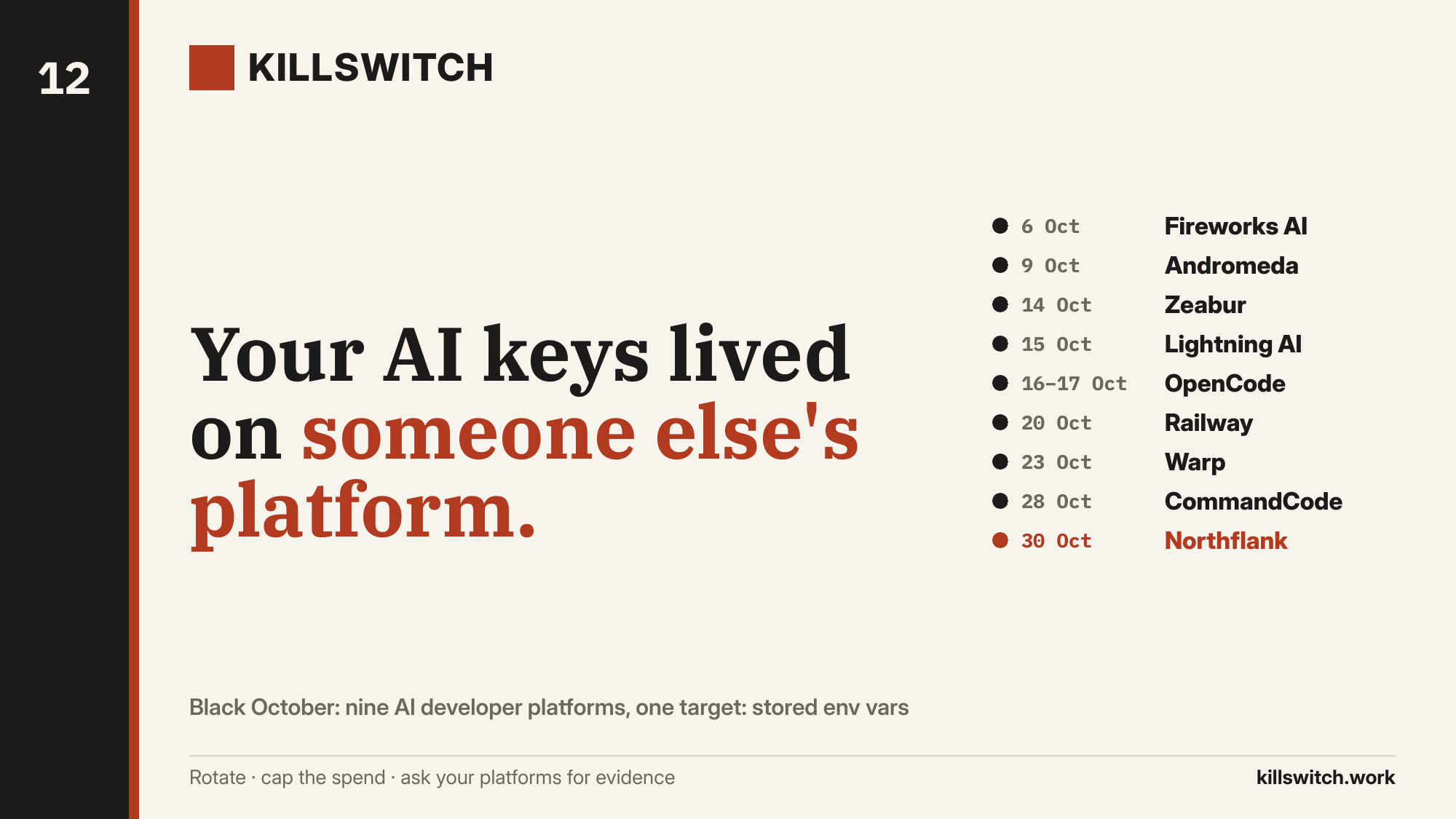
In October at least nine AI developer platforms disclosed incidents in which attackers went after the environment variables customers stored with them, especially AI keys. Northflank, the ninth, told every customer to assume theirs were decrypted. Here is what to rotate first, how to cap the bill, and what to ask your platforms for.
Facts as of 7 Nov 2026.
On 30 October at 13:58 UTC, Northflank posted a status update that every customer of a hosting platform should read twice: "Assume all environment variables have been decrypted. Disable/rotate all keys." [2] By 23:38 UTC it added: "Users have reported unauthorised use of AI API keys supplied to the Northflank platform" [2] (an API key is the password-like key software uses to reach a service).
Northflank's own timeline starts with a Wiz threat alert at 11:43 UTC the same day [2]. Its 6 November update adds that the first known decryption of secrets happened between 02:39 and 03:08 UTC that morning, more than eight hours before that alert, and that it has found no evidence that customer workloads or workload data were accessed [2].
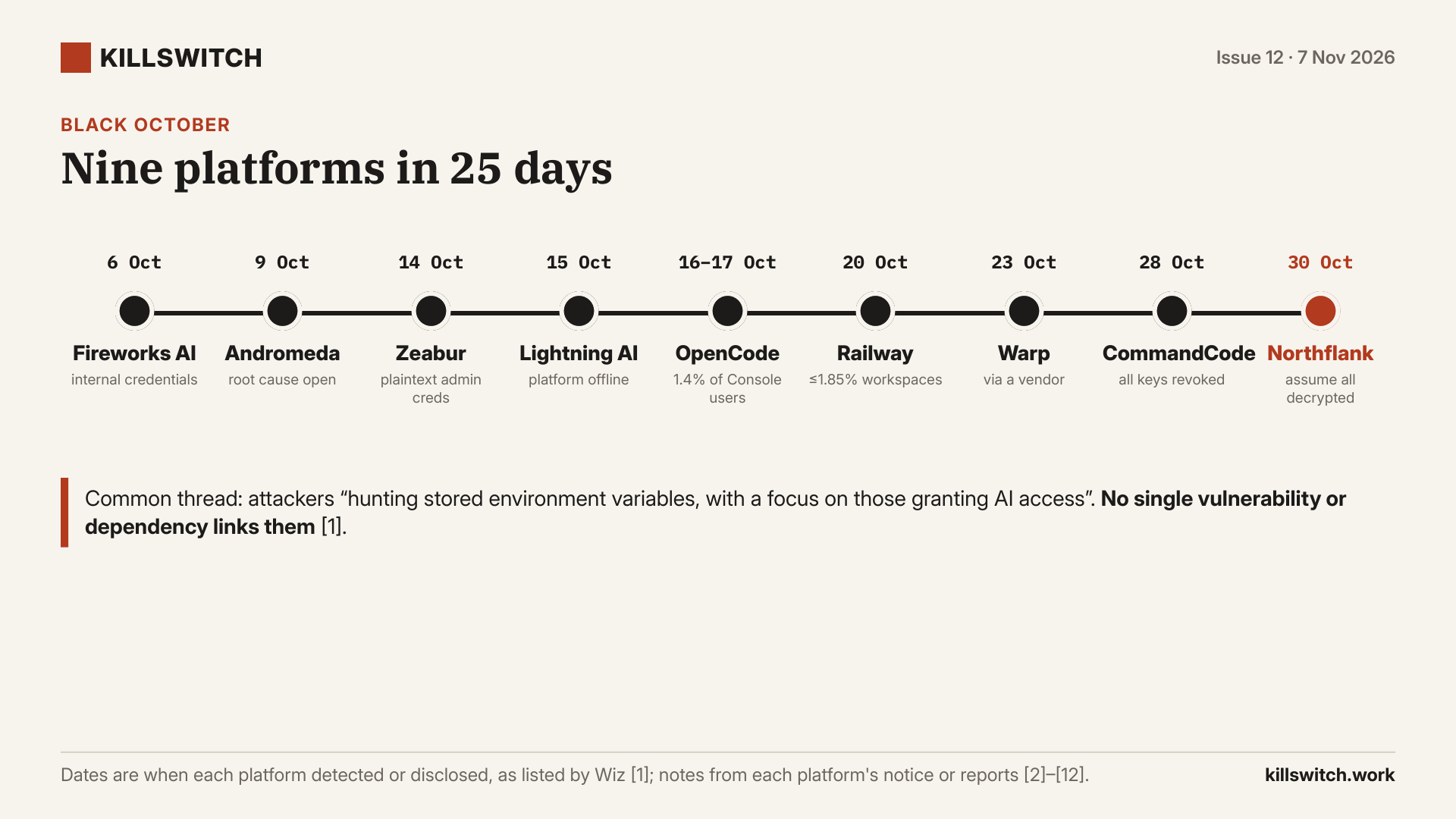
Northflank was not alone. The same day, Wiz published a roundup counting at least nine AI developer platforms that disclosed incidents during October: Fireworks AI, Andromeda, Zeabur, Lightning AI, OpenCode, Railway, Warp, CommandCode and Northflank [1]. Wiz calls it "Black October". Its summary: "All public reports highlight targeted exploitation, explicitly hunting stored environment variables, with a focus on those granting AI access" [1].
The list has kept growing. Between 2 and 7 November Wiz updated its post with five more publicly reported incidents: Brev (NVIDIA), Trigger.dev, Chainstack, kernel.sh and Blacksmith, the last disclosed on 5 November [1].
Wiz says Brev, Trigger.dev and Chainstack had not shared attacker techniques or indicators when it added them [1]. We have not read those five companies' own notices, so we report them as Wiz lists them, and the rest of this issue is about the original nine.
What the platforms themselves say
Go to each platform's own notice and the picture is consistent in the outcome and varied in the cause. Fireworks AI says an unauthorised third party used internal Fireworks credentials to reach environment variables in evaluation jobs for "a limited number of customer accounts" [6].
Andromeda says the activity began "as part of an industry-wide attack on or about October 9th" and that it has "not yet established the root cause" [7]. Lightning AI cut all user access to its platform on 16 October and believes "certain customer credentials were compromised to gain access to environments and connected third-party services" [8].
Zeabur's preliminary report is the most candid: "long-lived admin credentials were stored in plaintext and could be used from the public internet", and the attacker "eventually read the platform database" holding environment variables [4]. It had already announced it will wind down, with services closing from 1 December and fully by 31 December 2026 [5].
In its preliminary report, Railway says the attacker decrypted a subset of encrypted environment variables and that "at most 1.85% of all workspaces", about 100,000, had some potentially compromised [3]. Railway's reading is that the attacker "was attempting to obtain AI provider API keys to perform distillation attacks" [3]. OpenCode said on X that 1.4% of OpenCode Console users were affected [17]; TechCrunch and The Hacker News report a breach of a legacy system [9][10].
Warp's CEO said on 26 October that the company detected the attack on 23 October and that attackers reached "a limited amount of agent trace and telemetry data" through a vendor dependency, affecting an upper bound of roughly 1% of users [18][11]. CommandCode revoked all API keys as a precaution [12].
Now the gaps. Wiz says "there is no single vulnerability or dependency linking these attacks" [1]. Several investigations are still open. Northflank has not published a root cause or a count of affected customers [2]. Treat any claim that one actor did all nine as unproven.
Why your env vars became a wallet
A platform's environment-variable store is, in practice, a shared secrets vault you don't run. And an AI key is not just an access credential. It is a prepaid card. Wiz followed two enterprise keys it could tie to one of the vendor breaches. Both saw their first unauthorised call "within 30 minutes of the reported credential access": a single test request in a sweep across organisations [1].
Then came days of low-level checks (14–120 calls a day), then a flood. One key made about 800,000 Bedrock calls in 30 hours. The other made about 1.7 million in 13 hours. Wiz estimates the two cases "likely ran up over $100k in usage" at list price (a Wiz estimate) [1].
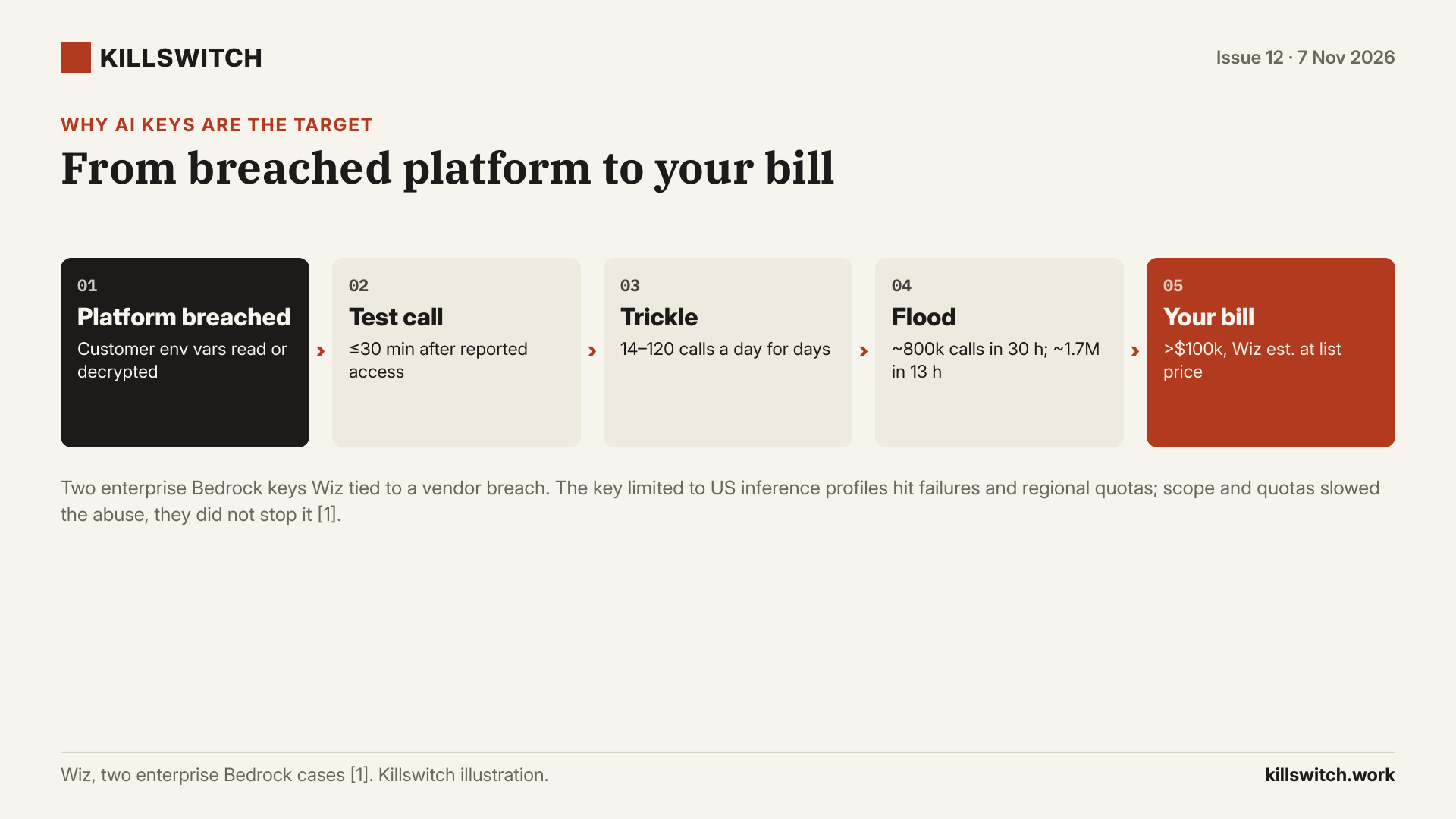
Wiz also found the keys being tested from infrastructure tied to sites that openly resell discounted model access [1]. That is the economics: stolen keys have a market, so every platform that stores them is a target. Wiz cannot definitively link the resellers to the original breaches [1], and neither can we.
Rotate in this order
Every notice says the same thing in different words: rotate. Fireworks puts the point most clearly: "Removing a stored secret alone does not invalidate the underlying credential" [6]. You revoke at the issuing provider, then replace. Northflank says the same: revoke with the provider, generate replacements, update secrets and workloads, and review AI provider usage and billing logs [2].
If you have hundreds of secrets on an affected platform, order matters. This is our priority order. Northflank's 2 November update gives a similar one, starting with AI provider keys, then cloud provider credentials, payment provider keys, private keys and database credentials [2]:
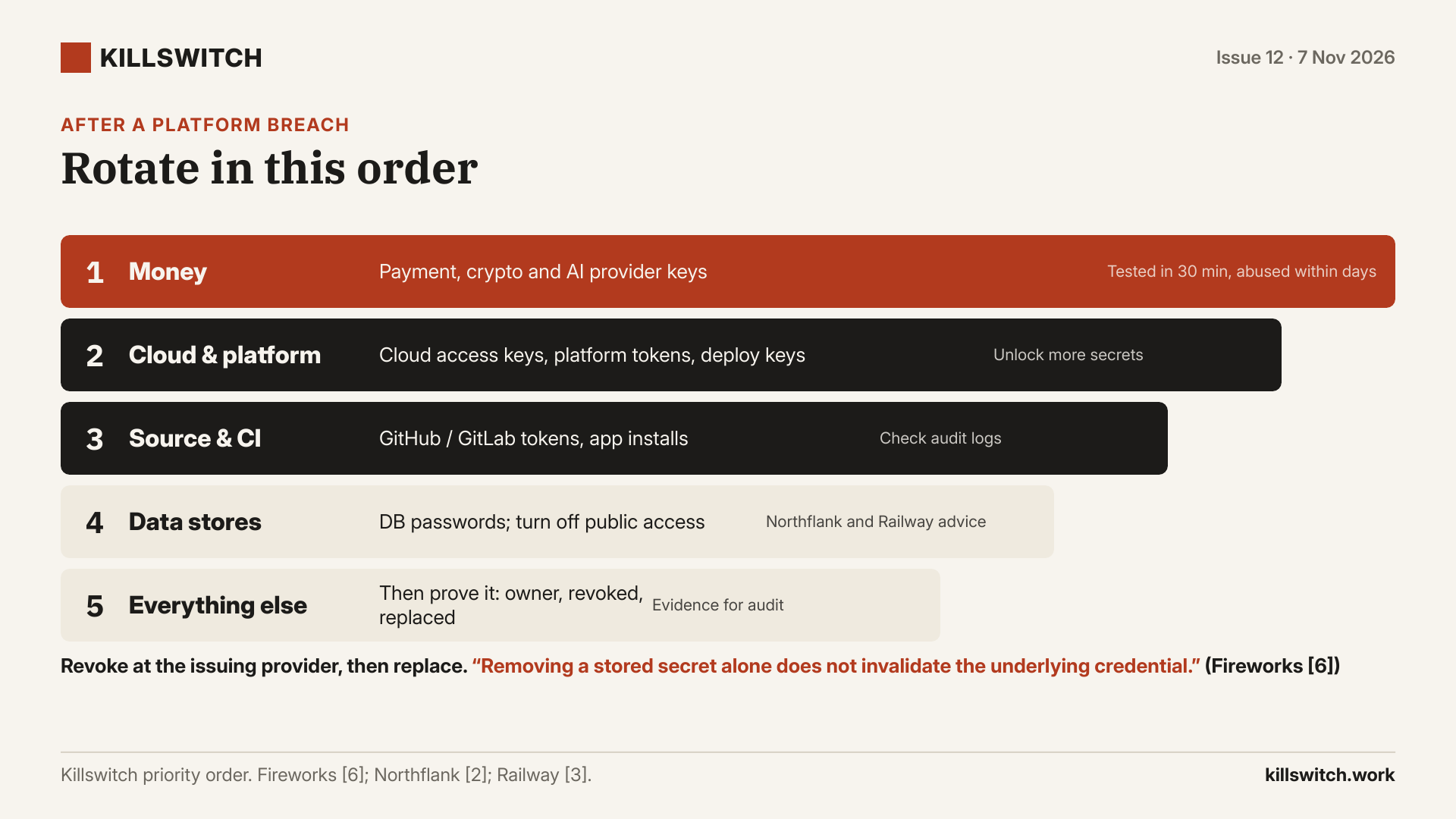
- Keys that move money or spend it. Payment keys, crypto keys and AI provider keys. Wiz cites reports of crypto theft using keys stored on Railway, which it labels anecdotal [1]. AI keys were tested within 30 minutes and abused at scale within days [1].
- Cloud and platform credentials. Cloud access keys, the platform's own tokens and deploy keys. These let an attacker reach more secrets.
- Source and CI. GitHub or GitLab tokens and app installations. Railway asked users to check GitHub audit logs and app access [3].
- Data stores. Database passwords, and turn off public access. Northflank and Railway both advise disabling public exposure of databases and add-ons [2][3].
- Everything else, then prove it: list each secret, its owner, the date it was revoked and the date the replacement went live.
Our advice, not any vendor's: store replacements on the platform only once it confirms containment. Until then, keep the old key revoked and the workload paused or moved. As of 7 Nov 2026, Northflank has not published a root cause; it says an independent forensic review is ongoing [2].
Cap the bill before the next one
Rotation fixes the last breach. Spend limits limit the next one. Wiz's two cases show why scope matters. The key whose policy allowed global cross-region inference saw only about 6% of calls throttled. The key restricted to US inference profiles saw thousands of failed calls first, and later its traffic "ran into the account's regional quotas" [1]. Tight scopes and quotas did not stop the abuse. They slowed it.
- One key per platform, per environment. Then a stolen key tells you where it leaked from and does less damage.
- Budgets and alerts at the AI provider, not only in the platform. A platform's budget only sees traffic through its own gateway [10].
- Narrow model and region scopes and low quotas for every key that does not need more [1].
- Watch for the pattern Wiz saw: one test call, days of trickle traffic, then a flood [1].
Don't count on refunds. Railway says it "is unable to refund customers for spend performed with compromised API keys" and sends you to the AI providers [3]. Zeabur will take incident claims only until 30 November 2026, and wants "third-party platform invoices or usage records" as proof [13]. Keep your provider billing exports.
What to ask your platforms for
This is the GRC part. Northflank says it "enabled audit logs for all customers, including free users" on 31 October, after the incident [2]. Ask whether your platforms give you that before the incident. These are the four pieces of supplier evidence we would ask for:
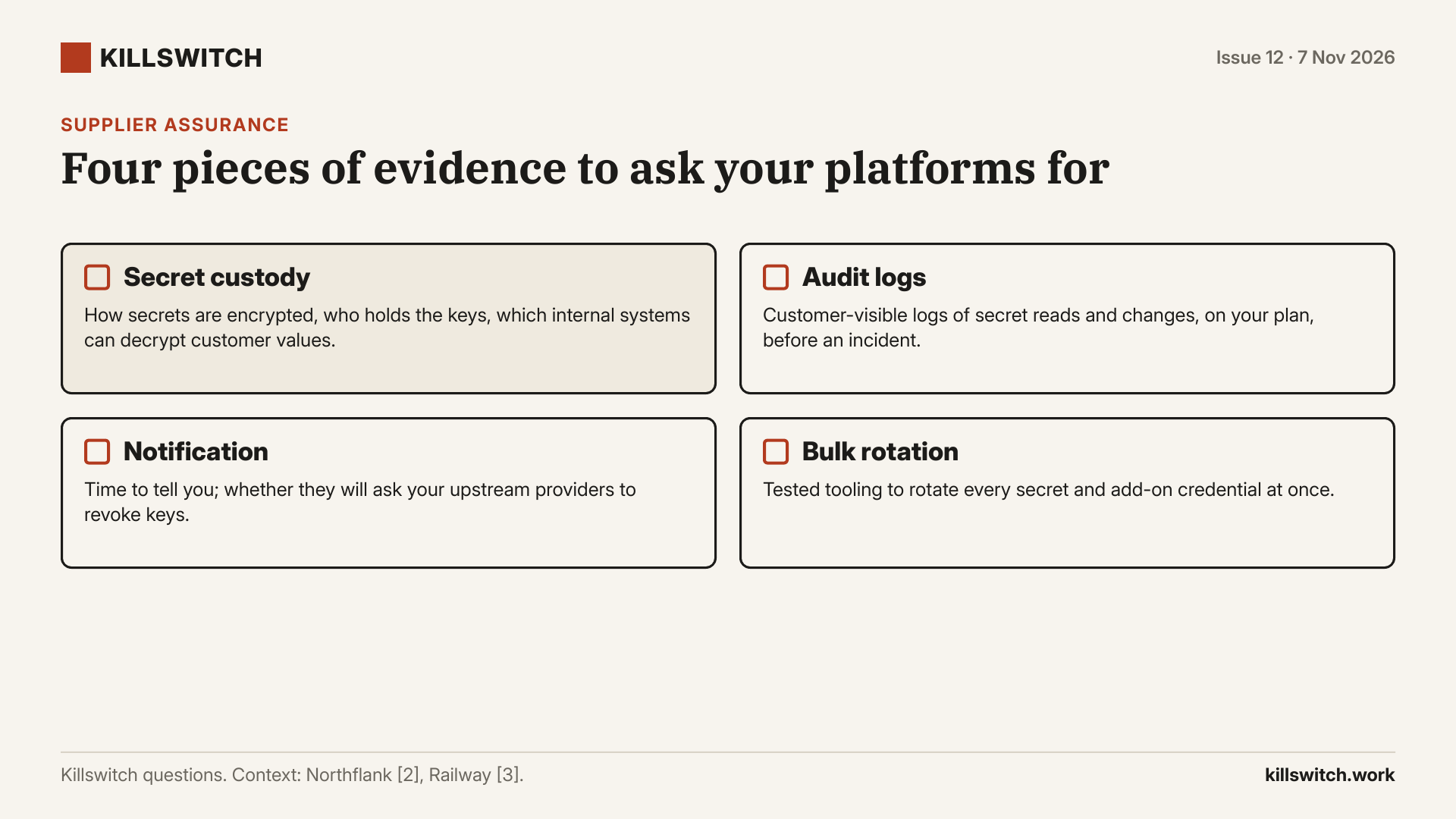
- How secrets are stored and who can decrypt them. Envelope encryption, key custody, and which internal systems can read customer secrets. Railway's notice shows why: a CI (build pipeline) credential let the attacker decrypt artefacts [3].
- Customer-visible audit logs, on your plan, covering secret reads and changes.
- Notification terms: how fast they tell you, and whether they will tell your upstream providers to revoke keys. Railway sent potentially decrypted keys to the providers for revocation before its public disclosure [3].
- Bulk rotation tooling. Northflank rolled out rotation for each add-on type across 30 and 31 October [2]. You want that tested before the incident.
Mapping it to your frameworks
These mappings are Killswitch's own, not an official crosswalk.
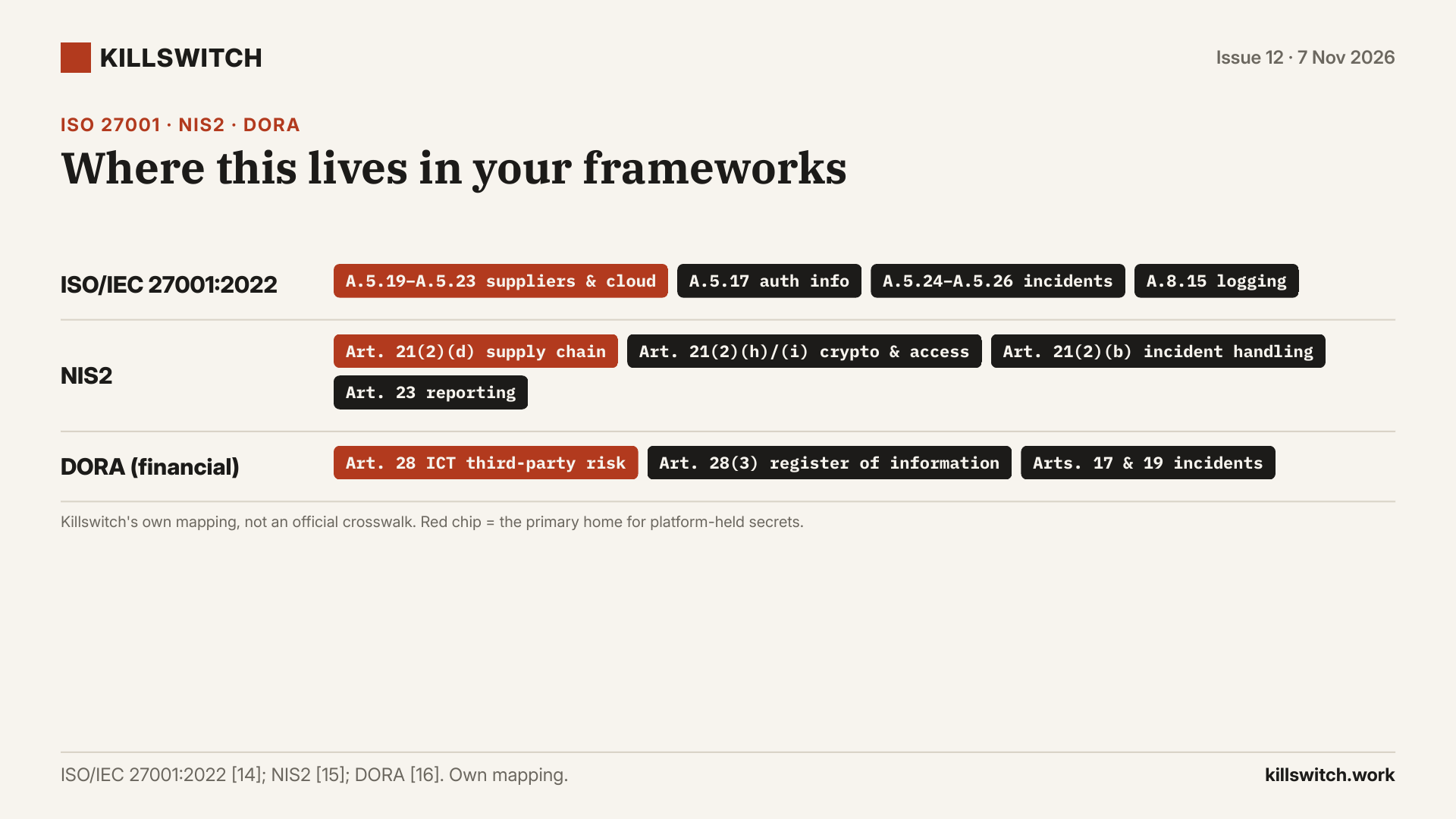
- ISO/IEC 27001:2022 [14]: A.5.19 to A.5.23 (supplier relationships, agreements, ICT supply chain, monitoring of supplier services and cloud services) cover the platform questions. A.5.17 covers the handling of authentication information. A.5.24 to A.5.26 cover your own response, and A.8.15 logging covers the audit logs you should be able to see.
- NIS2 Art. 21(2)(d) [15], supply chain security, is where a platform holding your secrets belongs if you are in scope. Art. 21(2)(h) cryptography and (i) access control cover how secrets are encrypted and who can read them. Your response sits under Art. 21(2)(b), and any reporting under Art. 23.
- DORA [16], for financial entities: ICT third-party risk (Art. 28) and the register of information (Art. 28(3)); incident handling and reporting under Arts. 17 and 19. A hosting platform holding production secrets belongs in that register.
What we don't know yet
As of 7 Nov 2026, we don't know Northflank's root cause or how many of its customers were affected; it says it will share a root cause analysis once it has confirmed findings [2]. There is no public evidence of a single actor or single flaw across the nine, or the five reported since [1].
Several of the other notices give percentages or say "limited" rather than counts, and most investigations are still open [3][6][7][8]. Distillation is the motive several platforms cite [3][9][12][17], but it is their reading, not a proven finding. We will update this issue if final reports change the picture.
Your next-week checklist
- List every platform that stores your environment variables, and which AI keys live on each.
- If you used any of the nine, revoke at the provider and replace, in the order above.
- Pull AI provider usage and billing for October and keep the exports.
- Set a budget and alert on every AI provider account, and split keys per platform.
- Send your platforms the four evidence questions and log the answers in your supplier register.
What matters this week, what can wait
Eight things matter in the coming week, 7 to 13 November. Most of the rest can wait. Our test is simple: it matters if attackers are already using it (it is on the Known Exploited Vulnerabilities list, KEV for short: the US government's list of flaws seen exploited in real attacks, kept by CISA, the US Cybersecurity and Infrastructure Security Agency), if a legal deadline that applies to you lands within about 30 days, or if it changes what an auditor will ask you now.
Dates below are CISA's "due dates", the patch deadline it sets for US federal agencies; they are a useful clock for everyone else too. KEV entries as of 7 Nov 2026 [19].
Matters this week
- Ivanti Connect Secure (the remote-access VPN, or virtual private network, gateway). CISA added two flaws on 30 October: CVE-2026-111357 (due 2 November, now passed; a CVE is the public ID number for a known flaw) and CVE-2026-118527 (due 13 November). CISA notes they can be chained with a third flaw, CVE-2026-104935 [19][20]. If you run it, apply Ivanti's fix now and check the box for signs of compromise; CISA asks agencies to follow its forensic triage requirements for both [19].
- GitLab self-managed. CVE-2026-97229, added 29 October, lets an attacker with no login run code on the GitLab server through a crafted pattern in CI/CD configuration (CI/CD, continuous integration and continuous delivery, is the pipeline that builds and ships your code). CISA's due date, 1 November, has already passed [19][21]. This is the issue's story one step closer to home: CI holds the same kind of secrets the nine platforms lost. Patch, then treat the CI variables on any unpatched server as exposed.
- SonicWall SSL VPN (remote access on SonicWall firewalls). CVE-2026-19868, added 6 November and due 20 November, may let a user with valid credentials for another sign-in method bypass SAML single sign-on, and with it the multi-factor sign-in that SAML enforces [19][31]. SonicOS Gen7 7.3.3-7015 and older and Gen8 8.2.2-8015 and older are listed as affected [31]. It affects only firewalls that use SAML for SSL VPN sign-in. If you run it, apply SonicWall's fix [28] and review recent VPN sign-ins.
- WordPress core. CVE-2026-119977, the update-window flaw we cover in Issue 13, was added on 3 November with a due date of 6 November, now passed [19][30]. Confirm every site runs 7.1.4 or the fixed release for its branch.
- Apple devices left on old software. CVE-2024-27834, a 2024 flaw in WebKit (the engine behind Safari), was added on 4 November and is due 18 November. It lets an attacker who can already read and write memory bypass Pointer Authentication, a hardware defence [19][29]. Apple fixed it in Safari 17.5 and the matching system updates listed with the KEV entry [19][29]. Current devices are covered; this matters for managed devices stuck on old versions.
- Adobe Commerce and Magento (online shops). CVE-2026-48356, added 27 October and due 10 November, allows a dangerous file upload that can lead to code execution [19][22]. If your shop runs on it, patch now.
- VMware ESX (VMware's hypervisor, the software layer that runs your virtual servers). CVE-2026-41709, added 28 October and due 11 November, lets someone who already has admin access do certain things without being logged [19][23]. Patch, and keep in mind your ESX logs may be incomplete if you are investigating.
- The Cyber Resilience Act now has teeth for reporting. Since 11 September 2026, makers of software and connected products sold in the EU must report actively exploited vulnerabilities and severe incidents through the Single Reporting Platform run by ENISA, the EU cybersecurity agency [24]. If you build products, expect auditors and big customers to ask who files that report and how fast.
Can wait
- AI Act marking for older generative AI systems, 2 December 2026. Real, and now under four weeks away, but it applies to providers of generative systems placed on the market before 2 August 2026, not to teams that just call a model with an API key. If you ship such a system, move it to this week's list (Article 111(4) of the AI Act, added by Regulation (EU) 2026/1744) [25].
- Notified bodies under the Cyber Resilience Act, 11 December 2026. This is a target for EU member states, not a duty on your company. Look again in 2027, before the Act applies in full on 11 December 2027 [24][26].
- Plex Media Server. On KEV, with due dates of 23 October and 3 November, both passed [19][27]. It matters only if someone runs it on a work network; if they do, it is a shadow IT question first (software staff installed without IT's approval). Home and lab servers: patch when you can. Everyone else can skip it.
Keep going
Get sharp issues on security, AI security and GRC, written for CISOs, vCISOs and GRC leads.
GRCompliance: track third-party vendors and their security posture in a central registry, and map controls to ISO 27001 and NIS2.
GRCompliance Core, the open-source edition. Your data stays on your infrastructure.
Ready-to-run training and audit kits for security and GRC teams.
Sources
- Wiz: “Black October” for AI Developer Platforms (30 Oct 2026, updated to 7 Nov 2026)
- Northflank status: Security incident (30 Oct–6 Nov 2026)
- Railway: Preliminary Report, Oct 21st Security Incident (22 Oct 2026, updated 26 Oct)
- Zeabur: October 2026 security incident (preliminary report, 19 Oct 2026)
- Zeabur: Zeabur is shutting down: what happens next (17 Oct 2026)
- Fireworks AI: October 2026 security incident (bulletin, updated 10 Oct 2026)
- Andromeda: October 2026 Security Incident (20 Oct 2026)
- Lightning AI: October 2026 Security Incident
- TechCrunch: Hackers hit AI coding tool OpenCode, running up charges on users' AI accounts (19 Oct 2026)
- The Hacker News: OpenCode Console breach may have exposed OpenAI, Anthropic and Google API keys (Oct 2026)
- BleepingComputer: Warp discloses breach exposing AI agent logs, user telemetry data (27 Oct 2026)
- Command Code on X: security incident notice (28 Oct 2026)
- Zeabur: Service migration, refunds, and security incident claims
- ISO/IEC 27001:2022 Information security management systems
- NIS2 Directive (EU) 2022/2555
- DORA, Regulation (EU) 2022/2554 (digital operational resilience, financial sector)
- OpenCode on X: security breach notice (17 Oct 2026)
- Zach Lloyd (Warp CEO) on X (26 Oct 2026)
- CISA Known Exploited Vulnerabilities catalog, JSON feed (catalogVersion 2026.11.06, fetched 7 Nov 2026)
- Ivanti: Security Advisory, Ivanti Connect Secure (CVE-2026-104935, CVE-2026-111357, CVE-2026-118527)
- GitLab: Patch release 19.4.2
- Adobe: Security bulletin APSB26-73, Adobe Commerce
- Broadcom: VMware ESX security advisory 38017
- European Commission: Cyber Resilience Act, reporting obligations (updated 11 Sep 2026)
- Article 111(4) of the AI Act, added by Regulation (EU) 2026/1744 (Official Journal, 24 Jul 2026), EUR-Lex
- Cyber Resilience Act, Regulation (EU) 2024/2847, EUR-Lex
- Plex forum: Important security update for Plex Media Server v1.43.2 and earlier
- SonicWall PSIRT: SNWLID-2026-0014, SonicOS SSLVPN (CVE-2026-19868)
- Apple: About the security content of Safari 17.5 (CVE-2024-27834)
- WordPress.org News: WordPress 7.1.4 security release (Oct 2026)
- NVD: CVE-2026-19868 (published 6 Nov 2026)
Facts are from each platform's own notice where one exists, and from Wiz's analysis, as published by 7 Nov 2026 (Northflank status page, Wiz's post and the KEV feed re-checked 7 Nov 2026; facts as of 7 Nov 2026). Root causes and affected-customer counts are not confirmed for most incidents. The rotation order, evidence questions and framework mappings are Killswitch's own. Not legal advice.
Emmanuel Aigbehi Walstra is a CISO who also serves as a virtual CISO (vCISO) for several organisations, with 30+ years in cybersecurity, 10,000+ people trained, and author of the CCSP Excellence books.
Checked against the primary sources cited above. Spotted an error? See our corrections page.