
Supply chain and third parties
One supplier login. Three years. Nobody noticed.
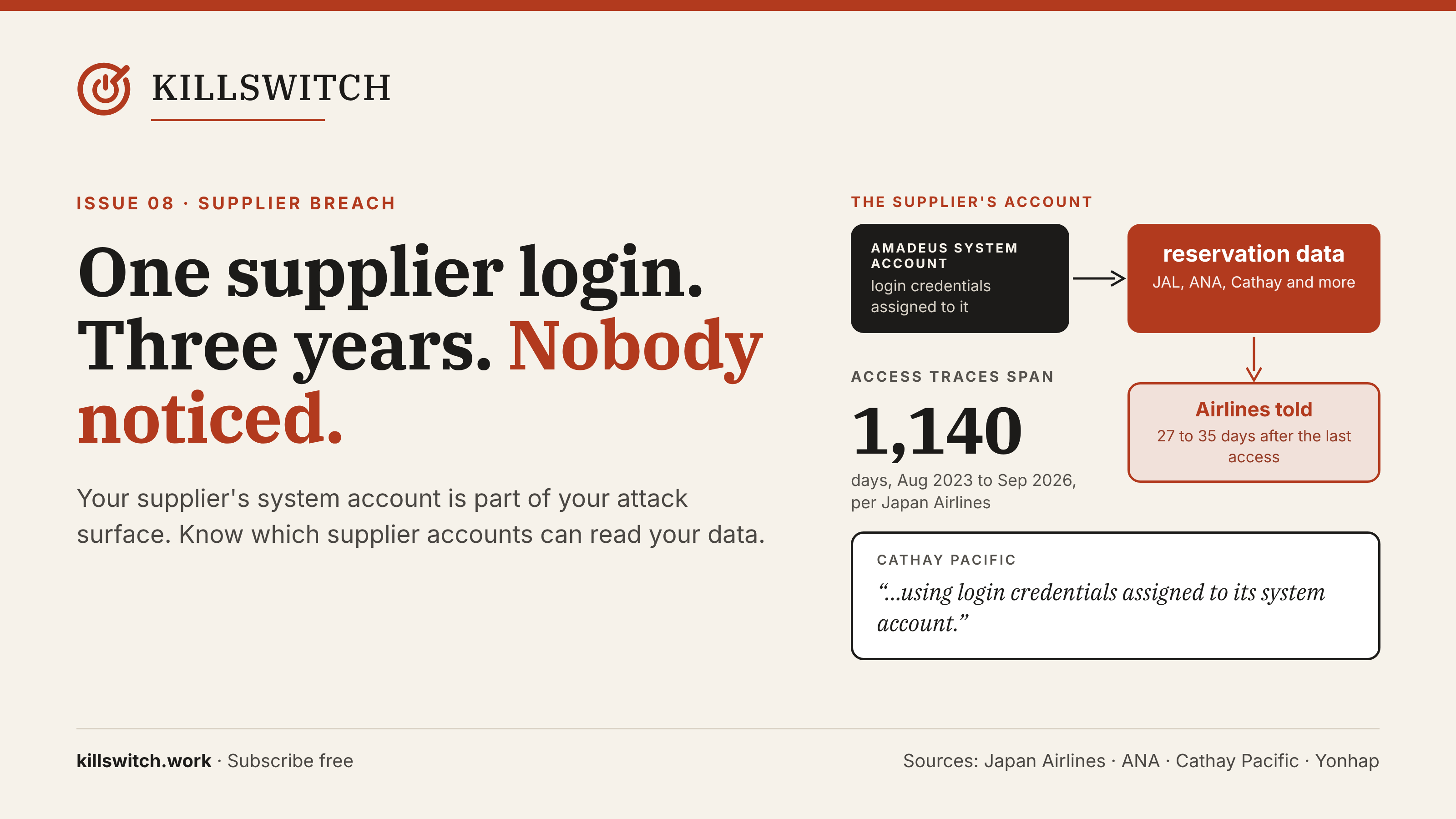
Japan Airlines says traces of outside access to its reservation data in Amadeus's passenger service system run from August 2023 to September 2026. Cathay Pacific and the Korean carriers say the access used login credentials assigned to an Amadeus system account.
Facts as of 2 Nov 2026.
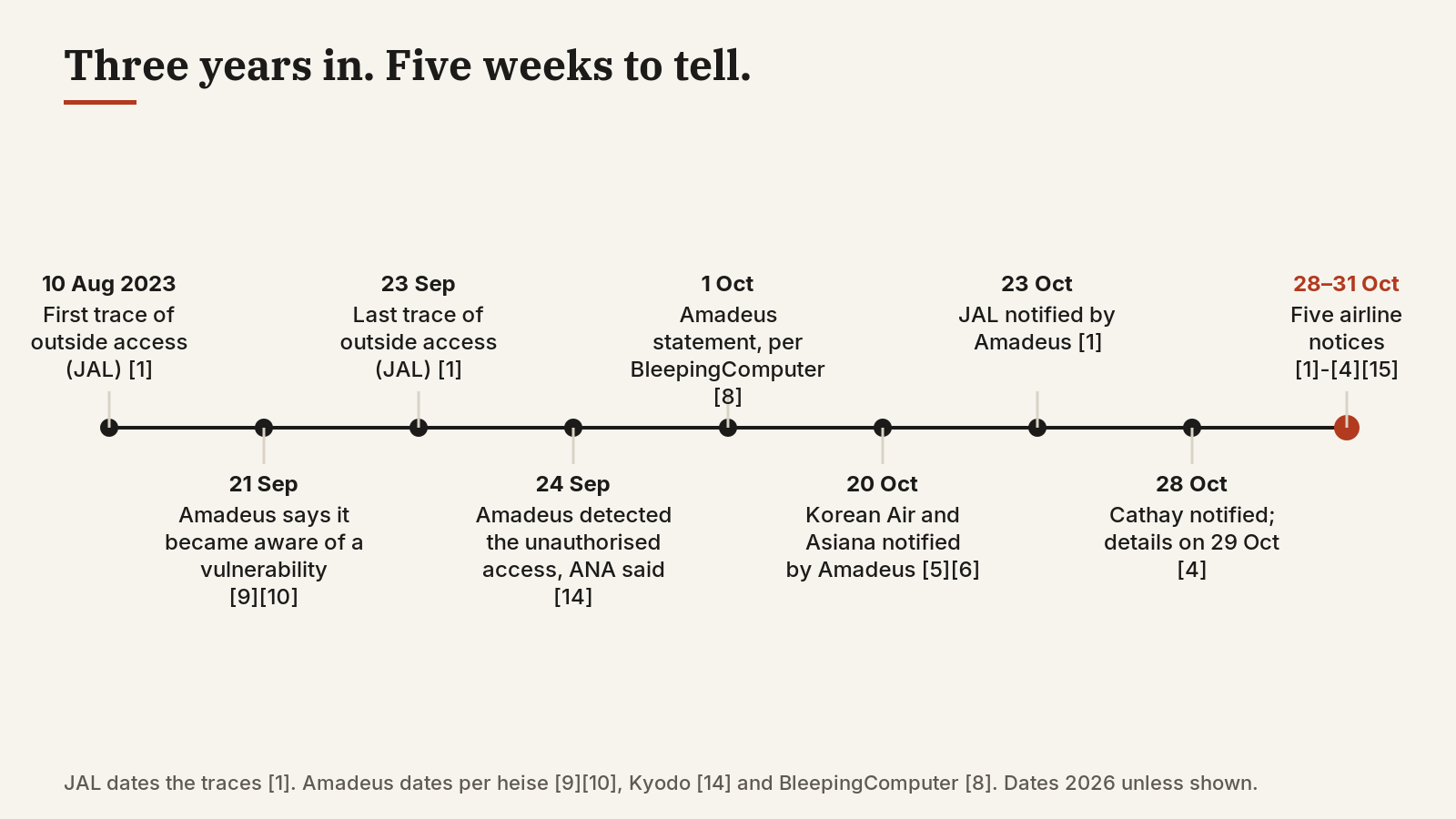
Japan Airlines says the traces of outside access to its reservation data in Amadeus's passenger service system run from 10 August 2023 to 23 September 2026 [1]. That is 1,140 days. JAL was told on 23 October [1]. ANA's affected customers booked in the same window [2].
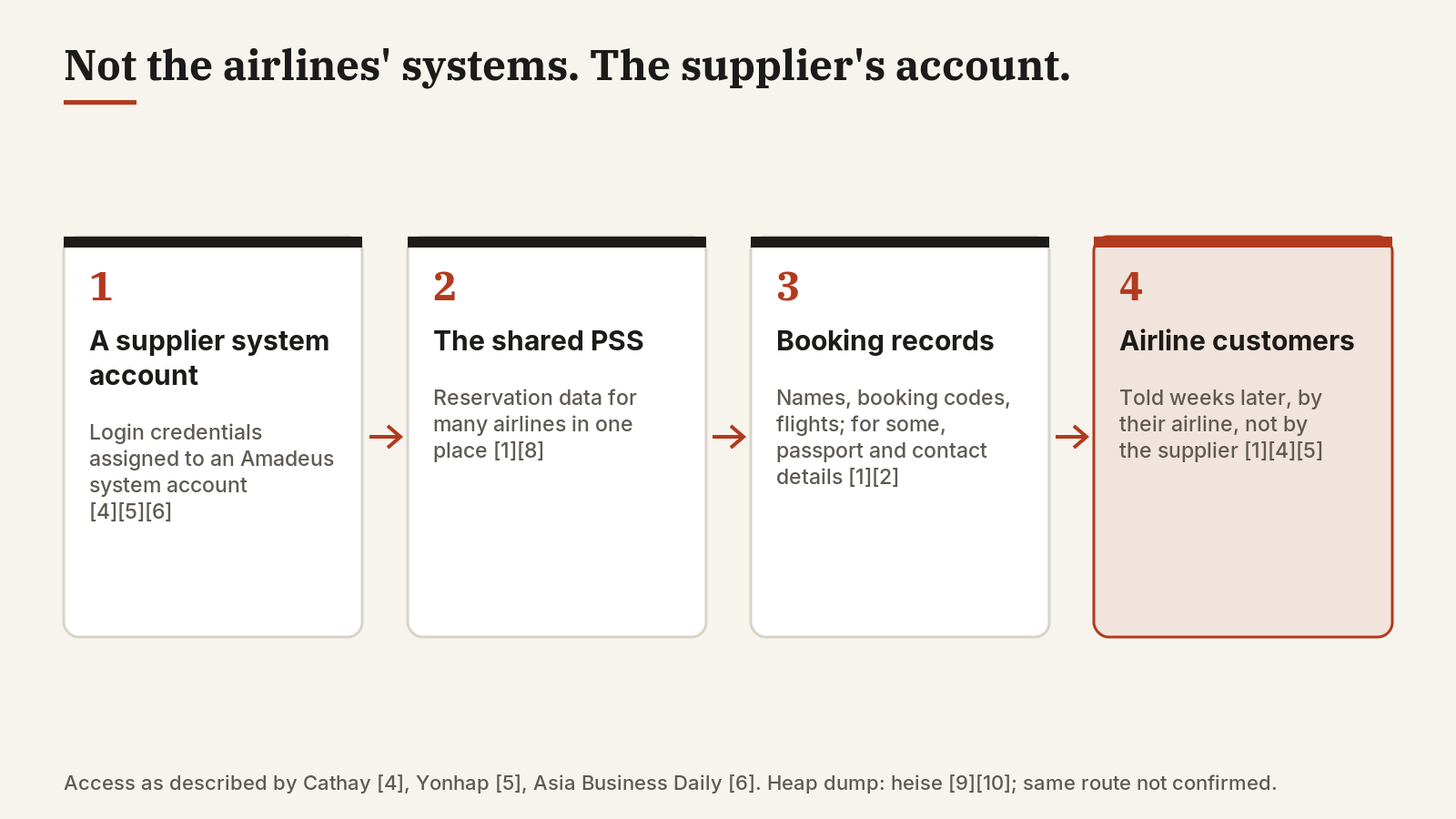
The access did not come through the airlines' own systems. Cathay Pacific says it was "by an unauthorised party using login credentials assigned to its system account", meaning an Amadeus account [4]. Korean Air and Asiana describe it the same way [5][6]. One supplier login, three years, and the airlines heard about it from the supplier weeks after it ended.
What the airlines say
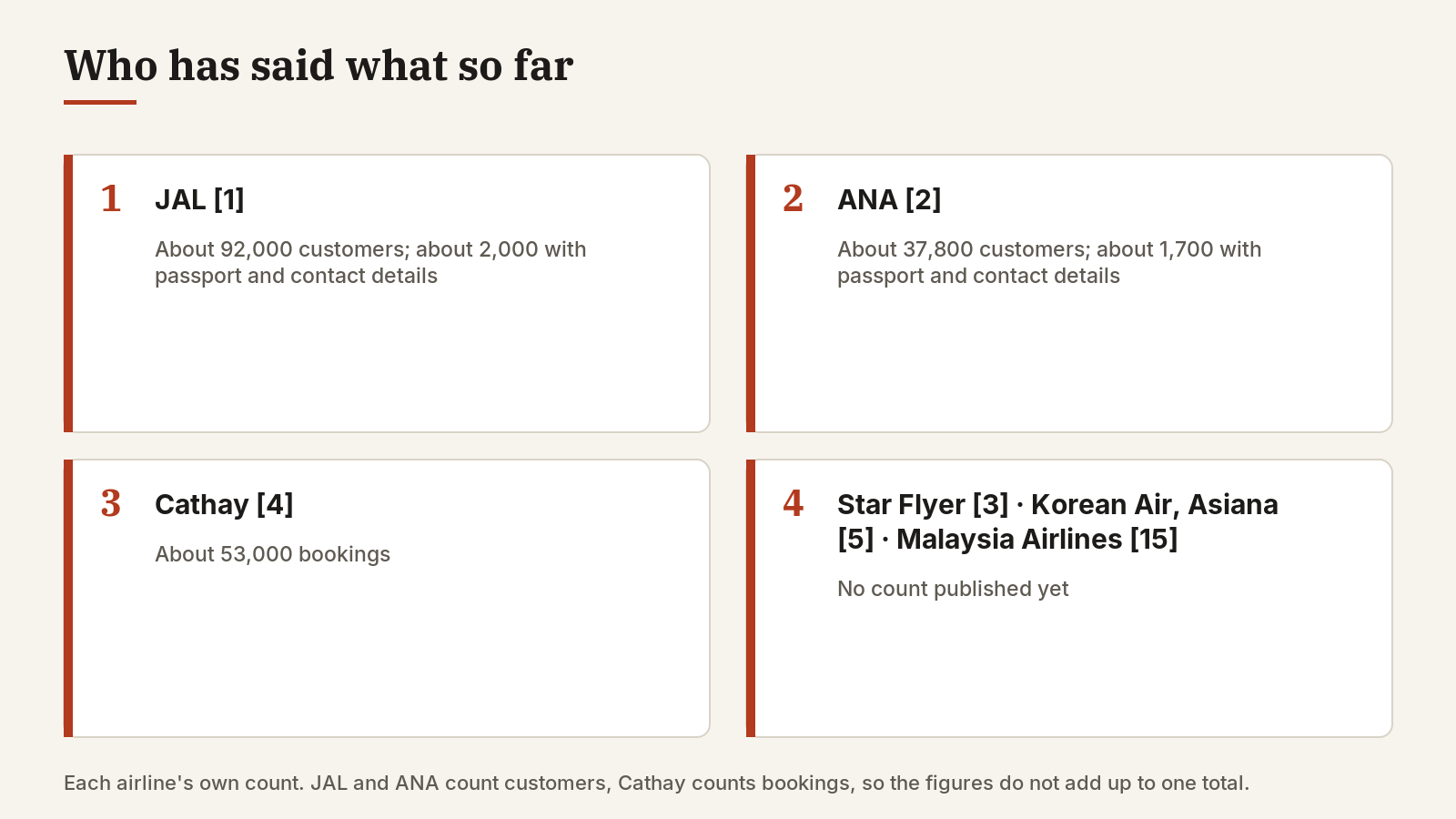
- Japan Airlines and Japan Transocean Air: about 92,000 customers. About 90,000 had their booking code, name, flight date, sector and class accessed. About 2,000 also had email, phone, passport number, nationality and frequent flyer number accessed [1].
- ANA: about 37,800 customers who booked between 10 August 2023 and 23 September 2026. About 1,700 of them also had contact, passport and nationality details accessed. ANA says it was told that "the compromised authentication credentials have already been revoked" [2].
- Star Flyer: customers who booked between 28 July 2025 and 23 September 2026. It is still verifying the number [3].
- Cathay Pacific: about 53,000 bookings, told on 28 October with details on 29 October. Amadeus reset the password and added monitoring, and Cathay has informed the authorities [4].
- Korean Air and Asiana: notified by Amadeus on 20 October. Korean Air's booking references were among the data. Neither has published a count [5][6].
- Malaysia Airlines: in a notice on its website it said customer information processed through Amadeus between August 2023 and September 2026 may have been affected [15].
What the notices say: JAL, ANA and Star Flyer say no credit card numbers or passwords were involved [1][2][3]; Cathay and Malaysia Airlines say there is no evidence financial or payment information was accessed [4][15]. JAL says, and Cathay relays from Amadeus, that there is no evidence so far of misuse [1][4]. Cathay, Korean Air, Asiana and Malaysia Airlines say their own systems were not breached [4][5][6][15].
What Amadeus has said
Amadeus told heise that it was made aware on 21 September of a "potential vulnerability" that "affected a display environment for travel bookings", and that payment or financial data could not be accessed [9].
Germany's federal cyber agency, the BSI, told heise it received the report through its coordinated vulnerability disclosure process and passed it to the vendor [10]. heise reports that a memory dump of an application was reachable without authentication and contained access credentials [9][10]. Amadeus says it has fixed the vulnerability [9].
ANA said Amadeus detected the unauthorised access on 24 September [14]. BleepingComputer reports that Amadeus posted a statement on 1 October [8], and Amadeus told Reuters that "there are no indications that the vulnerability has been exploited for ransomware purposes" [7]. Amadeus has not said how many airlines were affected [7][8]. It serves hundreds of airlines; BleepingComputer puts it at over four hundred [4][8].
The gap
Airline notifications ran between 20 and 28 October [1][4][5]. That is four to five weeks (27 to 35 days) after the last recorded access, and about a month after Amadeus says it was told of the vulnerability [1][9]. For three years before that, nobody, at the supplier or at the airlines, appears to have spotted the access. That is the lesson for everyone else.
Why this matters if you don't run an airline
Your customer data does not only live in your systems. It lives in your suppliers' platforms, and they log in to those platforms with accounts you never see. If one of those accounts is used by someone else, your own monitoring has nothing to watch.
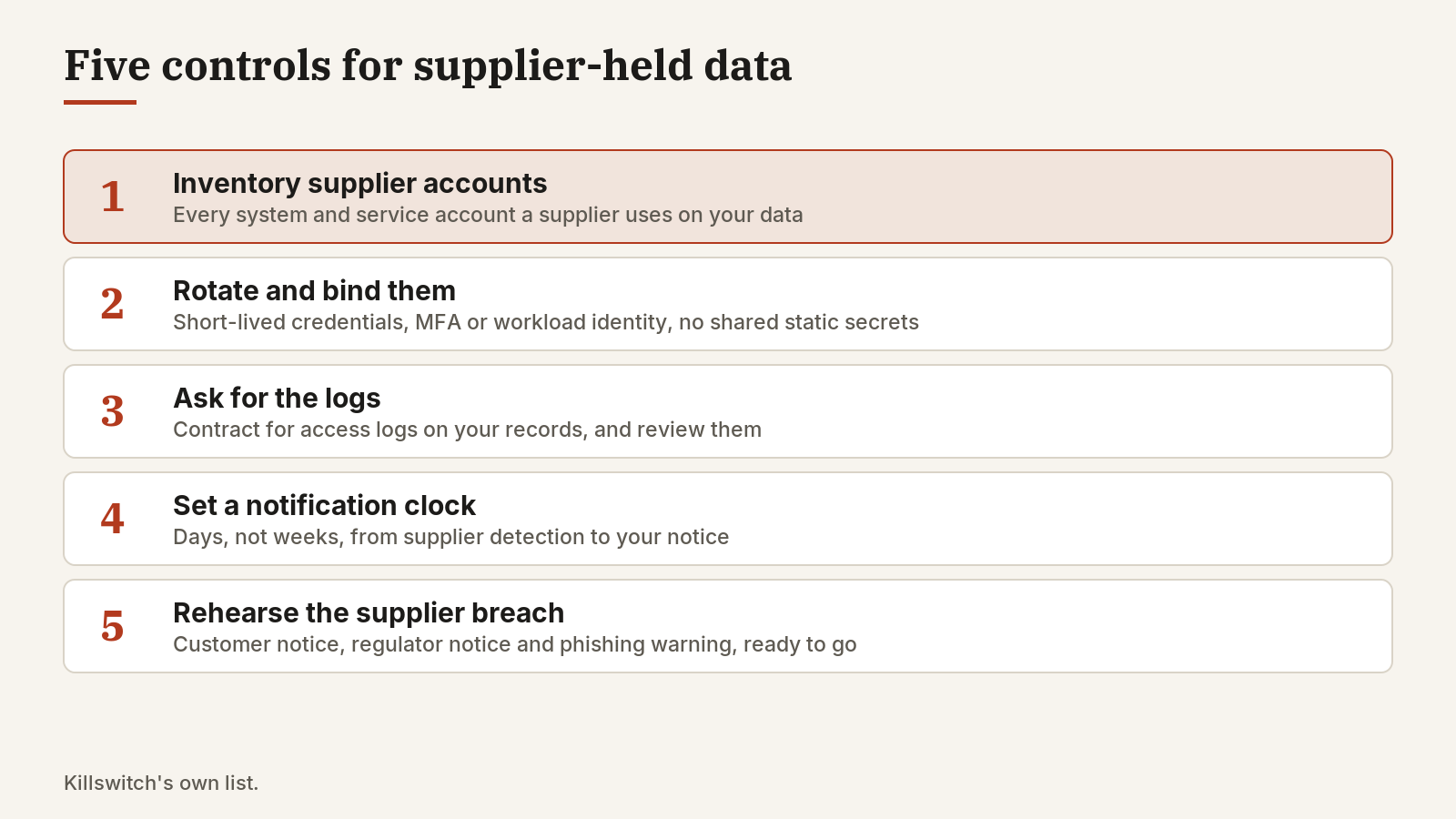
The questions to ask are about the supplier's accounts, not just the supplier's certificate:
- Which supplier accounts can read our data? System and service accounts as well as named users.
- How are those credentials issued and rotated? A static secret that outlives the person who set it up is a three-year problem waiting to happen.
- Who reviews access to our records? If the supplier holds the logs, ask for them, and look.
- How fast will we hear? Put a notification clock in the contract and test it.
Mapping it for GRC
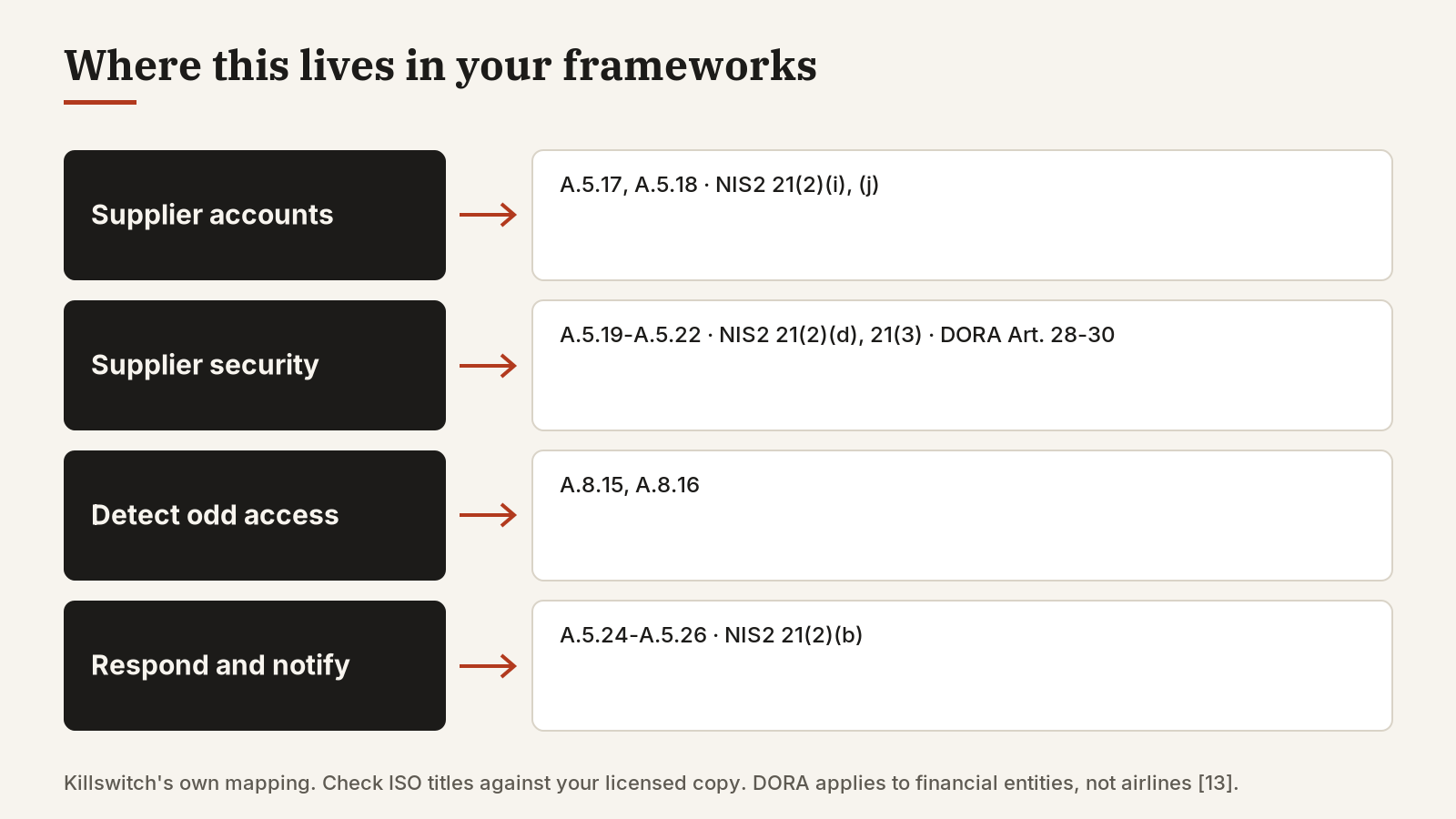
- ISO/IEC 27001:2022 [11]: authentication information (A.5.17) and access rights (A.5.18) for the supplier's accounts; supplier relationships, supplier agreements, the ICT supply chain and monitoring of supplier services (A.5.19 to A.5.22); logging (A.8.15) and monitoring activities (A.8.16) for spotting odd access; incident management (A.5.24 to A.5.26) for the response. This is our mapping; check the control titles against your licensed copy.
- NIS2 [12]: Art. 21(2)(d) supply chain security, (i) access control and asset management, (j) multi-factor authentication, and (b) incident handling. Art. 21(3) requires entities to take into account "the vulnerabilities specific to each direct supplier and service provider". Air carriers are in Annex I, so EU air carriers that meet the size rules are in scope.
- DORA [13]: Art. 28 to 30 set the ICT third-party risk rules, including key contractual provisions. They apply to financial entities, not airlines, but a bank or insurer that relies on a shared SaaS platform faces the same question.
What we don't know yet
- One route or two? heise's heap-dump finding and the airlines' "system account" login may be the same route, or not. Amadeus has not said [4][9].
- How the login was obtained. No one has published it.
- Which airlines. Amadeus has not published a list [7][8].
- What Amadeus itself says. Amadeus's own statement says certain booking-display data "was accessible through the vulnerability", and does not say it was accessed [16]. The page gives no day.
- Final counts. Star Flyer, Korean Air, Asiana and Malaysia Airlines have not published numbers [3][5][15].
Your next-month checklist
- List every supplier that holds your customer data, and every account it uses on that data.
- Ask each one how those credentials are issued, bound and rotated.
- Get access logs for your records into your own monitoring, or a contractual right to them.
- Add a notification clock to supplier contracts, in days.
- Rehearse a supplier-breach notice, including the phishing warning your customers will need.
Download the slides
Use this issue in your next team briefing. The slides are free to download:
Keep going
- Try the live demo: GRCompliance. Keep your supplier register, access reviews and incident controls, owners and evidence in one place, mapped to ISO 27001, NIS2 and DORA.
- Install free from GitHub (self-hosted): GRCompliance Core, the open-source edition. Your data stays on your infrastructure.
- Sectutor books and kits: security and GRC books, training and audit kits.
- Subscribe to Killswitch: sharp issues on security, AI security and GRC.
About the author. Emmanuel Aigbehi Walstra is a CISO who also serves as a virtual CISO (vCISO) for several organisations, with 30+ years in cybersecurity, 10,000+ people trained, and author of the CCSP Excellence books.
Sources
- Japan Airlines: Regarding Unauthorized Access to Amadeus Passenger Service System and Our Response (first published 28 Oct, updated 30 Oct 2026)
- ANA: notice on unauthorized access to the Amadeus passenger service system
- Star Flyer: notice on unauthorized access to the Amadeus system (29 Oct 2026)
- Cathay Pacific: Personal data security
- Yonhap (Korean): Korean Air and Asiana, personal data leaked at reservation system operator (23 Oct 2026)
- Asia Business Daily (Korean): Korean Air and Asiana customer data leaked via contractor (23 Oct 2026)
- Reuters via StreetInsider: Cathay Pacific says Amadeus breach affected 53,000 bookings (30 Oct 2026)
- BleepingComputer: Japan Airlines suffers third-party data breach exposing passenger info
- heise online: Security vulnerability in flight booking system (13 Oct 2026)
- heise online (German): Reisebranche: BSI rät wegen Amadeus-Lücken zu Vorsicht (updated 15 Oct 2026)
- ISO/IEC 27001:2022 Information security management systems
- NIS2 Directive (EU) 2022/2555, Article 21 and Annex I
- DORA, Regulation (EU) 2022/2554, Articles 28 to 30
- The Mainichi (Kyodo): ANA says data on 37,800 customers leaked in hacking (30 Oct 2026)
- Malaysia Airlines: Cybersecurity Incident Involving Third-Party Technology Provider
- Amadeus: Amadeus statement (October 2026)
Facts are from the airlines' own notices, Amadeus's own statement [16] and Amadeus statements quoted by named news reports, and those reports, as published by 2 Nov 2026. Amadeus has not published a root cause or a list of affected airlines. The control list and the framework mapping are Killswitch's own.
Checked against the primary sources cited above. Spotted an error? See our corrections page.