
They Didn't Steal Binance's Keys. They Made Binance Sign.
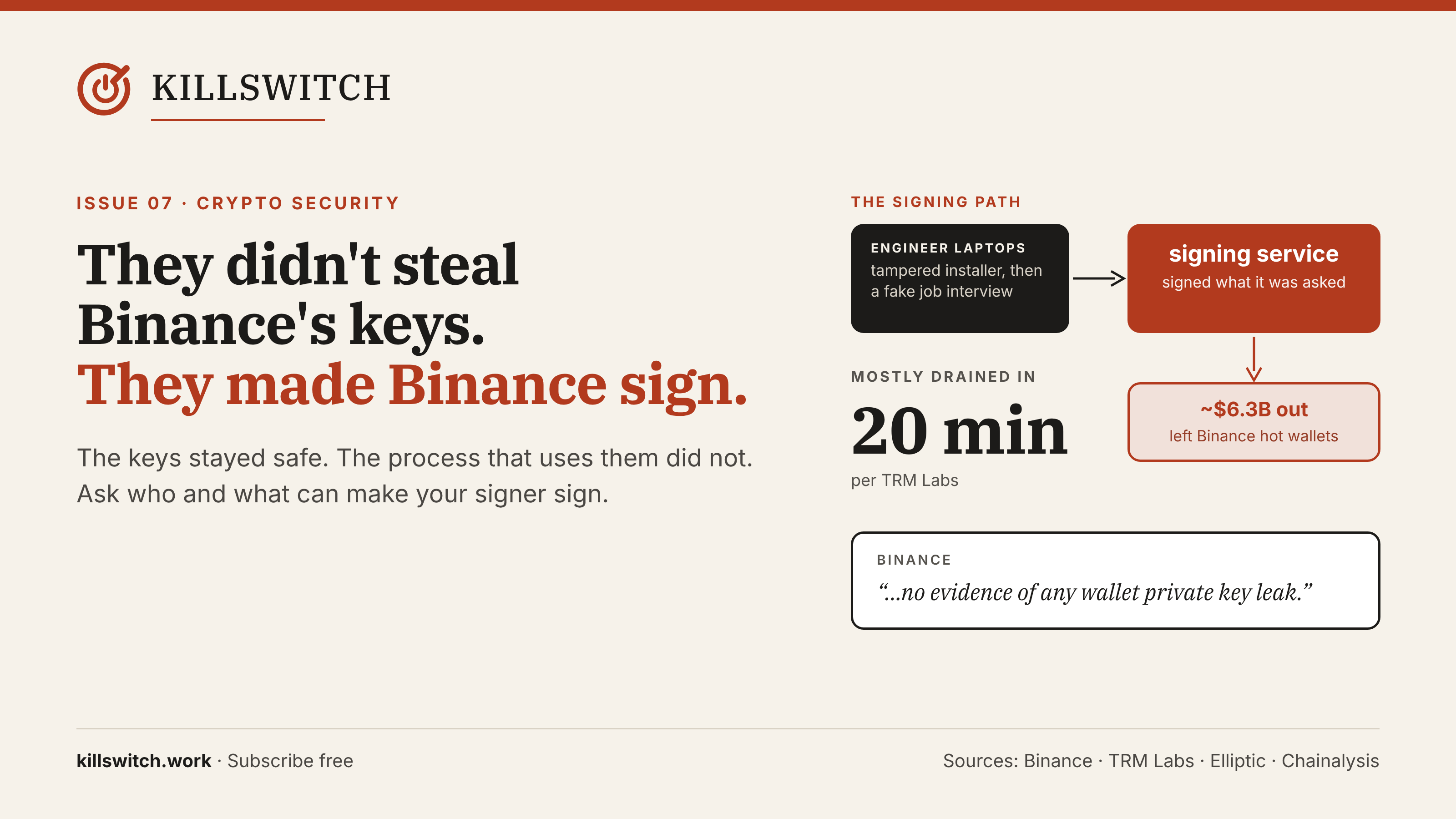
About $6.3 billion left Binance hot wallets on 29 October, most of it in about 20 minutes. Binance says it found no evidence of a private key leak. Analysts read the chain evidence as an attacker who got Binance's own signing machinery to sign.
Facts as of 4 Nov 2026.
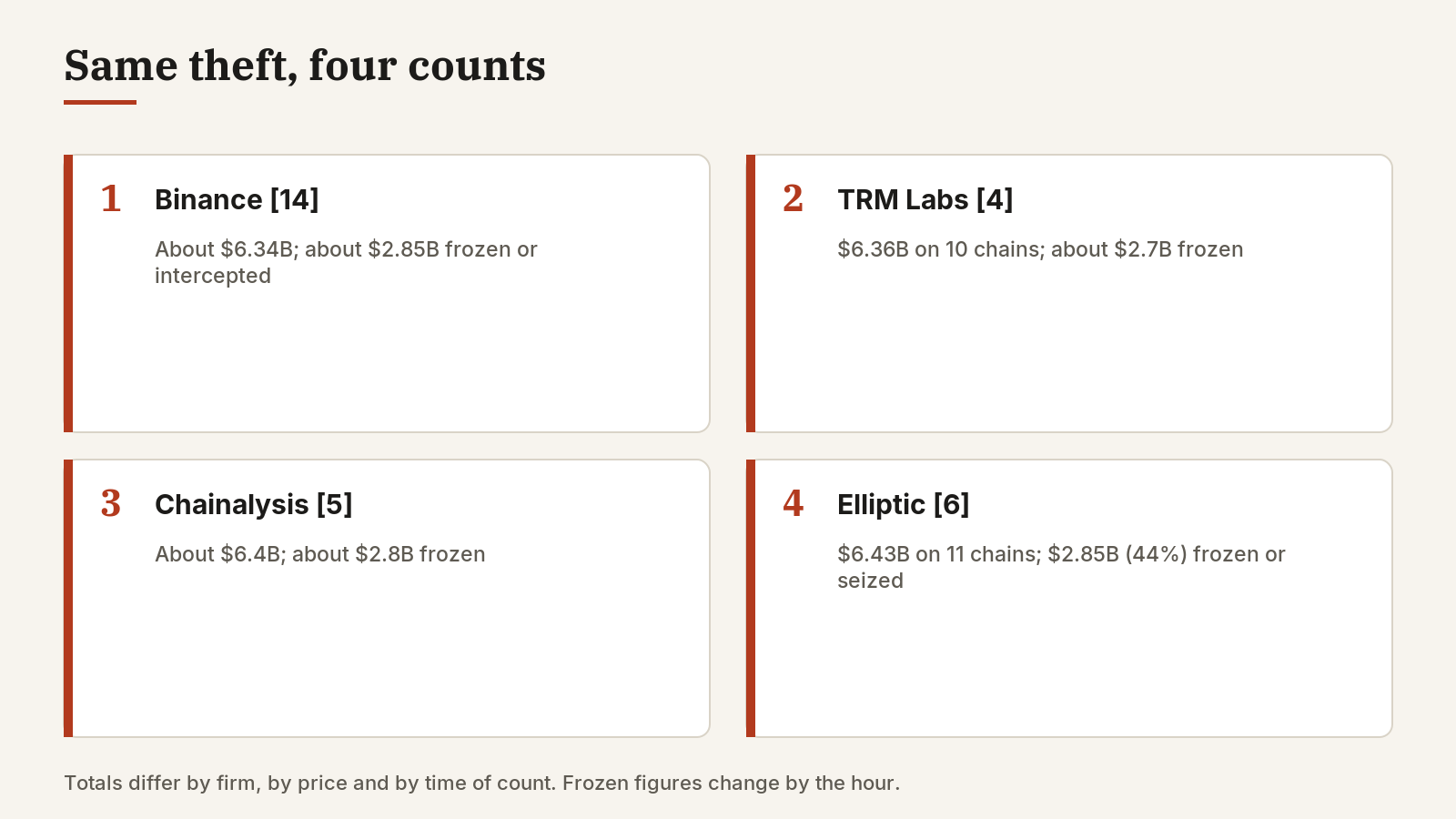
On 29 October, about $6.3 billion in crypto left Binance hot wallets, by Binance's own estimate [1]. Analysts put it slightly higher: $6.36 billion (TRM Labs), about $6.4 billion (Chainalysis) and $6.43 billion (Elliptic) [4][5][6]. TRM says most of it left in about 20 minutes, and that this is about four times the $1.5 billion Bybit theft of February 2025, the previous record [4].
Binance says it found "no evidence of any wallet private key leak" [1]. That is the point of this issue. The keys stayed where they were. On the analysts' reading, the attacker reached the machinery that asks for signatures, and the machinery signed [4][6]. Binance's own initial report, on 3 November, now says much the same [14].
What Binance says happened
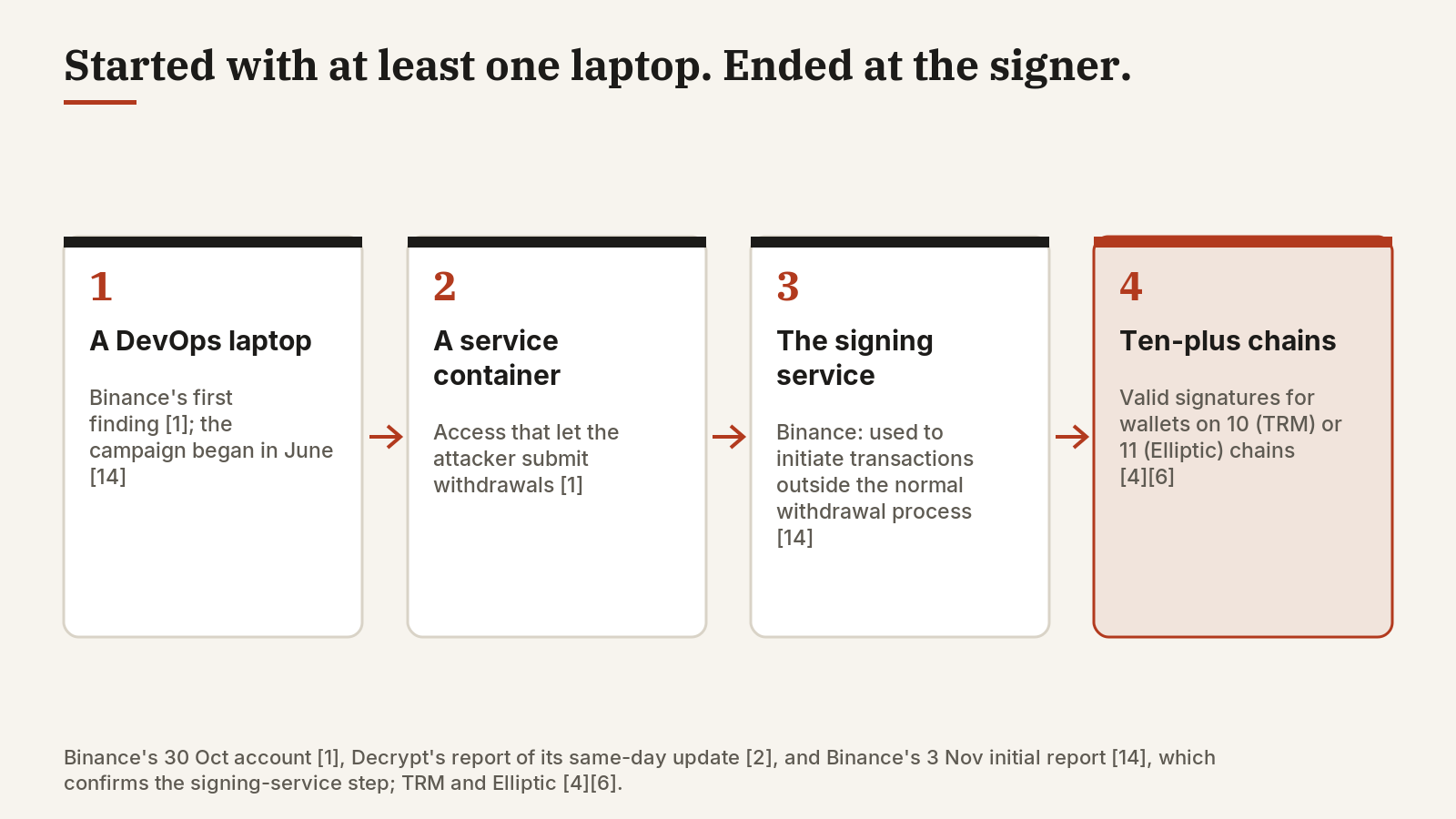
Binance's first account, on 30 October, said the incident "may involve a compromised DevOps engineer's laptop, which allowed an attacker to gain access to a service container and submit unauthorized withdrawal transactions" [1]. Binance suspended withdrawals, "revoked the affected address authorisation" and said it would cover all losses from its SAFU fund and company funds [1].
A later update the same day changed the picture. Binance said its investigation "has uncovered additional points of breach" and called it "a complex attack" [2]. Co-CEO Richard Teng said the attacker "did not simply use one engineer's permissions, and this was not a single 'one-click' action" [2]. In a video update he added that the attack "was not carried out by one person" and that the EIP-7702 delegation "did not pass through our normal approval controls" [3][6].
So the laptop is where the investigation started, not where the attack started. Binance's initial report on 3 November describes "a sophisticated, multi-stage campaign" [14]. In June, a Wallet DevOps engineer downloaded a tampered Homebrew installation while trying to install an AI coding tool. Binance replaced the device and rotated credentials, but the engineer's role and colleagues on the wallet infrastructure team were exposed to the attacker.
In September, someone posing as a Project Director arranged fake job interviews with a second engineer, who was told to download an "assignment" containing malicious code onto his work computer. On 20 October the attacker used an internal AI tool to gain control over two wallet engineers, and on 29 October used stolen credentials to deploy a container and launch the attack [14].
From there, Binance says, the attacker "exploited unauthorized access to an internal wallet signing service to initiate transactions outside the normal withdrawal process" [14]. Binance calls this an initial report: the investigation is ongoing and independent security firms will review it [14].
What the chain shows
TRM and Elliptic read the on-chain record in the same way [4][6].
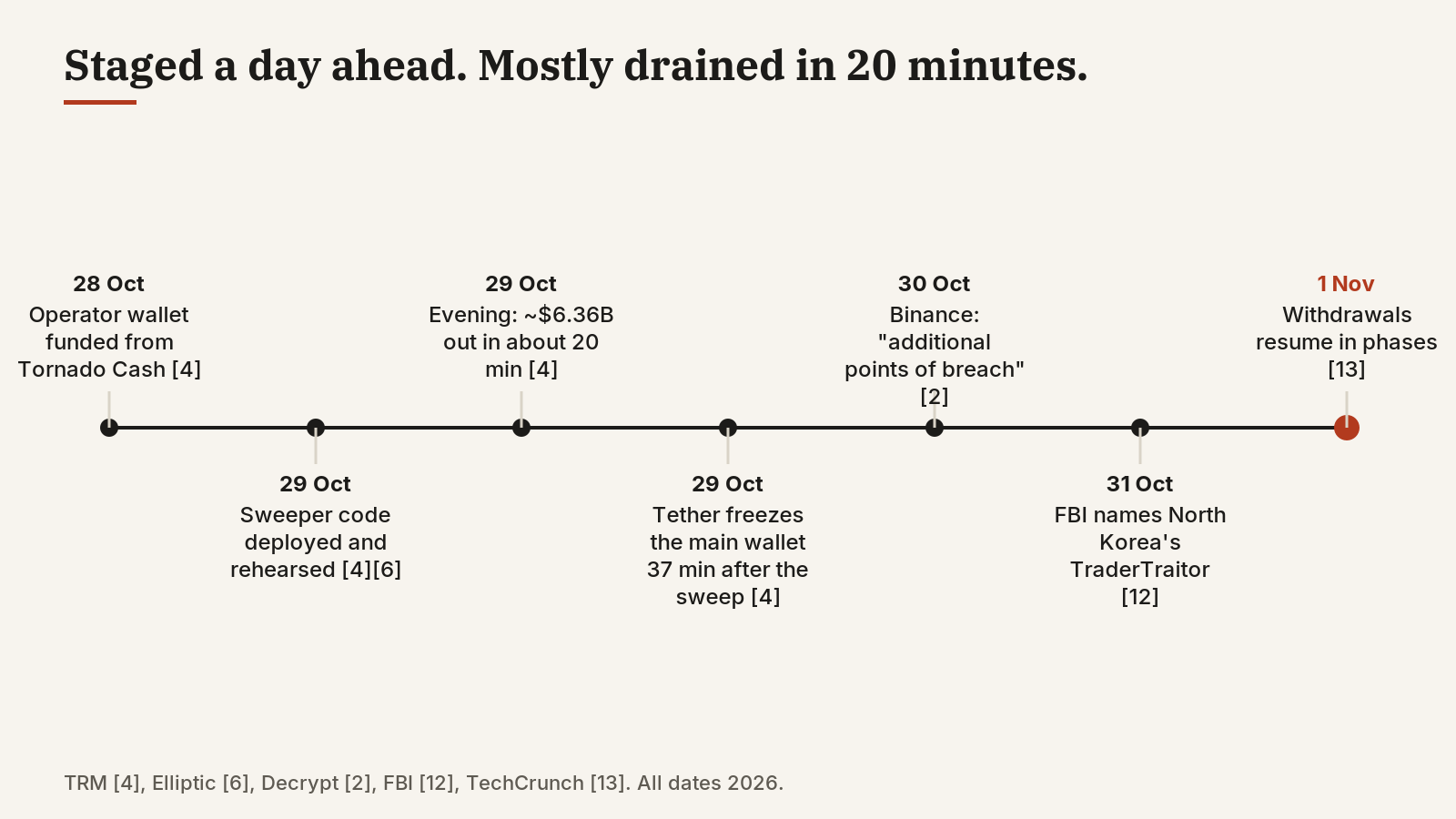
- Staged a day ahead. The attacker's operator wallet received three small withdrawals from the Tornado Cash mixer starting on 28 October. On 29 October the attacker deployed and rehearsed the "sweeper" code, about four hours before using it on Binance [4][6].
- XRP went first. Five Binance wallets on the XRP Ledger sent 233.46 million XRP to one attacker address [4]. Bitcoin, Tron, Solana and other chains followed within minutes, including 18,270 BTC [4][6].
- Ethereum was taken over, not just drained. The attacker submitted one transaction carrying 50 authorisations, each validly signed by a Binance hot wallet and each covering a different nonce, so that one would match when it landed [4][6]. That EIP-7702 delegation handed the wallet to the attacker's sweeper, which emptied it a few minutes later. Elliptic puts that single transaction at $2.53 billion [6]. The delegation stayed in place, so later deposits were swept again, and the wallet's rights over another Binance account let the attacker pull 823 million USDC [4].
- The other chains signed normally. Wallets on the other chains, with different key types and signing schemes, sent funds "through ordinary signed transfers" [4]. A second wave reached Avalanche and Polygon about two and a half hours later [4].
TRM's assessment: "the most likely explanation is that the attacker gained the ability to make Binance's hot wallet signing system sign transactions of its choosing across chains." The batch of 50 pre-signed authorisations "suggests the access may have been limited in time, or that signatures had to be requested through a system" [4].
Elliptic draws the same conclusion and compares it with Bybit, where "it was the infrastructure and people around the wallets that were compromised, not the cryptography" [6]. Binance's 3 November report now confirms the signing-service step: it says the attacker "used the signing service to exploit Ethereum's EIP-7702 authorization mechanism" [14].
The freeze race
Stablecoin issuers moved fast. TRM reports that Tether froze the main receiving wallet 37 minutes after the main sweep, and Circle froze the 823 million USDC shortly afterwards [4]. Binance said it had about $3 billion frozen on-chain [1].
Elliptic has verified $2.85 billion frozen or seized, 44% of the theft, almost all of it USDT and USDC [6]. Elliptic says the attacker now controls about $3.25 billion that no issuer can freeze, mostly ETH and BTC [6]. In its 3 November report Binance put the impact at about $6.34 billion and the amount frozen or intercepted at about $2.85 billion [14].
Who did it
On 31 October the FBI said North Korea was "responsible for the theft of more than $6 billion USD in virtual assets" from Binance and named the activity "TraderTraitor" [12].
TRM had already attributed it to TraderTraitor "with high confidence", and Chainalysis linked it through stolen funds that commingled with those from September's Bitget theft [4][5]. Earlier, the FBI had said only that it was "aware of the incident" [3][7], and Reuters reported that the FBI and the US Secret Service were working with Binance [7].
Binance says its investigation has not blamed any individual employee [2].
Why this matters if you don't run an exchange
Most organisations protect keys well: hardware modules, vaults, split custody. This attack, on the analysts' reading, didn't need the keys. It needed a path to the system that uses them. The same pattern applies to anything that signs or approves on your behalf: payment release, code signing, certificate issuance, cloud admin consoles.
The question to ask is not "can someone steal our keys?" It is "who and what can ask our signer to sign, and what does the signer check before it does?"
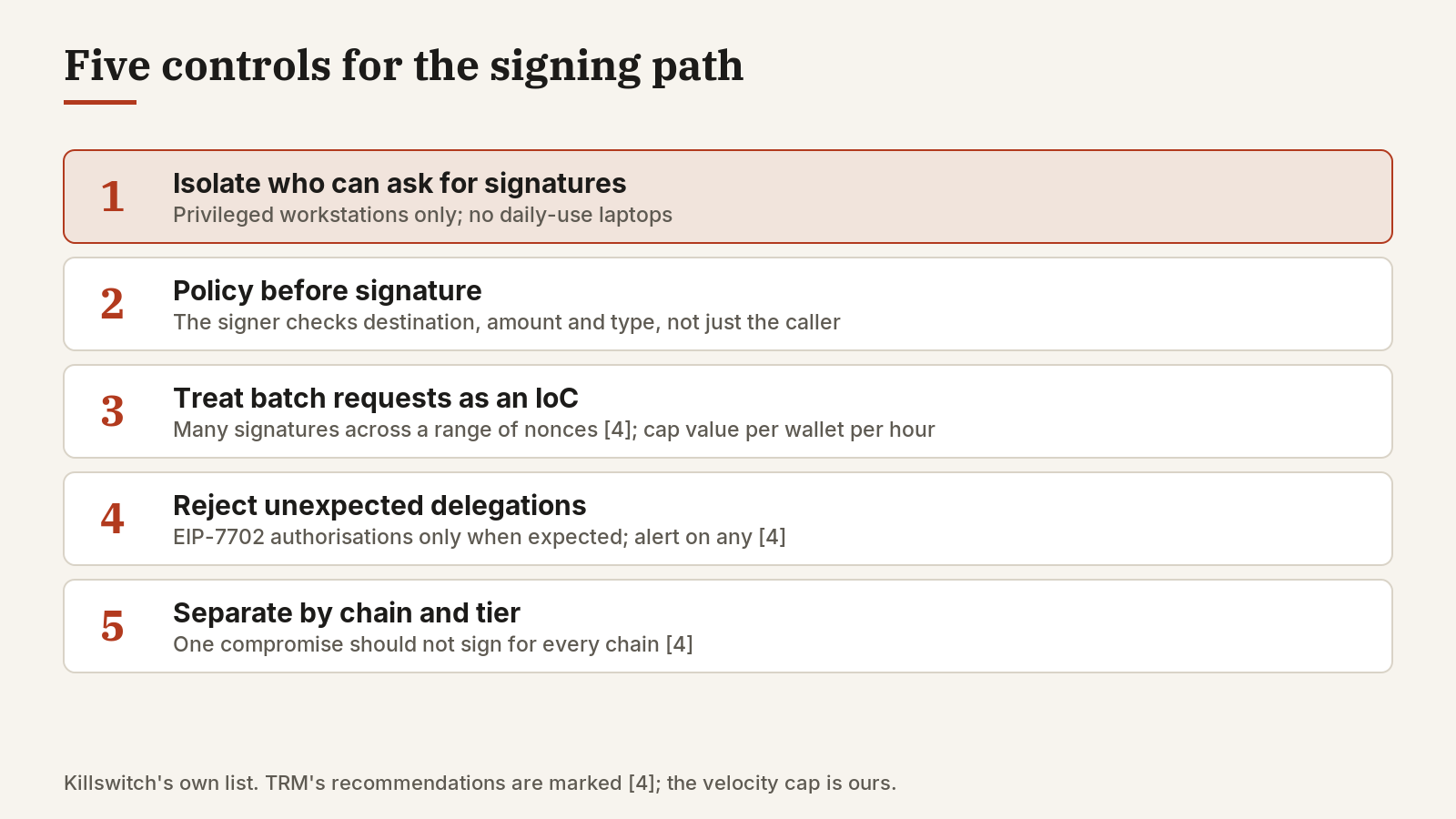
- Isolate who can ask for signatures. Requests to a signing system should come only from dedicated privileged workstations or service identities, never from a laptop that also reads email.
- Put policy before the signature. The signer, or a policy engine in front of it, should check destination, amount and transaction type, not just whether the caller is authenticated.
- Treat batch requests as a red flag. Treat a batch request for many signatures across a range of nonces as an indicator of compromise, as TRM recommends [4]. The velocity cap is Killswitch's own advice: cap the value any one wallet can move per hour, and require a second approver above it.
- Reject unexpected delegations. TRM recommends that signing policies reject EIP-7702 authorisations unless they are expected, that any delegation on a treasury wallet raises an immediate alert, and that teams keep a tested, pre-approved way to sign a revocation [4].
- Separate by chain and wallet tier. "In this incident, a single actor obtained valid signatures for wallets on ten chains within hours" [4]. One compromised path should not be able to sign for everything.
Mapping it for GRC
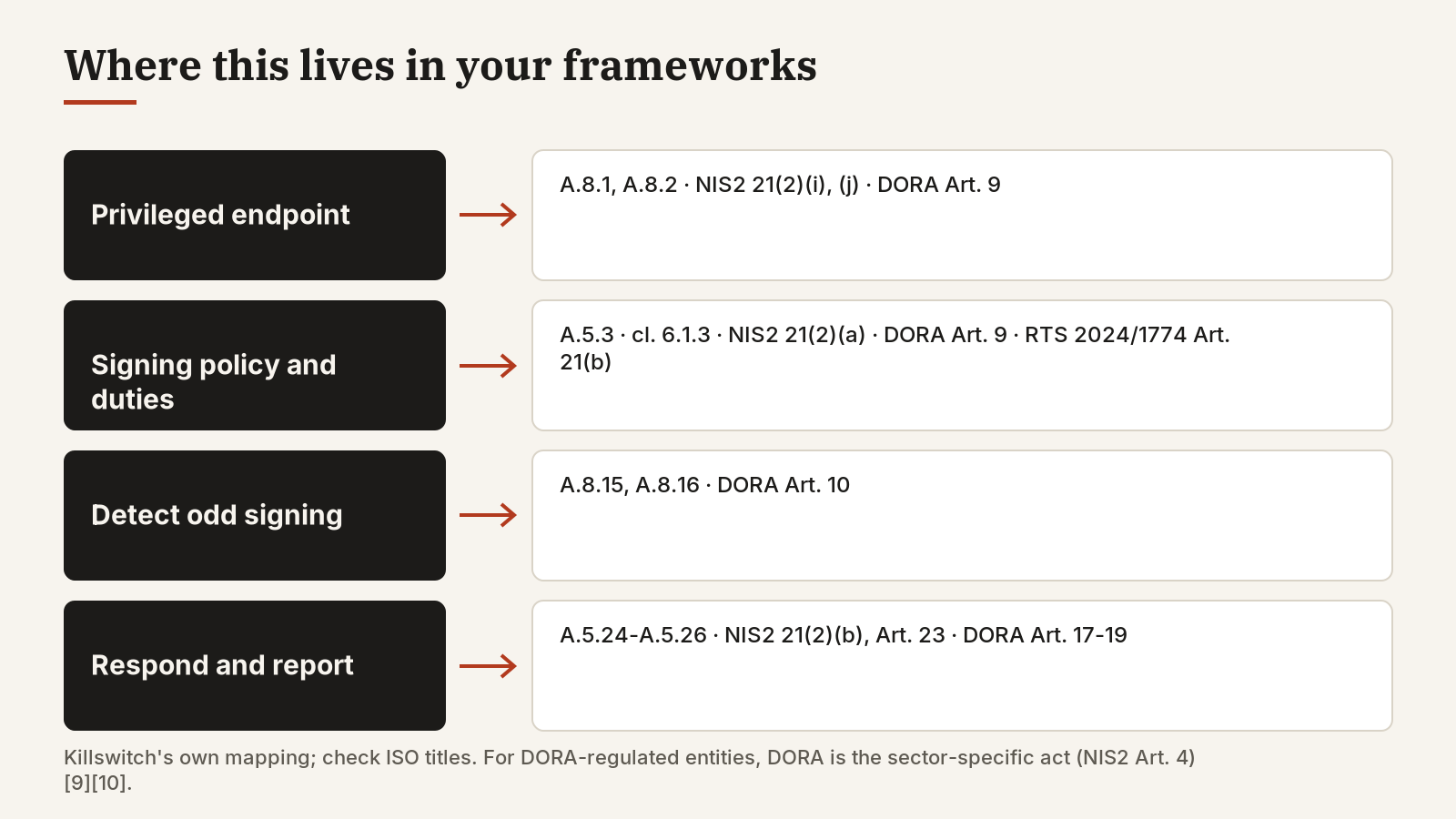
- ISO/IEC 27001:2022 [8]: user endpoint devices (A.8.1) and privileged access rights (A.8.2) for the workstation; segregation of duties (A.5.3) and risk treatment (clause 6.1.3) for the signing policy; logging (A.8.15) and monitoring activities (A.8.16) for detecting odd signing patterns; incident management (A.5.24 to A.5.26) for the response. This is our mapping; check the control titles against your licensed copy.
- NIS2 [9]: Art. 21(2)(a) risk analysis and security policies, (b) incident handling, (i) access control and asset management, and (j) multi-factor authentication; Art. 23 for reporting. Whether NIS2 applies to you depends on your sector and size. For DORA-regulated financial entities, DORA applies as the sector-specific act (NIS2 Art. 4).
- DORA [10]: crypto-asset service providers authorised under MiCA are in scope (Art. 2(1)(f)). Protection and prevention (Art. 9), detection (Art. 10), and incident management, classification and reporting (Art. 17 to 19). The segregation-of-duties requirement sits in the ICT risk-management RTS, Art. 21(b) [11].
What we don't know yet
- The full findings. Binance's 3 November report is an initial one. The investigation is ongoing and independent firms will review it [14].
- What stays confidential. Binance says some technical details will remain confidential "to prevent malicious actors from using them to plan attacks" [14].
- Chain count. TRM counts 10 chains, Elliptic 11 [4][6].
- Final totals. Stolen and frozen figures differ by firm and are still moving.
Your next-month checklist
- List every system that signs or approves on your behalf, and who or what can send it a request.
- Confirm that those requests come only from privileged workstations or service identities.
- Check what the signer verifies before it signs, beyond authentication.
- Add an alert for batch or out-of-pattern signing requests, and a per-wallet or per-account value cap.
- Rehearse revoking a delegation or authorisation, and keep the record as evidence.
Download the slides
Use this issue in your next team briefing. The slides are free to download:
Keep going
- Try the live demo: GRCompliance. Keep your privileged-access, signing and incident controls, owners and evidence in one place, mapped to ISO 27001, NIS2 and DORA.
- Install free from GitHub (self-hosted): GRCompliance Core, the open-source edition. Your data stays on your infrastructure.
- Sectutor books and kits: security and GRC books, training and audit kits.
- Subscribe to Killswitch: sharp issues on security, AI security and GRC.
About the author. Emmanuel Aigbehi Walstra is a CISO who also serves as a virtual CISO (vCISO) for several organisations, with 30+ years in cybersecurity, 10,000+ people trained, and author of the CCSP Excellence books.
Sources
- Binance: Security Incident Update (30 Oct 2026)
- Decrypt: Binance Finds "Additional Points of Breach" in $6.3B Hack
- BBC News live: Binance hack
- TRM Labs: North Korea Steals USD 6.36 Billion From Binance in the Largest Hack in History
- Chainalysis: Binance Hack: Tracing the $6.4 Billion Theft to North Korea
- Elliptic: The largest theft in history: North Korea behind the $6.4 billion Binance hack (final update 1 Nov 2026)
- Reuters via Yahoo News: FBI and US Secret Service working with Binance after $6.3 billion hack, source says
- ISO/IEC 27001:2022 Information security management systems
- NIS2 Directive (EU) 2022/2555, Articles 4, 21 and 23
- DORA, Regulation (EU) 2022/2554, Articles 2, 9, 10 and 17 to 19
- Commission Delegated Regulation (EU) 2024/1774 (ICT risk-management RTS), Article 21
- FBI Cyber Alert: North Korea Responsible for $6 Billion+ Binance Attack (31 Oct 2026)
- TechCrunch: Binance resumes withdrawals following $6.3 billion breach (1 Nov 2026)
- Binance: 29 October Binance Security Incident: Initial Findings and Response Update (3 Nov 2026)
Facts are from Binance, the FBI, TRM Labs, Chainalysis, Elliptic and named news reports, as published by 4 Nov 2026. On-chain figures are the analysts' and differ by firm and by time. Binance's 3 Nov report is an initial one and its investigation is ongoing. The velocity cap, the control list and the framework mapping are Killswitch's own.
Checked against the primary sources cited above. Spotted an error? See our corrections page.