
Localhost Was the Password: The GPUStack Flaw That Turned "127.0.0.1" Into Admin
GPUStack, an open-source manager for AI model servers, made any request that looked local the administrator. Behind a reverse proxy, every request looks local. It has been exploited, CISA requires US federal agencies to check for compromise, and the fix shipped months ago.
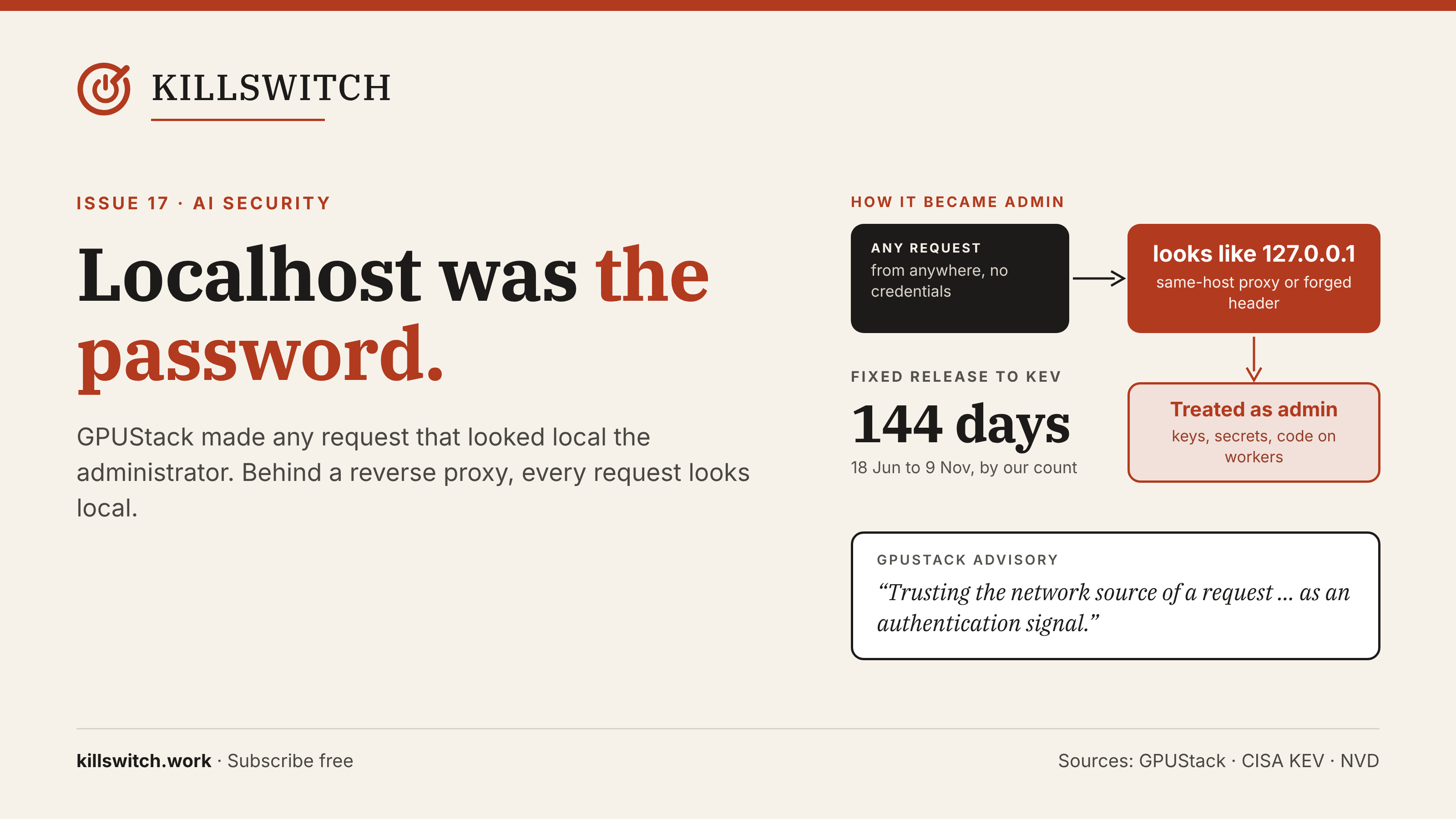
Facts as of 11 Nov 2026.
For most software, "the request came from this machine" sounds like a safe thing to trust. In GPUStack it was the whole login. Before version 2.2.0, GPUStack treated any request whose source looked like loopback (127.0.0.1, the machine talking to itself) as the built-in administrator, as long as a setting called force_auth_localhost was left at its default of false [1].
The problem is how often a remote request looks local. GPUStack's own advisory puts it plainly: in "the canonical self-hosted shape", GPUStack sits behind a reverse proxy on the same host, and "every remote request arrives at GPUStack with TCP peer 127.0.0.1" [1]. In some gateway set-ups, a client could also send a forged X-GPUStack-Real-IP header with a loopback value [1]. Either way, the result was "full, unauthenticated administrative access over the network" [1].
GPUStack says this "has been observed exploited in the wild against a v2.1.1 deployment", with "attacker-created custom backends running reverse shells" [1]. On 9 November, CISA added it to its Known Exploited Vulnerabilities (KEV) catalog as CVE-2026-102895, and flagged it for forensic triage [2][3].
At a glance
- What it is. GPUStack is an open-source GPU cluster manager for serving AI models [4]. The flaw is an authentication bypass in versions before 2.2.0 [1][4].
- How bad. The advisory rates it Critical, CVSS 3.1 score 9.8: network, low complexity, no privileges, no user interaction [1][4].
- What an attacker gets. Users, models, workers and configuration; persistent admin API keys with full scope; worker credentials and cloud or provider secrets; and code execution on worker hosts through admin-only features [1][3].
- Exploited. Yes, per GPUStack, against a 2.1.1 deployment [1]. CISA lists it as known exploited, with forensic triage required and a US federal deadline of 12 November [3].
- Fixed. First in 2.2.0, released 18 June [1][6]. Upgrade to the latest release (2.3.0 at the time of writing): 2.2.0 and 2.2.1 have a separate cluster-takeover flaw, fixed in 2.2.2 [12].
Timeline
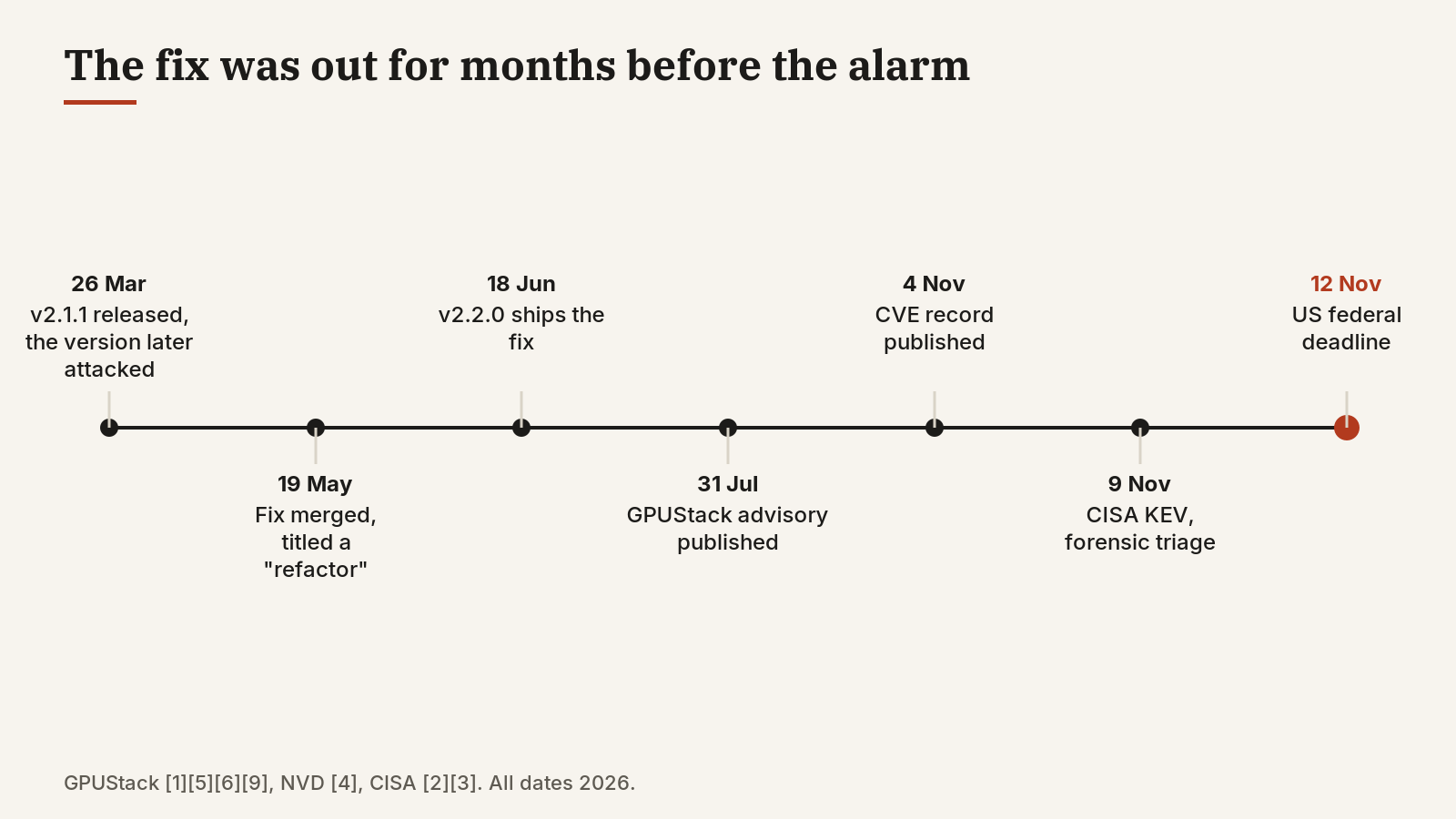
The fix was not new. It was merged on 19 May in a pull request titled "refactor: remove localhost auto-admin bypass" [5], and shipped in 2.2.0 on 18 June [6]. The advisory followed on 31 July [1]. The CVE record appeared in the NVD on 4 November [4], and CISA's KEV listing on 9 November [3]. That is 144 days from the fixed release to the KEV listing, by our count.
How it works
We describe the design flaw, not how to use it. GPUStack decided who you were partly from where the request seemed to come from [1]. The advisory names the root cause: "Trusting the network source of a request (socket peer, or a client-controllable header) as an authentication signal" [1].
Two common set-ups break that assumption [1]:
- A reverse proxy on the same machine. The proxy forwards every outside request from 127.0.0.1, so to GPUStack everyone looks local. No header or credential is needed [1].
- A header the client controls. In some gateway set-ups, a request can claim a loopback address in the
X-GPUStack-Real-IPheader [1].
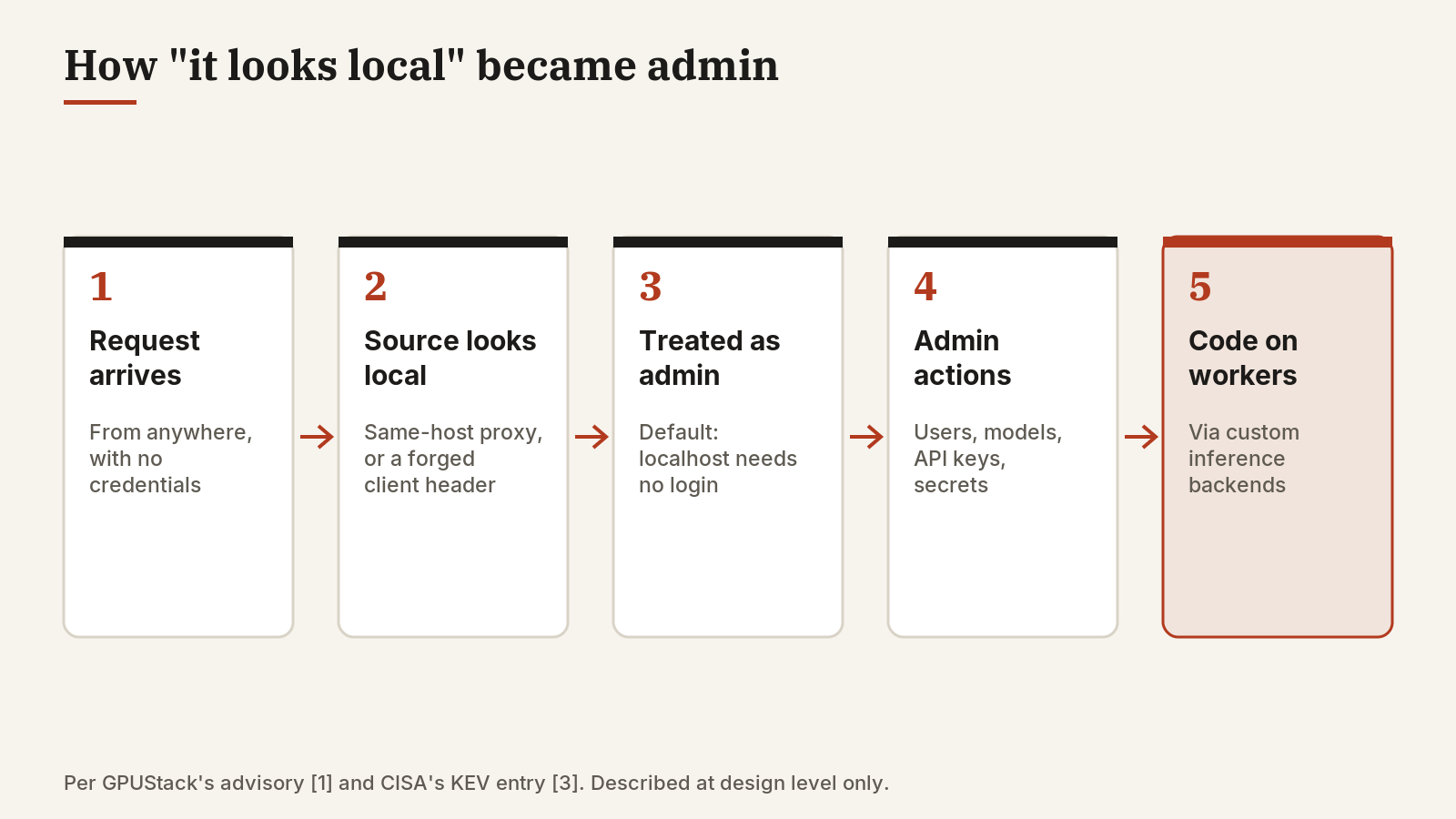
Once treated as admin, an attacker can mint API keys that stay valid "from any source IP thereafter" [1], and, combined with admin-only features such as creating inference backends from YAML, run code on the worker machines [1][3]. In our reading, that means the attacker does not need the bypass to stay open: a key they created is a new way in, and upgrading alone does not revoke it.
Am I affected?
You are in scope if you run GPUStack below 2.2.0 [1]. Your exposure is highest if:
- it sits behind a reverse proxy on the same host, which is the set-up the advisory calls canonical [1];
- the API or web UI is reachable from the internet or from any network you don't fully trust [1];
force_auth_localhostwas never set to true [1].
The release notes for 2.2.0 list model catalogue updates, features and bug fixes. We could not find the authentication fix mentioned in them [6]. The pull request that removed the bypass was titled a refactor, although the commit itself says "fix" [5]. Later releases, such as 2.2.2, have a security section [12]; 2.2.0 did not [6]. If your team reads release notes to decide when to upgrade, this one would have been easy to defer.
What to look for
CISA's KEV entry requires forensic triage for this CVE [3]. Its BOD 26-04 guidance lays out six steps (scoping, preserving and collecting evidence, patching and stabilising, containing, triage analysis, and an escalation decision), with a written triage report at the end [8]. BOD 26-04 binds only US federal civilian agencies, but CISA encourages all organisations to adopt risk-based vulnerability management and prioritise KEV vulnerabilities [2]. The triage steps are a useful model for anyone [8]. The useful questions come straight from what the advisory says an attacker can do [1][3]:
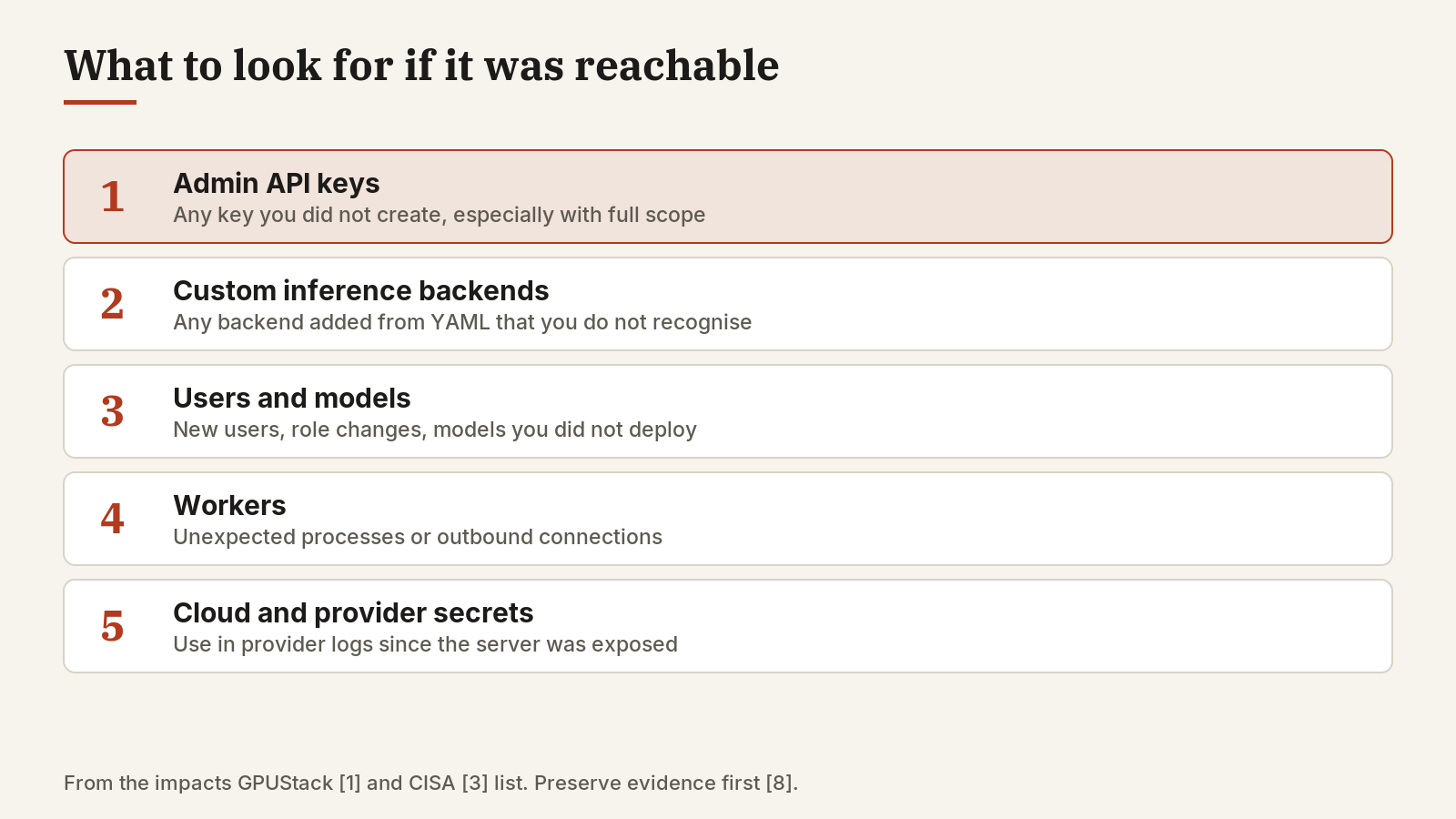
Preserve evidence (logs, the database, the list of keys and backends) before you clean up [8]. If you find an admin key or a custom backend nobody can explain, treat the server and its workers as compromised and escalate.
What to do now
GPUStack's fix and workarounds are short [1]:
- Preserve evidence first. If the server was reachable, snapshot memory if you can, then the logs, the database and the lists of API keys and backends, before you upgrade, as CISA's triage steps put evidence before patching [8].
- Upgrade to the latest release (2.3.0 at the time of writing). 2.2.0 is the first release with this fix, which removed the loopback auto-admin path and hardened client-IP and forwarding-header handling [1]. But the 2.2.2 release notes say 2.2.0 and 2.2.1 have a missing-authorisation flaw "allowing cross-user access and cluster takeover", fixed in 2.2.2 [12], so do not stop at 2.2.0. In the current documentation,
--force-auth-localhostis marked "Deprecated, no-op", because "Localhost callers are always authenticated" [7]. - Until you can upgrade, set
force_auth_localhost=true, make sure your proxy or gateway cannot make outside traffic look local, and strip any client-suppliedX-GPUStack-Real-IPheader at the edge [1]. - Keep the API off untrusted networks, behind a VPN or edge authentication [1].
- While you are in the config, note that the documentation says
--trusted-hosts, the allowlist for theX-Forwarded-Hostheader, falls back to trusting any host if it and--server-external-urlare both unset [7]. That is a separate setting from this CVE, but it is the same kind of trust in a header.
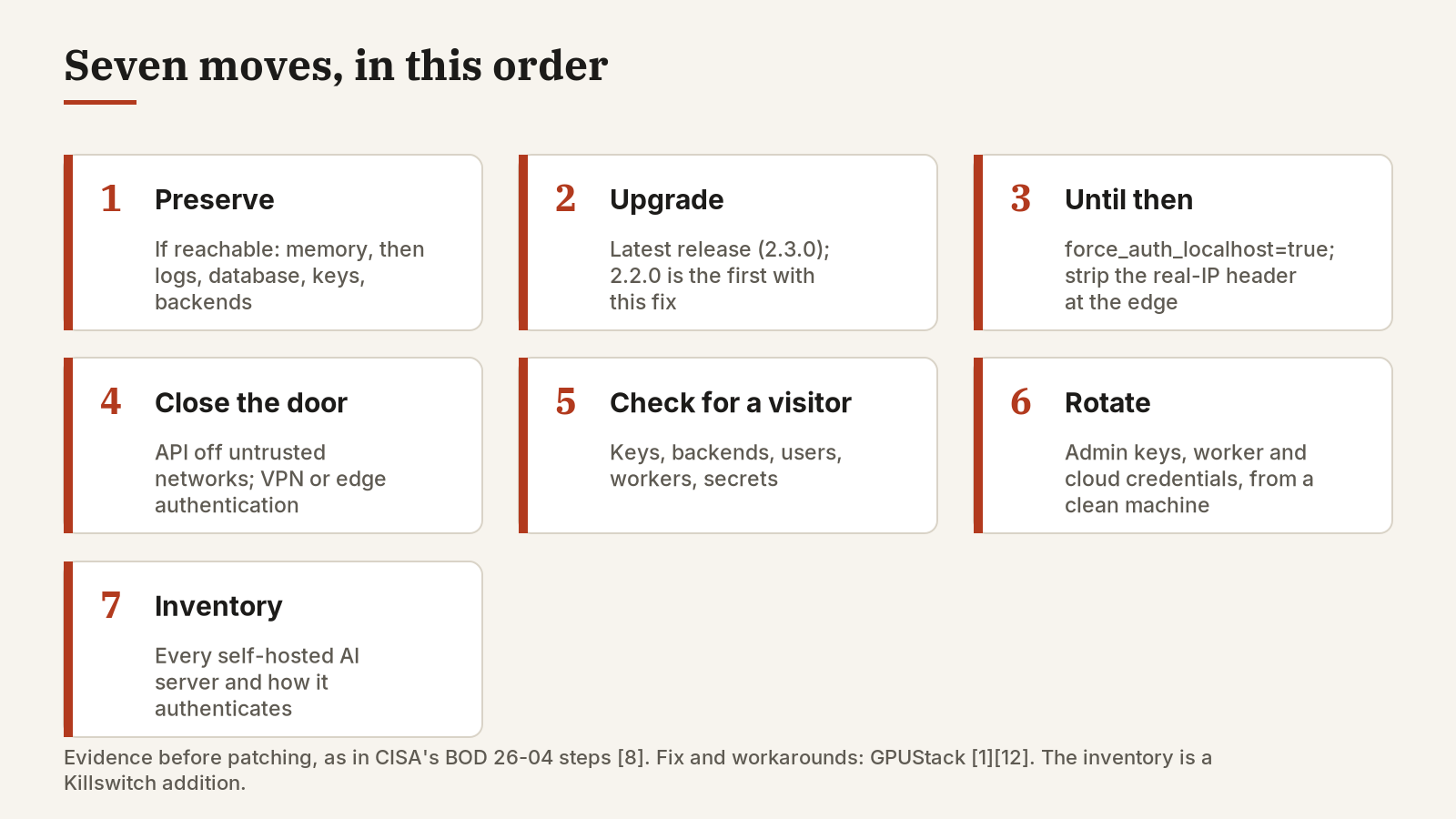
Then rotate. Our advice, based on what the advisory says an attacker could take [1]: revoke admin API keys you did not create, remove unknown custom backends, and rotate the worker and cloud-provider credentials the server could read. Do it from a clean machine, not from the server you are investigating.
Mapping it for GRC
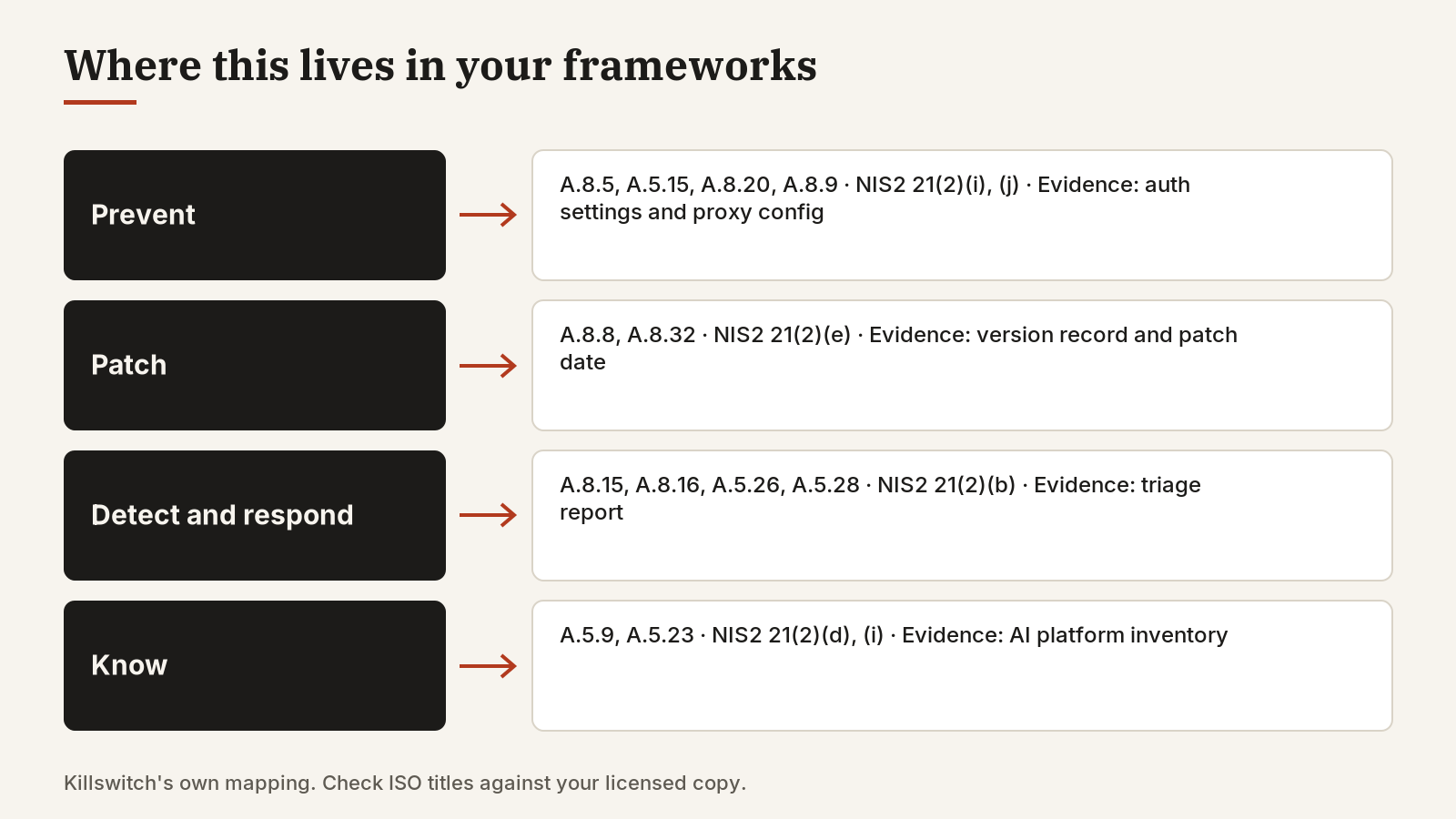
- ISO/IEC 27001:2022 [10]: secure authentication (A.8.5) and access control (A.5.15), which is where "the network source is not a credential" belongs; network security (A.8.20) and configuration management (A.8.9) for the proxy and the auth setting; technical vulnerability management (A.8.8) and change management (A.8.32) for the upgrade; logging and monitoring (A.8.15, A.8.16) and incident management and evidence (A.5.26, A.5.28) for the triage; the inventory of assets (A.5.9), and information security for the cloud services you use (A.5.23), for knowing where these servers run and who runs them. These are our mapping; check the control titles against your licensed copy.
- NIS2 [11]: if you are an essential or important entity, the anchors are Art. 21(2)(e), vulnerability handling, for the upgrade; (i), access control and asset management, and (j), multi-factor or continuous authentication, for the auth design; (b), incident handling, for the triage; and (d), supply chain security, if a provider runs the platform for you. Any notification duty under Art. 23 applies only if an incident is significant [11].
Lessons and a tabletop
The lesson is bigger than one product. Self-hosted AI tooling often starts as a single box that "only listens locally", then gets a reverse proxy, a domain name and a team. The trust decision made for the single box stays in the code. GPUStack is the case in point, and its advisory says so: once a same-host proxy is in front, "the 'localhost is trusted' assumption no longer holds" [1].
A 30-minute tabletop for your platform or AI team:
- List every self-hosted AI or MLOps server (model servers, GPU managers, notebooks, agent consoles). Who owns each one?
- For each, what does it treat as "trusted": localhost, an internal subnet, a header set by a proxy? Who checked?
- If someone minted an admin key on one of them last month, how would you know today?
- Which cloud or model-provider secrets would that key expose, and how fast can you rotate them?
What we don't know yet
- Who was attacked, and by whom. GPUStack describes one exploited 2.1.1 deployment and credits Javier Sixto (ulex.fr) with reporting it [1]. No victim organisation, actor or scale is public, and CISA's KEV entry lists known ransomware use as "Unknown" [3].
- When the exploitation happened. The advisory was published on 31 July and last updated on 29 September [1]. We could not tell from public sources whether the in-the-wild note was there on day one or added later.
- How the header path was fixed. The advisory says the client-IP and forwarding-header handling was hardened [1]. In our reading of the code, a change merged on 13 May (pull request #5310, commit 15767c7d, included in 2.2.0) made GPUStack accept the real-IP header only alongside the gateway's own token [13]. GPUStack does not name that change in the advisory [1].
- The score. CVSS 9.8 comes from the advisory's vector, also shown in the NVD record [1][4]. CISA's alert page does not restate a score [2].
Your checklist for this week
- Find every GPUStack server you or your providers run, and its version [1].
- If it was reachable, preserve logs, the database and the key and backend lists first [8].
- Upgrade to the latest release (2.3.0 at the time of writing), not just 2.2.0 [1][12]. Until then, set
force_auth_localhost=trueand stripX-GPUStack-Real-IPat the edge [1]. - Take the API off untrusted networks [1].
- Check for unknown admin keys, custom backends, users and worker activity; keep a short triage record [3][8].
- Rotate admin keys and worker and cloud credentials from a clean machine [1].
- Start an inventory of self-hosted AI servers and what each one trusts.
Download the slides
Use this issue in your next team briefing. The slides are free to download:
Keep going
- Try the live demo: GRCompliance. Keep an inventory of your AI platforms and their access controls, link the evidence, and map controls to ISO 27001 and NIS2.
- Install free from GitHub (self-hosted): GRCompliance Core, the open-source edition. Your data stays on your infrastructure.
- Sectutor books and kits: security and GRC books, training and audit kits.
- Subscribe to Killswitch: sharp issues on security, AI security and GRC.
About the author. Emmanuel Aigbehi Walstra is a CISO who also serves as a virtual CISO (vCISO) for several organisations, with 30+ years in cybersecurity, 10,000+ people trained, and author of the CCSP Excellence books.
Sources
- GPUStack: Security advisory GHSA-gj9m-f8ph-pmhr, authentication bypass via trusted loopback source grants unauthenticated admin (published 31 Jul 2026, updated 29 Sep 2026)
- CISA: CISA Adds Four Known Exploited Vulnerabilities to Catalog (9 Nov 2026)
- CISA: Known Exploited Vulnerabilities Catalog, CVE-2026-102895 (added 9 Nov 2026, due 12 Nov 2026, forensic triage required)
- NIST NVD: CVE-2026-102895 (published 4 Nov 2026)
- GPUStack: pull request #5346, "refactor: remove localhost auto-admin bypass" (merged 19 May 2026)
- GPUStack: release v2.2.0 (18 Jun 2026)
- GPUStack Docs: CLI reference, gpustack start (--force-auth-localhost, --trusted-hosts)
- CISA: BOD 26-04 Implementation Guidance, Prioritizing Security Updates Based on Risk (forensic triage steps)
- GPUStack: release v2.1.1 (26 Mar 2026)
- ISO/IEC 27001:2022 Information security management systems
- NIS2 Directive (EU) 2022/2555, Articles 21 and 23
- GPUStack: release v2.2.2, Security section (24 Jul 2026)
- GPUStack: pull request #5310, "Fix client ip getter" (merged 13 May 2026; commit 15767c7d)
Facts are from GPUStack's advisory, pull request, release and documentation, CISA's alert, KEV entry and BOD 26-04 guidance, and the NVD record, as published by 10 Nov 2026. The framework mapping, the inventory control and the tabletop are Killswitch's own.
Checked against the primary sources cited above. Spotted an error? See our corrections page.