
The Email Gateway's Admin Page Was the Way In
Two Barracuda flaws, used together, can take an attacker who can reach the Email Security Gateway's admin page to root on the device. Barracuda has seen exploitation, and CISA wants a forensic check as well as the patch. What to do this week, and why the admin page is the real control.
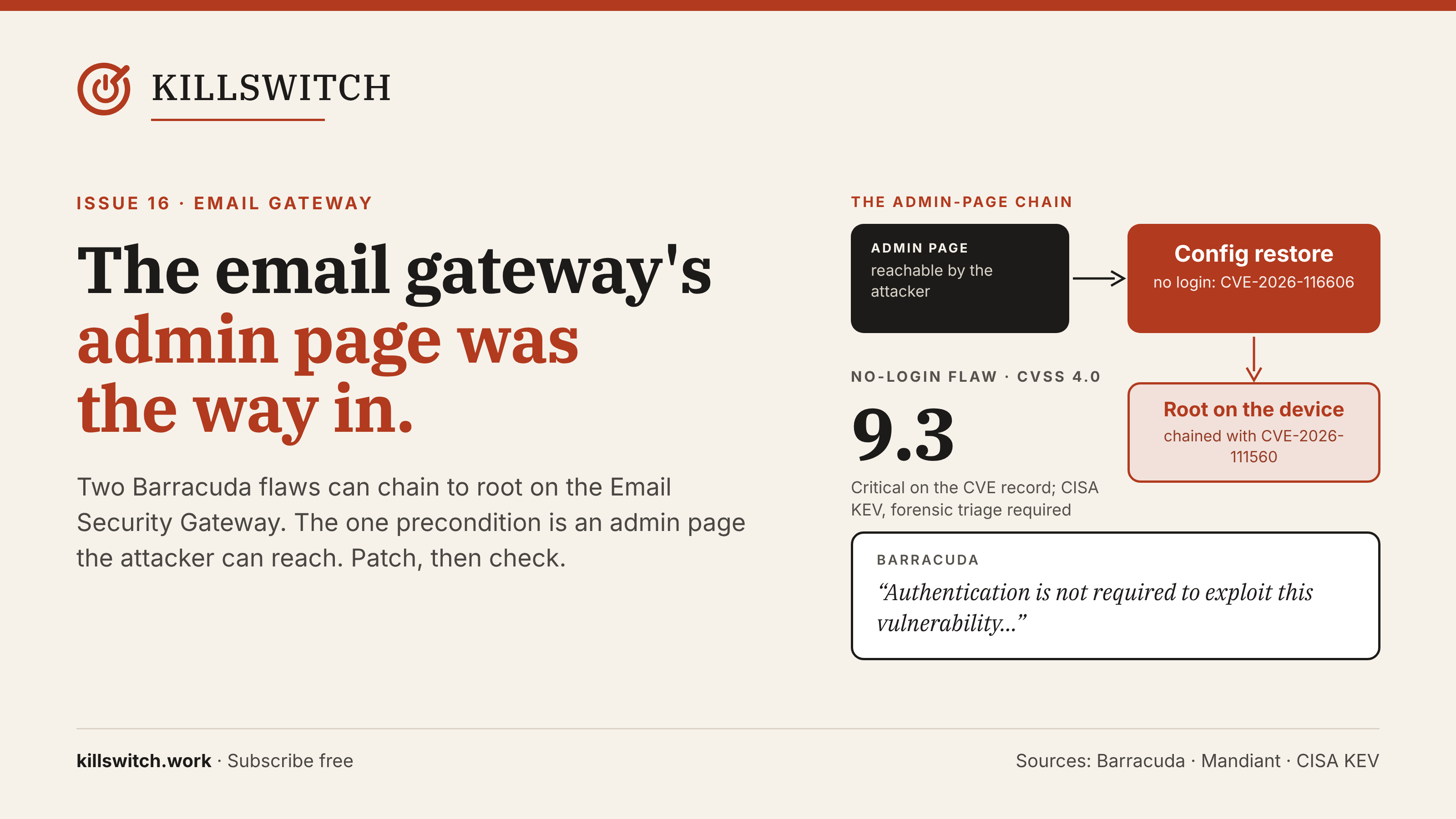
Facts as of 13 Nov 2026.
On 2 November, Barracuda published an advisory, with patches, for two flaws in several of its appliances [1]. Read alone, each has a limit. One needs the attacker to be an administrator already. The other, in the Email Security Gateway (ESG), changes the device's configuration. Together, Barracuda says, they "could allow an attacker to bypass authorization controls and obtain root access to the device" [1]. On 9 November it added that it had "identified exploitation activity affecting a small number of organizations" [1]. On 10 November, CISA added both to its Known Exploited Vulnerabilities catalog, with forensic triage required and a federal due date of 13 November [4].
Both flaws share one precondition. Barracuda's advisory says it plainly: "Successful exploitation requires an attacker to have access to the administrative interface of an affected product" [1].
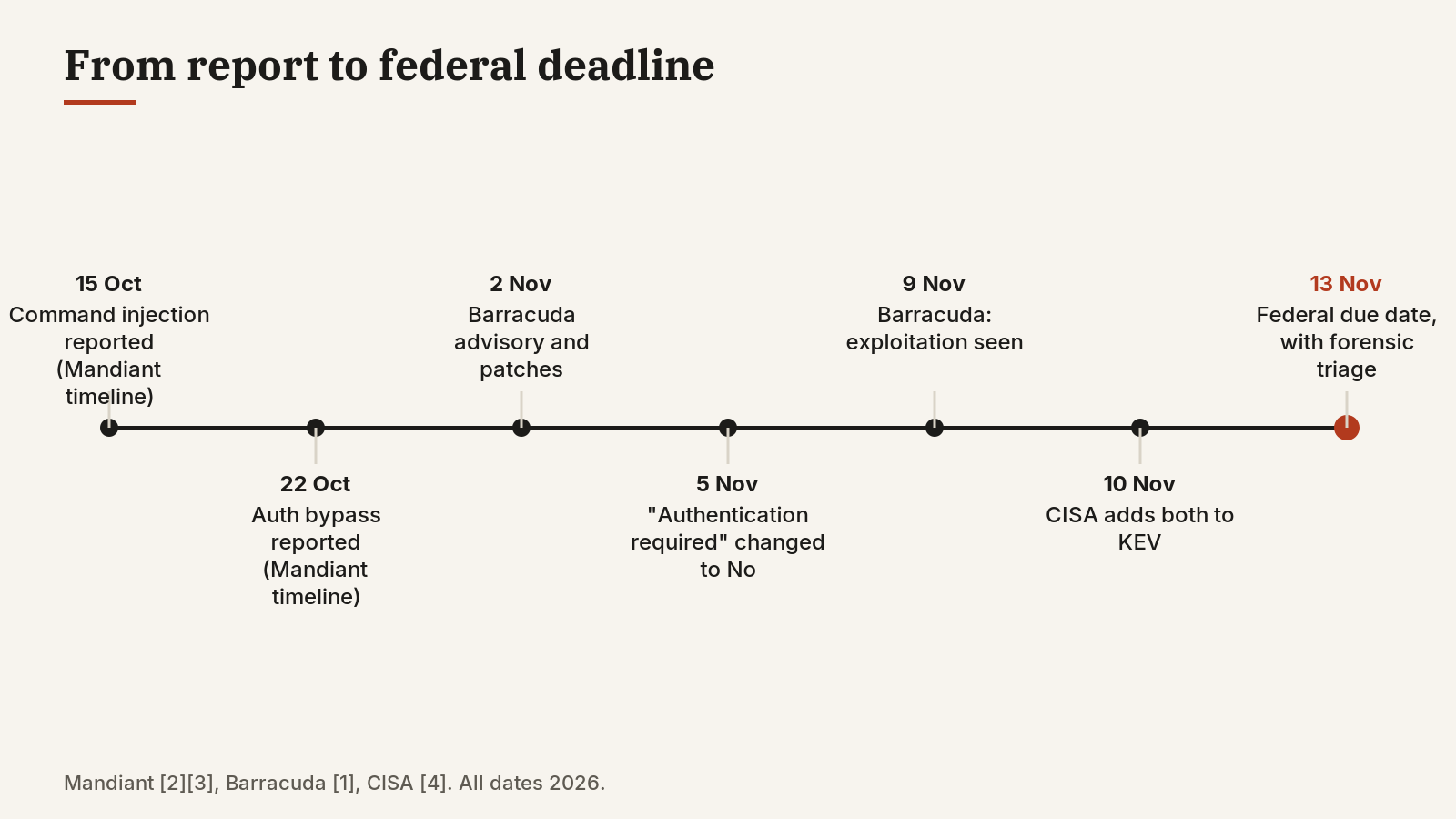
What the two flaws do
- CVE-2026-116606 (ESG only, CVSS 4.0: 9.3). Mandiant describes an authentication bypass that "allows an unauthenticated remote attacker to invoke a configuration-import function and restore a crafted, compatible backup archive, resulting in unauthorized modification of the appliance's global configuration" [2][7]. Its weakness class is "authentication bypass using an alternate path or channel" [2].
- CVE-2026-111560 (six products, CVSS 4.0: 8.6). An authenticated administrator can inject operating-system commands, through a configuration field, "that execute with root privileges" [3]. It affects ESG, Web Security Gateway, Web Application Firewall, WAF Control Center, Load Balancer ADC and Message Archiver [1][3].
CISA's catalog says of each that it "can be chained with" the other [4]. Barracuda's advisory labels both High. On the CVE records, Mandiant's CVSS 4.0 scores are 9.3 (Critical) and 8.6 (High); NVD analysed both on 12 November and scores them under CVSS 3.1 at 9.8 (Critical) and 7.2 (High) [10].
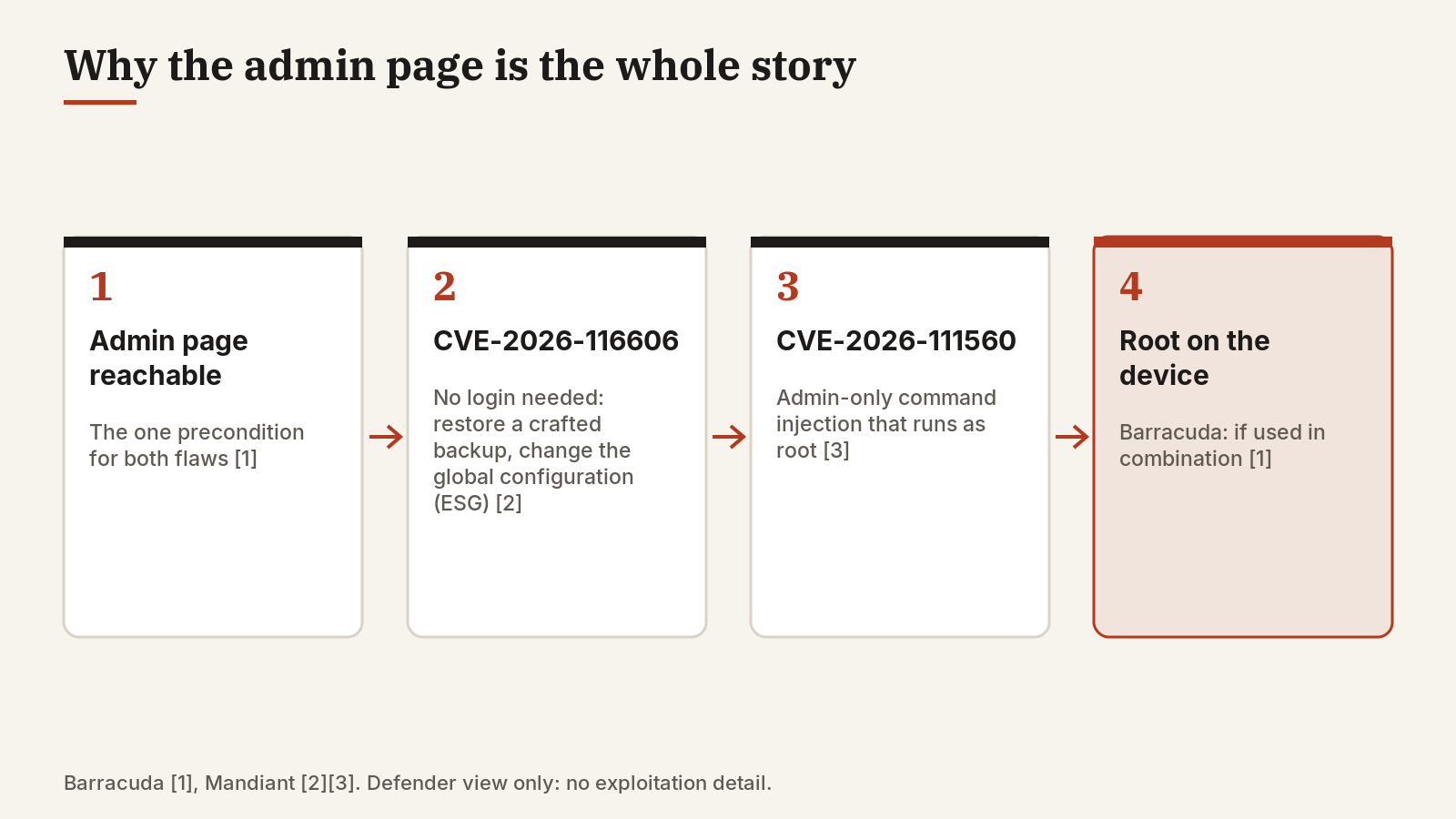
The line that changed on 5 November
Barracuda's first advisory listed "Authentication Required: Yes, administrative access" for CVE-2026-116606. On 5 November it changed that to "No (Administrative UI Access Required)", and added: "Authentication is not required to exploit this vulnerability; however, exploitation requires the administrative user interface (Admin UI) to be accessible to the attacker" [1].
If your team triaged the advisory on 2 or 3 November and read "needs admin access", it may have filed this as lower risk. Re-read it. The precondition is not a stolen password. It is a reachable admin page.
Which products, and which patch
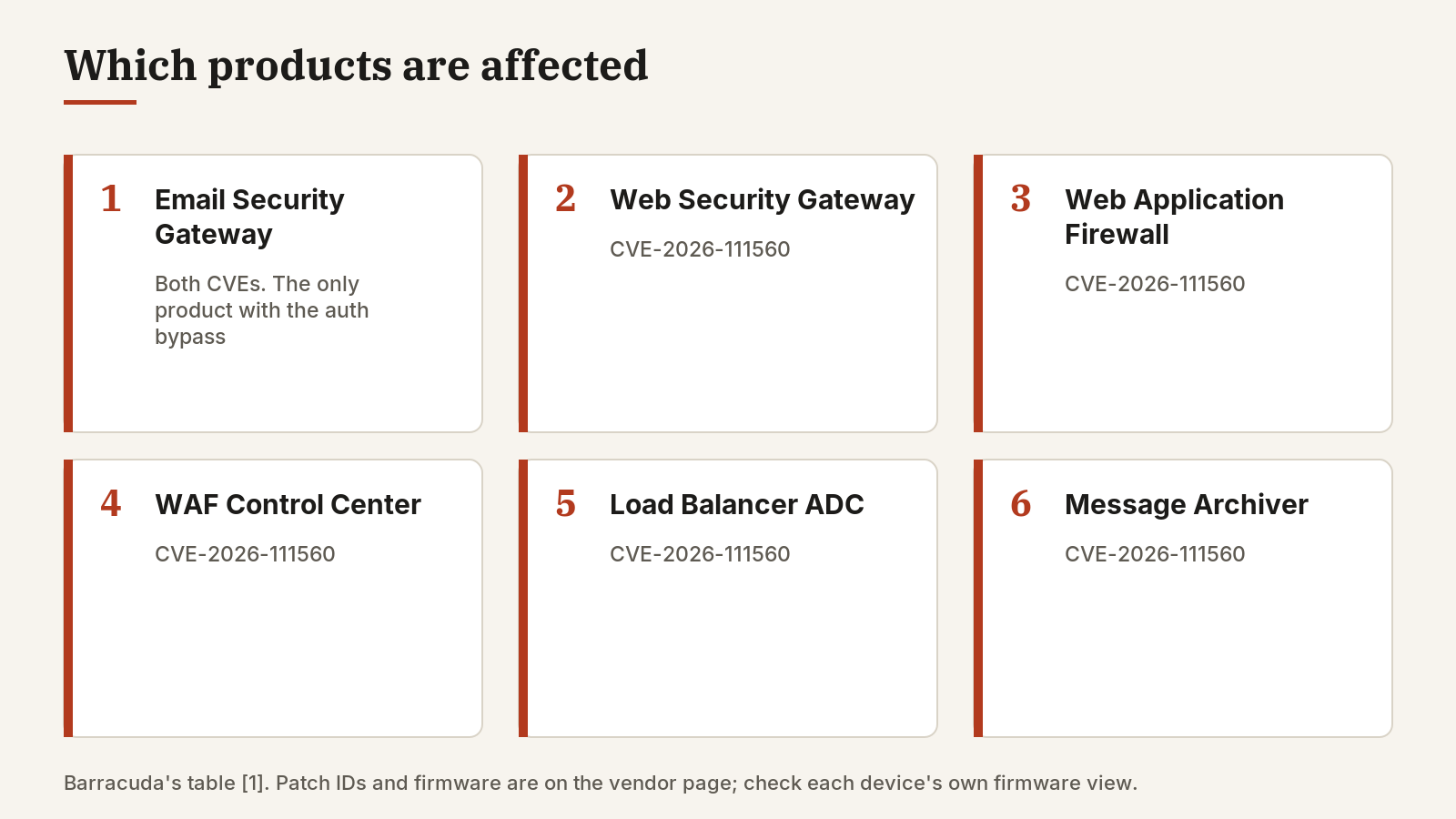
Barracuda lists a patch for each product, and two for ESG depending on the firmware line [1]. Its guidance [1]:
- Check that each device runs the latest firmware and has all security patches. "The device will show the latest firmware version available."
- If firmware is several versions behind, more than one update may be needed.
- If a patch was not applied automatically, apply it by hand as soon as possible. If automatic patching was turned off, turn it back on.
Mandiant's advisories give affected version ranges [2][3]. They do not use the same version notation as Barracuda's patch table, so take the fix for each device from Barracuda's page and the device's own firmware view, not from a version number copied into a ticket.
Patched is not the same as checked
CISA's catalog entry for both CVEs asks agencies to follow BOD 26-04 and its "Forensics Triage Requirements" [4]. Under the directive, "& forensic triage" means remediating or mitigating within three days and also carrying out "a forensic triage of the asset to assess whether the system is compromised" [5]. The deadline binds US federal agencies, but the logic applies to anyone with an exposed gateway: an attacker who already restored a configuration is not removed by the patch.
CISA's implementation guidance sets out six steps [6]. One detail is easy to miss: collect the evidence before you patch where you can, because "patching may jeopardize the availability of artifacts" [6]. Its target times put evidence collection and patching in the same first day [6], so this is about order, not delay.
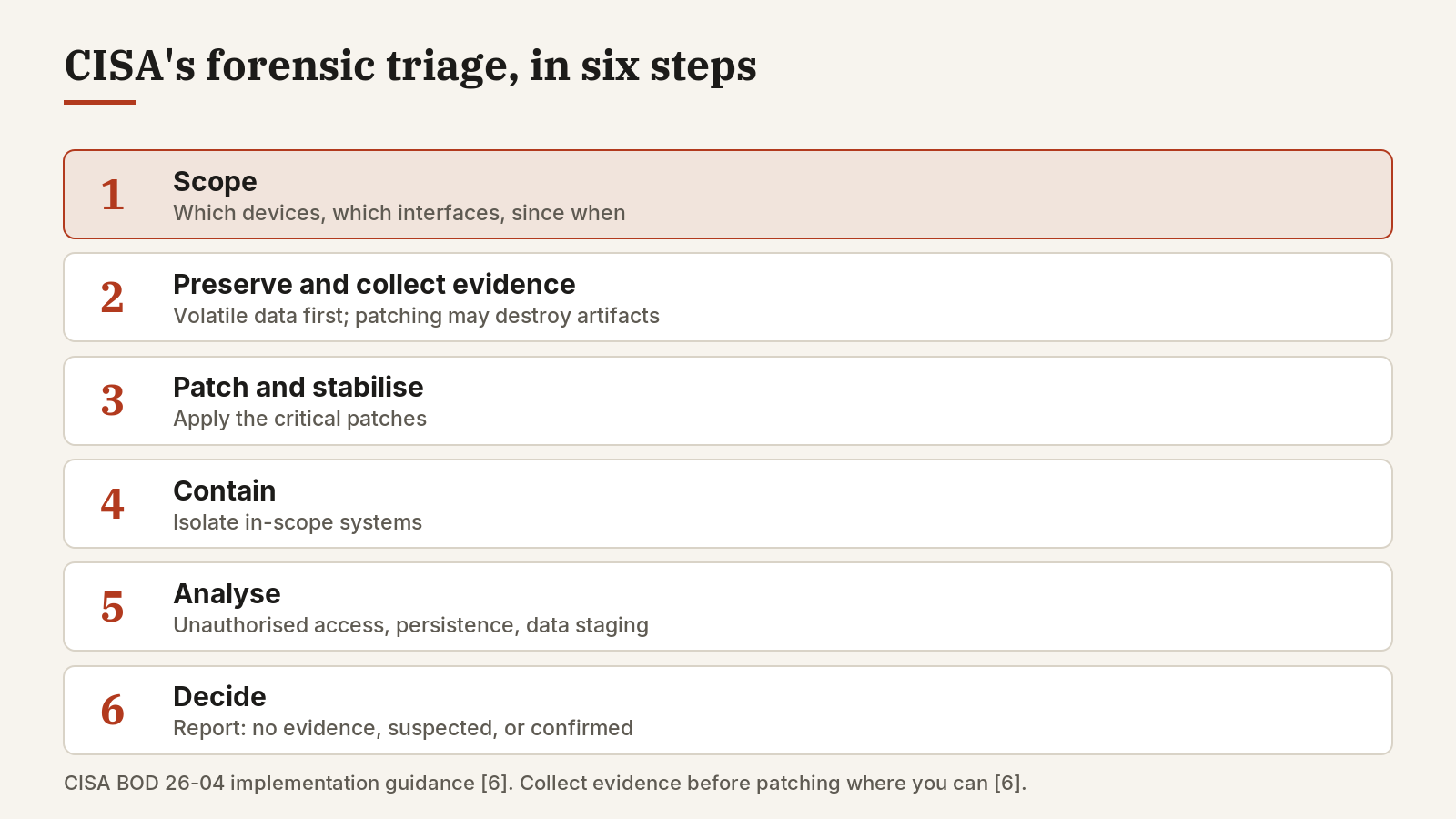
For an ESG that had its admin page on the internet, our reading of the advisories is that the triage should at least cover configuration changes and imports, administrator accounts and sessions, and anything the device sent or ran that it should not have [1][2][3][6]. Barracuda has not published indicators of compromise in its advisory [1]. For help confirming firmware or patches, Barracuda points customers to its Support team [1]. If you find signs of compromise, follow your incident plan.
The controls that would have helped
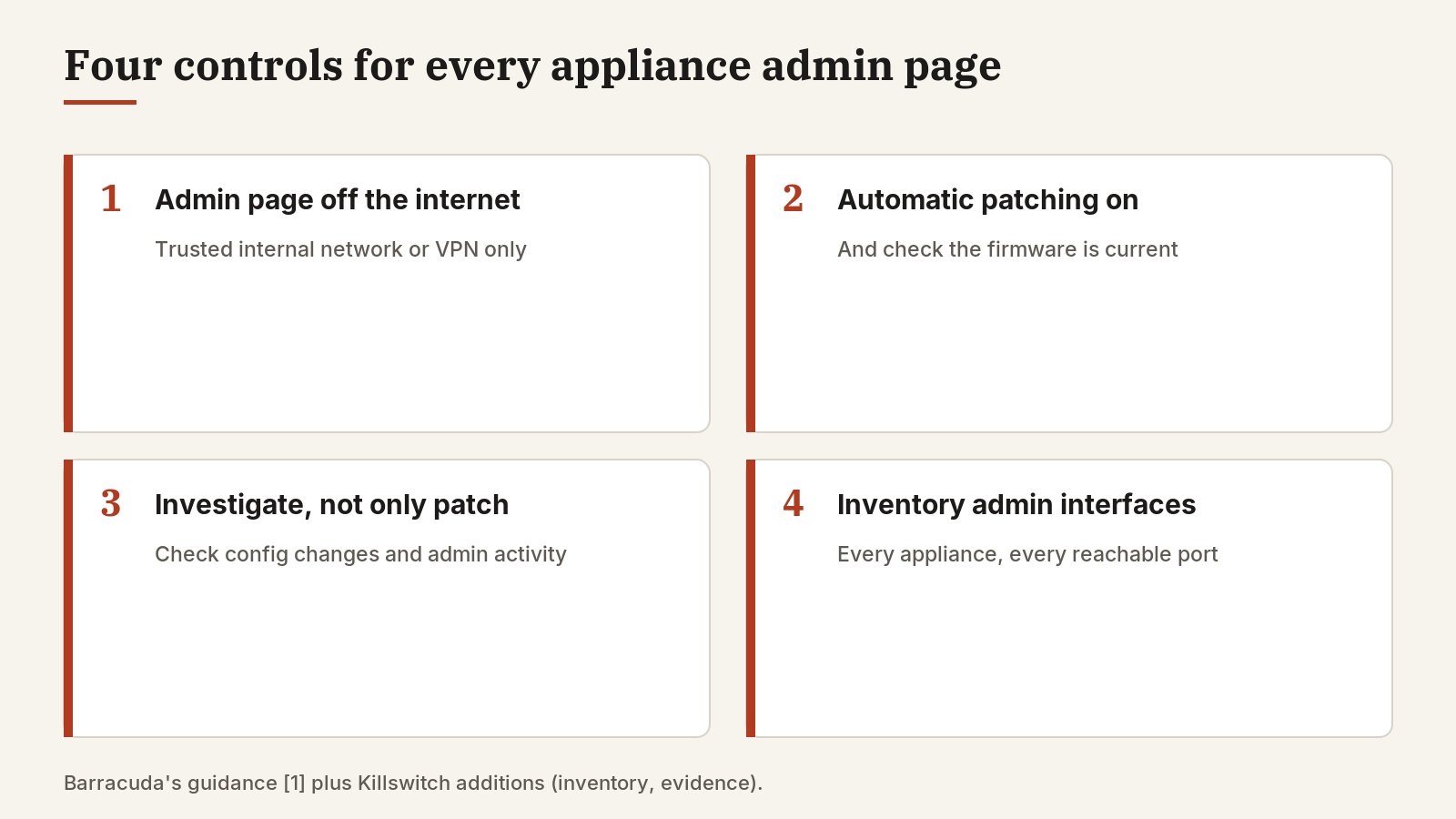
- Take the admin page off the internet. Barracuda: organisations whose admin interfaces are not reachable from the internet "are less exposed to this attack path", and it recommends restricting them "to trusted internal networks" [1]. Removing a system from the internet is also one of the mitigations BOD 26-04 itself recognises [5].
- Keep automatic patching on, and check the firmware is current [1].
- Investigate, not only patch, when an exploited flaw was reachable [4][6].
- Inventory every admin interface. This one is ours: you cannot answer "was our admin page reachable last week?" in an hour unless you already know which appliances you run, which interfaces they expose and to whom.
Mapping it for GRC
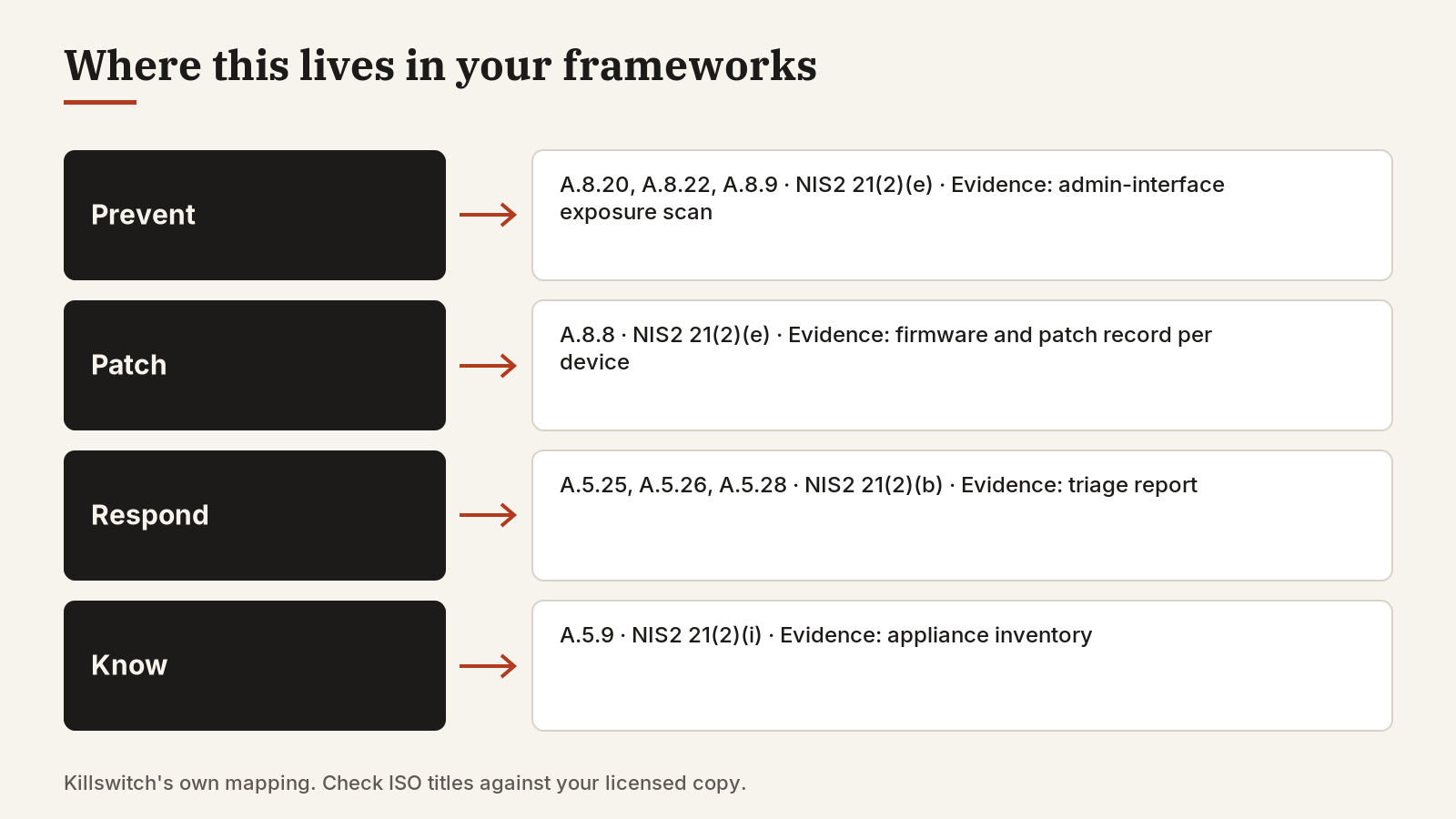
- ISO/IEC 27001:2022 [9]: management of technical vulnerabilities (A.8.8); configuration management (A.8.9); network security and segregation of networks (A.8.20, A.8.22), which is where the admin page belongs; inventory of assets (A.5.9); and assessment of events, response to incidents and collection of evidence (A.5.25, A.5.26, A.5.28). This is our mapping; check the control titles against your licensed copy.
- NIS2 [8]: if you are an essential or important entity, the anchors are Art. 21(2)(e), security in maintenance "including vulnerability handling and disclosure", for patching and exposure; (b), incident handling, for the triage; and (i), access control policies and asset management, for the admin-interface inventory. Our mapping.
What we don't know yet
- Who and how many. Barracuda says "a small number of organizations" and has not named them, the attacker, or what was done after access [1].
- Whether every case used both flaws. Barracuda and CISA say they can be combined [1][4]. Neither says every exploited case did.
- Indicators. No indicators of compromise are in Barracuda's advisory or the KEV entries [1][4].
- Ransomware. CISA lists known ransomware use as "Unknown" [4].
Your checklist for this week
- List every Barracuda ESG, WSG, WAF, WCC, ADC and Message Archiver you run, including ones an MSP runs for you.
- Check from outside whether any admin interface is reachable from the internet. If it is, restrict it now.
- Collect logs and configuration for any device that was reachable, then apply Barracuda's patch and confirm the firmware on the device.
- Turn automatic patching back on where it was off.
- Run and record a triage for exposed devices: configuration changes, admin accounts, unexpected activity.
Download the slides
Use this issue in your next team briefing. The slides are free to download:
Keep going
- Try the live demo: GRCompliance. Keep an inventory of internet-facing assets and their admin interfaces, track patches and forensic checks as evidence, and map controls to ISO 27001 and NIS2.
- Install free from GitHub (self-hosted): GRCompliance Core, the open-source edition. Your data stays on your infrastructure.
- Sectutor books and kits: security and GRC books, training and audit kits.
- Subscribe to Killswitch: sharp issues on security, AI security and GRC.
About the author. Emmanuel Aigbehi Walstra is a CISO who also serves as a virtual CISO (vCISO) for several organisations, with 30+ years in cybersecurity, 10,000+ people trained, and author of the CCSP Excellence books.
Sources
- Barracuda: Pre-Authentication Authorization Bypass and Command Injection Vulnerabilities in Certain Barracuda Products (2 Nov 2026, updated 5 and 9 Nov)
- Mandiant: MNDT-2026-0042, CVE-2026-116606, Barracuda ESG authentication bypass (2 Nov 2026)
- Mandiant: MNDT-2026-0041, CVE-2026-111560, Barracuda command injection (2 Nov 2026)
- CISA: Known Exploited Vulnerabilities Catalog (CVE-2026-116606 and CVE-2026-111560 added 10 Nov 2026)
- CISA: BOD 26-04, Prioritizing Security Updates Based on Risk
- CISA: BOD 26-04 Implementation Guidance (Forensic Triage Steps)
- CVE record: CVE-2026-116606 (CNA: Mandiant)
- NIS2 Directive (EU) 2022/2555, Article 21 (EUR-Lex)
- ISO/IEC 27001:2022 Information security management systems
- NVD: CVE-2026-116606 and CVE-2026-111560 (analysed 12 Nov 2026)
Facts are from Barracuda's advisory (updated 9 November), Mandiant's advisories, the CVE record and CISA's KEV catalog and BOD 26-04 guidance, as published by 10 Nov 2026. Barracuda has not named the affected organisations or the attacker. The controls and the framework mapping are Killswitch's own.
Checked against the primary sources cited above. Spotted an error? See our corrections page.