
The Supermarket Fridge Is Now an EU-Level Incident
Since 11 October, refrigeration controllers left reachable from the internet have been hit in several EU countries. After a new wave on 1–2 November, EU agencies issued a joint warning. If you run, service or make these controllers, here is what to do today.
Since 11 October, refrigeration controllers left reachable from the internet have been hit in several EU countries. After a new wave on 1–2 November, EU agencies issued a joint warning. If you run, service or make these controllers, here is what to do today.
Facts as of 9 Nov 2026.
In the night of 11 to 12 October, the refrigeration systems of several French retail chains were changed so that frozen stock warmed up and was made unusable. That is how Austria's national response team, CERT.at, summed it up [6]. France's national response team, CERT-FR, published an alert the same day. It says it is aware of "nombreuses compromissions", many compromises, of remote controllers for refrigeration installations [3].
Three weeks later the story stopped being French. On 4 November the EU's cybersecurity agency, ENISA, published a joint statement with the European Commission, Europol's European Cybercrime Centre, the network of national computer security incident response teams (CSIRTs: the official teams that help organisations during cyber incidents) and EU-CyCLONe, the network of national cyber crisis authorities [1].
The statement is short and calm. "Since 11 October 2026, several commercial refrigeration systems and similar devices have been impacted by cybersecurity incidents in a number of EU Member States." It refers to "a new wave of incidents having occurred on 1-2 November" and advises organisations "to take immediate action to mitigate exposure in the affected systems" [1].
ENISA and its partners "will continue to monitor the incidents and contribute to the overall situational awareness at Union level" [1]. This issue is for the founder of a small retailer, food business or facilities firm, and for the people who make these controllers. You don't need to panic, but you should find out this week whether your fridges are on the internet.
What happened, in order
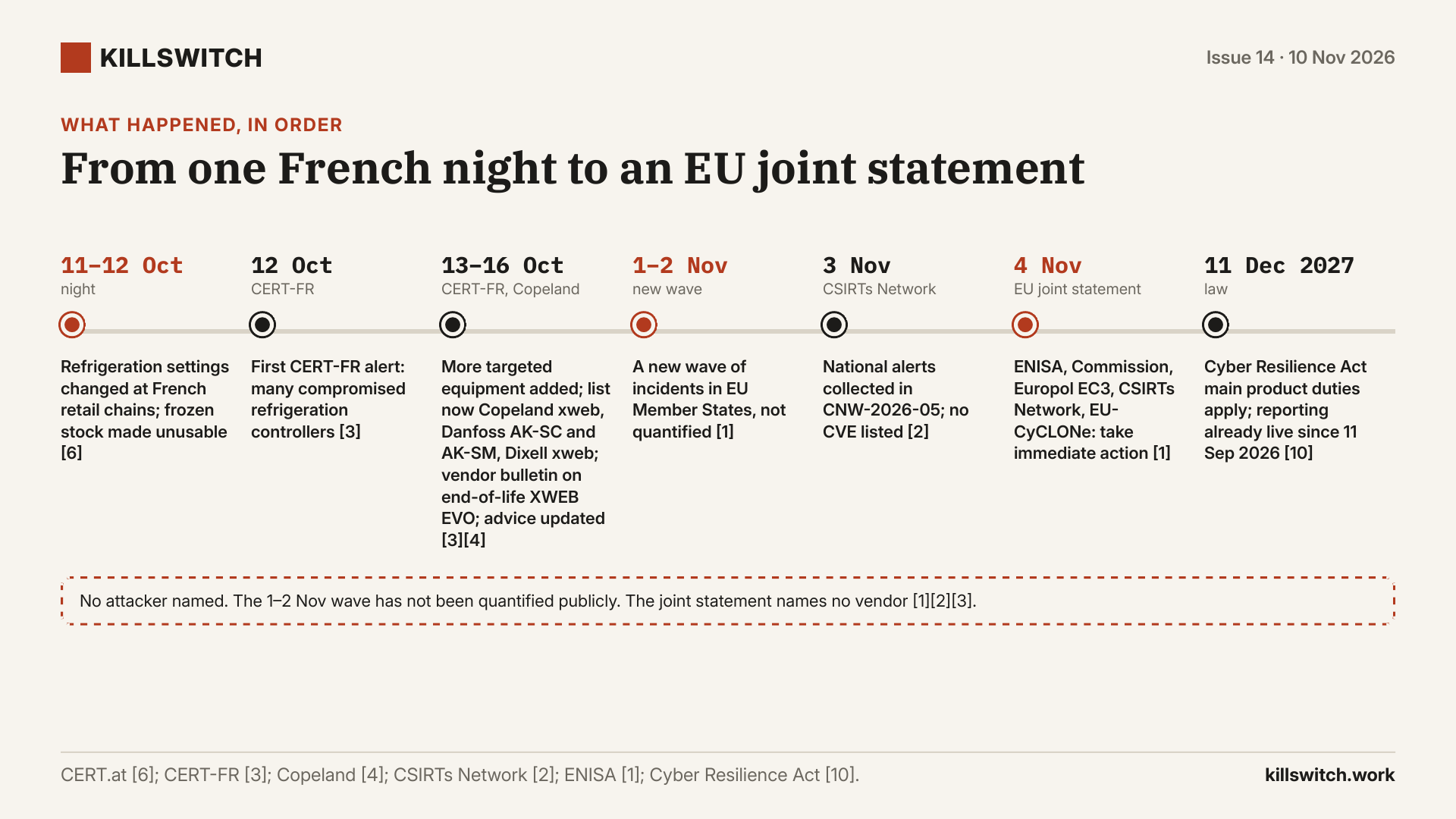
CERT-FR's alert lists four product families: Copeland xweb, Danfoss AK-SC series, Danfoss AK-SM series and Dixell xweb [3]. Its first version is dated 12 October. It added "other targeted equipment" on 13 October and updated its recommendations on 16 October [3]. The joint statement of 4 November names no vendor or product [1]. On 3 November the EU CSIRTs Network collected the national alerts in one advisory, CNW-2026-05, which ENISA keeps on GitHub.
It says that "As of mid October, 2026, cyberattacks have compromised remote control systems for refrigeration facilities in the retail sector across Europe". Its CVE field is empty: no public vulnerability ID is listed [2]. It links alerts or guidance from twelve national teams, from Ireland and the Netherlands to Italy, Greece and Sweden [2].
On the damage, the only figures we found from a national team come from Spain's INCIBE-CERT, which summarised French press reports. Its summary of the French reporting says controllers at "hundreds of supermarkets in France" were affected and "some refrigerators and freezers" were kept at temperatures "of up to 50°C for several hours".
It adds that "Reported losses reached tens of millions of euros" [9]. These figures come from press reports. We could not find them in a French official source, so treat them as reported, not confirmed. Nobody has said publicly how many systems were hit in the 1–2 November wave.
How a fridge ends up on the internet
A commercial refrigeration controller is the small computer in the plant room that runs the cold rooms and display cases: temperatures, defrost cycles and alarms. Many have a web page so that the refrigeration contractor can watch and adjust them remotely.
The trouble starts when that web page sits on a public internet address that anyone can reach. CERT-FR puts it in one sentence: "De manière générale l'exposition d'une interface de gestion sur Internet est contraire aux bonnes pratiques" [3]. In general, putting a management interface on the internet goes against good practice.
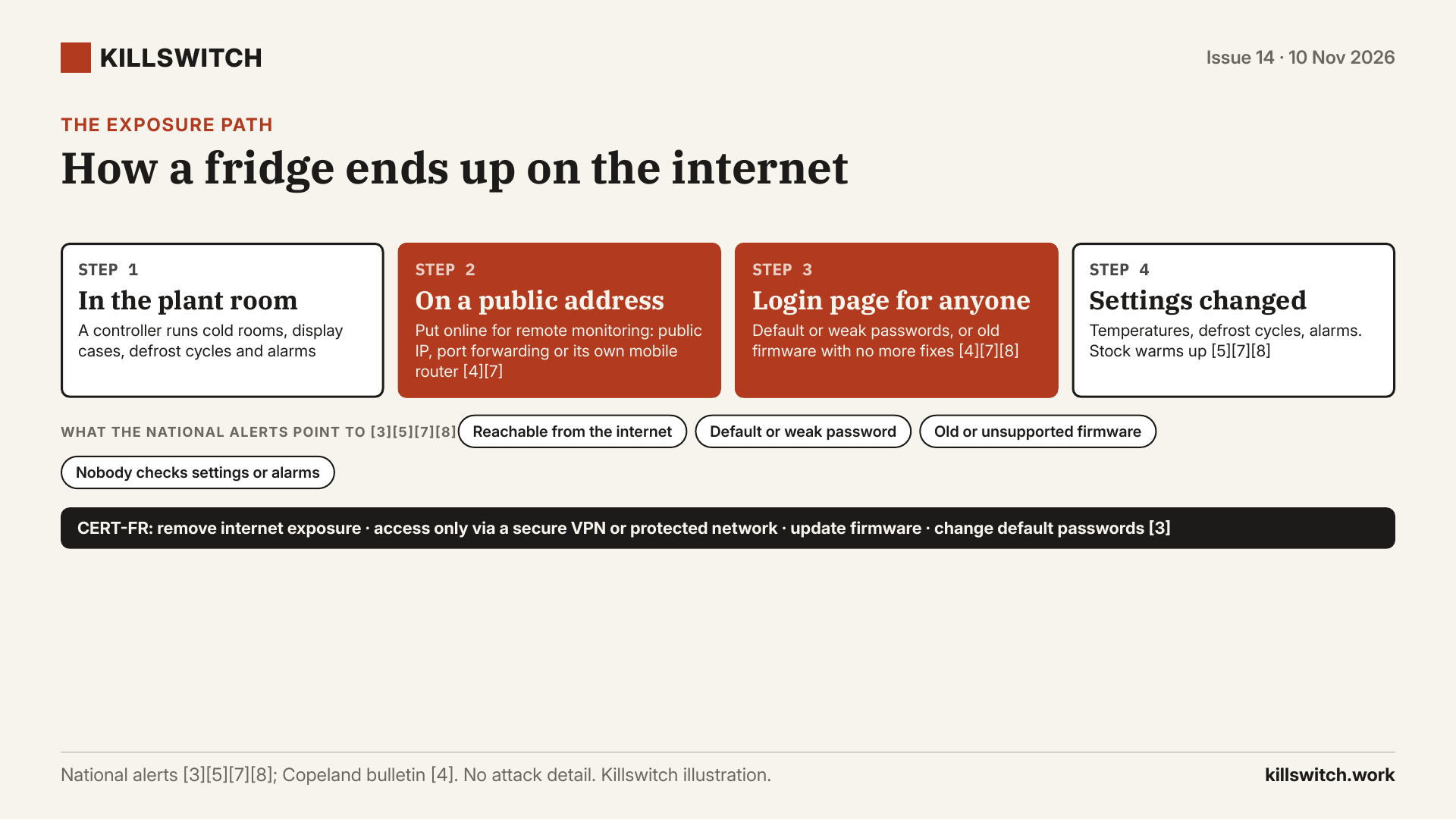
The national alerts agree on how the attackers got in, without naming them. Italy's agency, ACN, says the attack exploited "installazioni obsolete" (outdated installations), administration interfaces exposed directly on the internet and weak authentication, and that it allowed remote activation of defrost cycles and changes to operating settings [7].
The Dutch national team, NCSC-NL, mentions poor and default passwords and says attackers can change the temperature or defrost cycles [8]. Ireland's NCSC says attackers "have reportedly gained unauthorised access to refrigeration controllers that are directly accessible over the public internet" [5]. Copeland Controls, which makes the xweb supervisors, published a bulletin on 14 October.
It acknowledges a vulnerability in a generation of XWEB EVO controllers that is no longer sold and has reached end of life. It says XWEB EVO "ne reçoit plus de correctifs de sécurité" (no longer receives security fixes) and that the supported XWEB PRO "ne doit pas être exposé à Internet" either [4]. We don't describe how any controller was entered. There is no exploit detail in this issue.
The good news is that this isn't everywhere. When CERT.at searched for these web interfaces in Austria, it found only four internet addresses. One belonged to a bakery that had already installed current firmware.
The other three belonged to a restaurant chain, some on very old software, and CERT.at said it would contact them directly [6]. That is the realistic picture for most small businesses: either you have one of these on the internet or you don't. Each of the steps below removes a lot of risk.
What to do today
These steps come from CERT-FR, Ireland's NCSC, ACN and the vendor bulletin [3][4][5][7]. They work whatever brand you have. Ireland's advice is to "review all remotely accessible refrigeration equipment, regardless of manufacturer" [5].
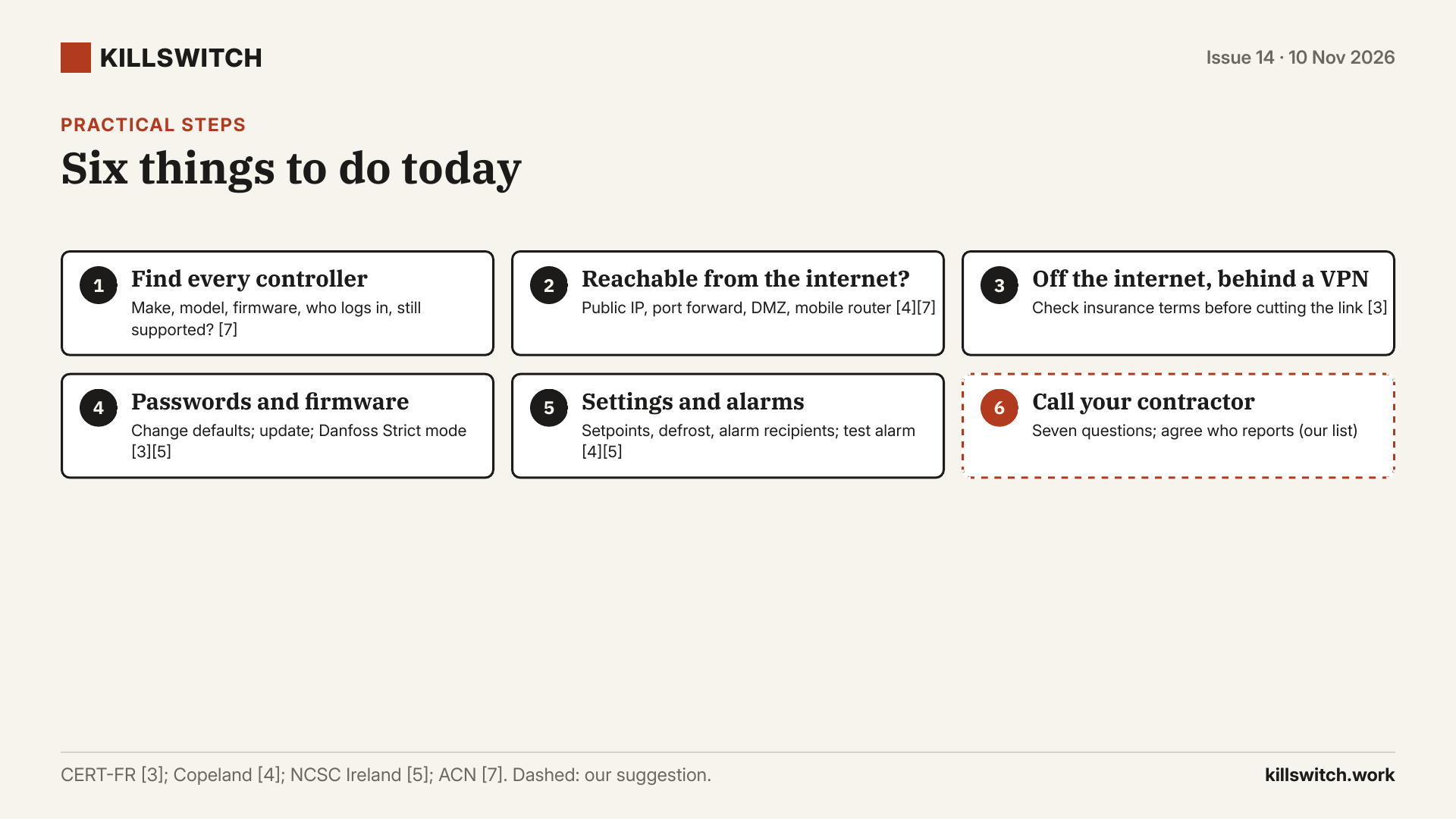
- Find every controller. Ask whoever looks after your refrigeration for a list of every controller and supervisor in your stores and warehouses: make, model, firmware version, who can log in, and whether it is still supported. ACN asks for exactly this inventory, including location and owner [7].
- Check whether it can be reached from the internet. Look for a public internet address, port forwarding, a DMZ (a network zone deliberately open to the internet) or a separate mobile (cellular) router that the contractor installed [4][7]. ACN warns that active scans of these devices should be agreed with whoever runs the installation first [7]. Your IT provider can usually answer from the router and firewall settings.
- Take it off the public internet, carefully. CERT-FR's first step is to remove internet exposure for these units and for every unit on a public address. Then restore access "uniquement via un VPN sécurisé ou un réseau protégé", only through a secure virtual private network (an encrypted tunnel) or a protected network [3]. Before you cut the data link to your refrigeration contractor, CERT-FR says to check your insurance contract terms [3]. If you need a stopgap, CERT-FR and Ireland's NCSC both allow a firewall rule that only lets in the contractor's own addresses. Both say it is not a permanent fix [3][5].
- Change default passwords and update firmware. CERT-FR's Danfoss example is to update the firmware, set the security level to Strict mode and make sure default passwords have been changed [3]. Ireland's NCSC asks for "strong, unique credentials" [5].
- Check the settings and the alarms. Compare temperature setpoints, defrost schedules, alarm thresholds and who gets the alarm messages with what they should be [3][5][7]. Copeland's bulletin suggests sending a test alarm to confirm that notifications really arrive [4].
- If a controller was tampered with, rebuild it, don't just reset it. CERT-FR warns that "Des campagnes d'attaques sont probablement toujours en cours", attack campaigns are probably still under way. For an end-of-life unit left on the internet, a factory reset alone is not enough: it "sera certainement de nouveau compromis", it will almost certainly be compromised again [3]. Keep screenshots of users and settings before you change anything. Copeland's support may need them, and so may an incident report [4].
Ask your vendor or maintenance contractor
Most small businesses don't run these controllers themselves. A refrigeration contractor does. The Dutch NCSC's first piece of advice is to contact your supplier and ask whether your installation is vulnerable [8]. These seven questions will get you a useful answer in one phone call. They are our own list, built from the national advice.
- Which of our controllers can you reach remotely, and how?
- Is any of them on a public internet address, behind port forwarding or on its own mobile router?
- Is any of them past end of support, so it no longer gets security fixes [4][7]?
- Have the default passwords been changed, and who holds the new ones?
- If a setting changes at 3 a.m., who gets the alarm, and has anyone tested it recently?
- Do you keep a backup of each controller's configuration, made before 11 October?
- If we move your access to a virtual private network, what do you need from us, and does our contract or insurance depend on the current data link [3]?
Check your reporting duties
The joint statement also reminds two groups of their legal duties [1]. Here is what the legal texts say, in plain English. This is not legal advice, and national laws that apply NIS2 differ from country to country.
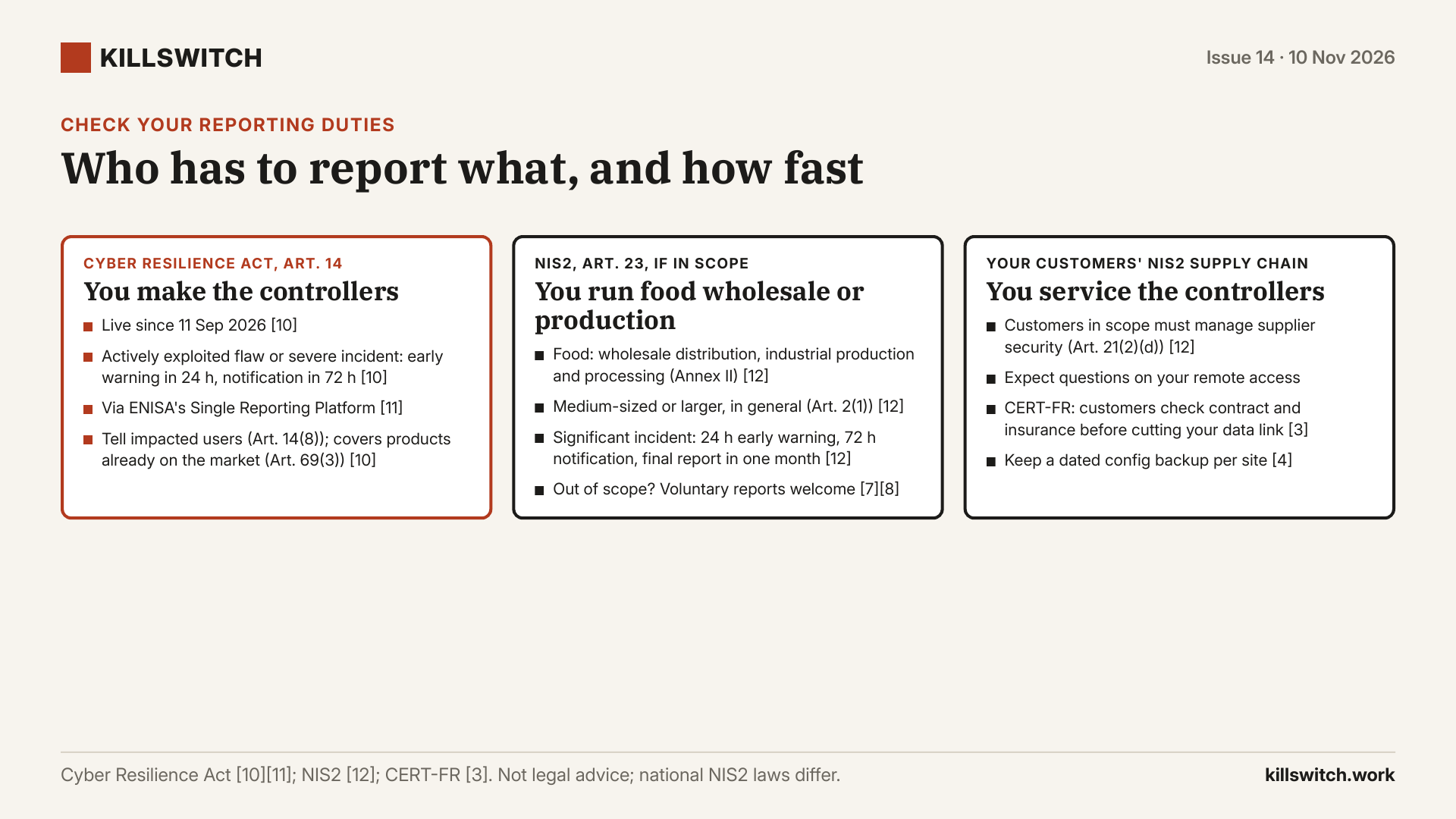
If you make the controllers. The Cyber Resilience Act is the EU law on the security of products with digital elements, meaning hardware and software. Its Article 14 has applied since 11 September 2026 [10]. A manufacturer must report any actively exploited vulnerability in its product, and any severe incident affecting the product's security.
Reports go through ENISA's Single Reporting Platform to the national team that coordinates for the country where the manufacturer has its main EU establishment [10][11]. The clock is tight: an early warning within 24 hours of becoming aware, a fuller notification within 72 hours, and a final report within 14 days of a fix being available (for a vulnerability) or within one month of the 72-hour notification (for a severe incident) [10][11].
Article 14(8) also says the manufacturer must inform impacted users and tell them what they can do to reduce the risk [10]. Article 69(3) applies these reporting duties to products placed on the market before 11 December 2027, so controllers already sold and installed are covered too [10].
If your company is medium-sized or larger, NIS2 may also apply to you as a manufacturer (Annex II, point 5), so check that too [12]. We could not find any public statement about whether any manufacturer has filed a Cyber Resilience Act report for these incidents, and we don't assume either way.
If you run stores or food operations. NIS2 is the EU directive on cybersecurity for important sectors. Food is one of them, but only for food businesses "engaged in wholesale distribution and industrial production and processing" (Annex II), and in general only for medium-sized or larger firms (Article 2(1)) [12]. Retail sales in shops are not on that list, so a supermarket is not in scope just for running stores, whatever its size.
A retail group is in scope for any wholesale distribution or industrial food production it does itself, and only if that business is medium-sized or larger. A small independent shop is outside it. A medium-sized wholesaler or food manufacturer may well be inside it. Some countries go further than the directive, so check your national law.
If you are in scope, a significant incident means an early warning to your national CSIRT or authority within 24 hours, an incident notification within 72 hours, and a final report within one month of the incident notification (Article 23(4)) [12]. An incident is significant if it has caused or could cause "severe operational disruption of the services or financial loss" for you, or considerable damage to others (Article 23(3)) [12]. Whether a warehouse of spoiled stock meets that test depends on the facts. Decide in advance who makes that call.
If you are outside both laws, you can still report. The Dutch NCSC invites voluntary reports [8]. Italy's ACN asks for immediate reporting to CSIRT Italia if you find signs of compromise [7].
Ireland's NCSC and CERT-FR publish ways to contact them [3][5]. If you service the controllers, expect questions. NIS2 requires companies in scope to manage "supply chain security" with their direct suppliers and service providers (Article 21(2)(d)) [12]. Your remote access is exactly what their auditors will ask about.
Mapping it to your frameworks
These mappings are Killswitch's own, not an official crosswalk.
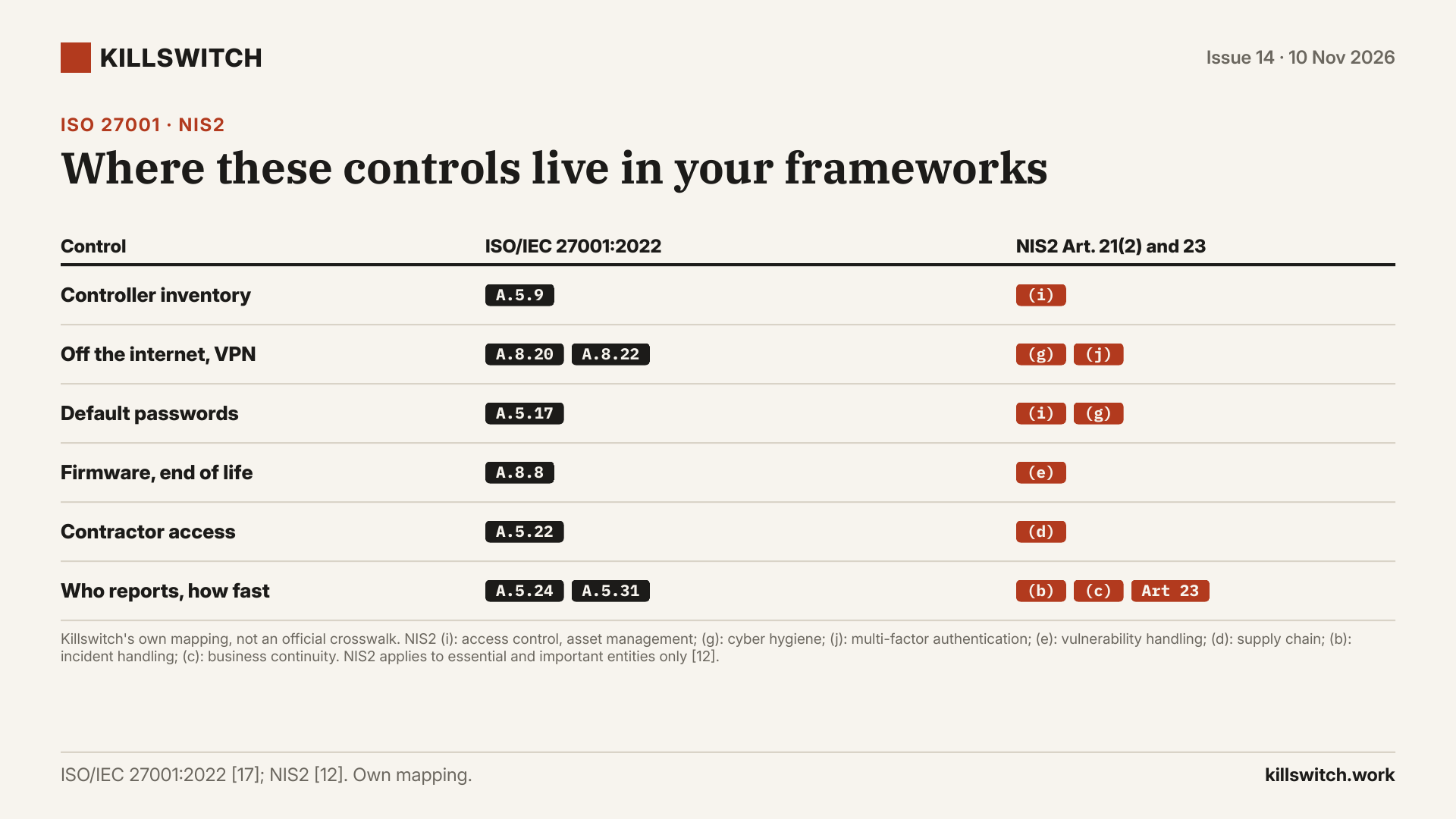
- ISO/IEC 27001:2022 [17]: A.5.9 (inventory of information and other associated assets) covers the controller list. A.8.20 (networks security) and A.8.22 (segregation of networks) cover taking controllers off the internet and behind a virtual private network. A.5.17 (authentication information) covers default passwords. A.8.8 (management of technical vulnerabilities) covers firmware and end-of-life units. A.5.22 (monitoring, review and change management of supplier services) covers the contractor's remote access. A.5.24 (information security incident management planning and preparation) and A.5.31 (legal, statutory, regulatory and contractual requirements) cover who reports, to whom and how fast.
- NIS2 Art. 21(2) [12]: (i) covers "asset management" and access control, (g) covers "basic cyber hygiene practices", (j) covers multi-factor authentication on the remote access, (e) covers vulnerability handling, (d) covers suppliers, and (b) and (c) cover incident handling and business continuity. Article 23 sets the reporting clock. These apply only if you are an essential or important entity.
What we don't know yet
No attacker has been named by any of the sources we read [1][2][3][9]. The 1–2 November wave has not been quantified publicly, and the joint statement doesn't say which products it involved [1]. No CVE number is listed in the EU collection [2]. Copeland acknowledges a vulnerability in end-of-life XWEB EVO units [4], while the Dutch and Italian advice also points to weak or default passwords [7][8].
We don't know how much of the damage came from each. The figures of hundreds of stores, 50°C and tens of millions of euros come from press reporting summarised by INCIBE-CERT, not from a French official source [9]. We also don't know whether any manufacturer has filed a Cyber Resilience Act report. Facts are as of 9 Nov 2026.
Your this-week checklist
- Get a list of every refrigeration controller in your stores and warehouses, with make, model and firmware.
- Find out whether any of them can be reached from the internet, and take those off it or put them behind a virtual private network.
- Change default passwords, update firmware and check setpoints, defrost schedules and alarm recipients.
- Call your vendor or maintenance contractor with the seven questions above.
- Decide who reports an incident, to which authority, and within how many hours.
What matters this week, what can wait
Here is what matters in the coming week, 10 to 16 November. Our test is simple: something matters if attackers are already using it (it is on the Known Exploited Vulnerabilities list, KEV for short: the US government's list of flaws seen exploited in real attacks, kept by CISA, the US Cybersecurity and Infrastructure Security Agency), if a legal deadline that applies to you lands within about 30 days, or if it changes what an auditor will ask you now.
Dates below are CISA's "due dates", the patch deadlines it sets for US federal agencies. They are a useful clock for everyone else too. KEV entries as of 9 Nov 2026 (catalog version 2026.11.06) [13].
Matters this week
- Adobe Commerce and Magento, if you run an online shop on them. CVE-2026-48356 (a CVE is the public ID number for a known flaw) was added to KEV on 27 October and is due today, 10 November [13]. Adobe fixed it in July. Its bulletin rates it Critical, 9.6, with no login needed to exploit it [14]. Ask whoever runs your shop to confirm you are on the July 2026 builds or later [14].
- Apple devices left on old software. CVE-2024-27834, a 2024 flaw that lets an attacker who can already read and write memory get past one of Apple's protections, was added on 4 November and is due 18 November [13]. Apple fixed it in the Safari 17.5 generation [15]. Any shop iPad or office Mac still on 2024-era software should be updated.
- SonicWall firewalls used for remote access. CVE-2026-19868 was added on 6 November and is due 20 November. It may let someone with valid credentials for another login method bypass SAML sign-on controls (SAML is a standard for single sign-on), including the multi-factor authentication those controls enforce [13]. If your remote access runs through a SonicWall, check your build against SonicWall's advisory [16].
- Also still open on KEV: Brotli (due today, 10 November), VMware ESX (due tomorrow, 11 November) and Ivanti Connect Secure (due 13 November) [13]. Issues 12 and 13 cover them.
Can wait
- The refrigeration warning itself, as a list item. It isn't on KEV and it brings no new legal deadline: the Cyber Resilience Act reporting duty has applied since 11 September 2026 [1][10]. But if you run, service or make these controllers, the steps above are today's work, not something for the list.
- The Cyber Resilience Act's main product duties, 11 December 2027. Security by design and lifecycle support apply from that date [1][10]. If you make controllers, plan for it now, but it is more than a year away.
- Who is behind the attacks. Nobody has been named [1][3]. Attribution won't change your steps, so don't wait for it.
Keep going
Get sharp issues on security, AI security and GRC every working day, Monday to Friday, written for CISOs, vCISOs and GRC leads.
GRCompliance: keep your asset inventory, ISO 27001 and NIS2 Art. 21(2) evidence and supplier checks in one place, including the equipment facilities looks after.
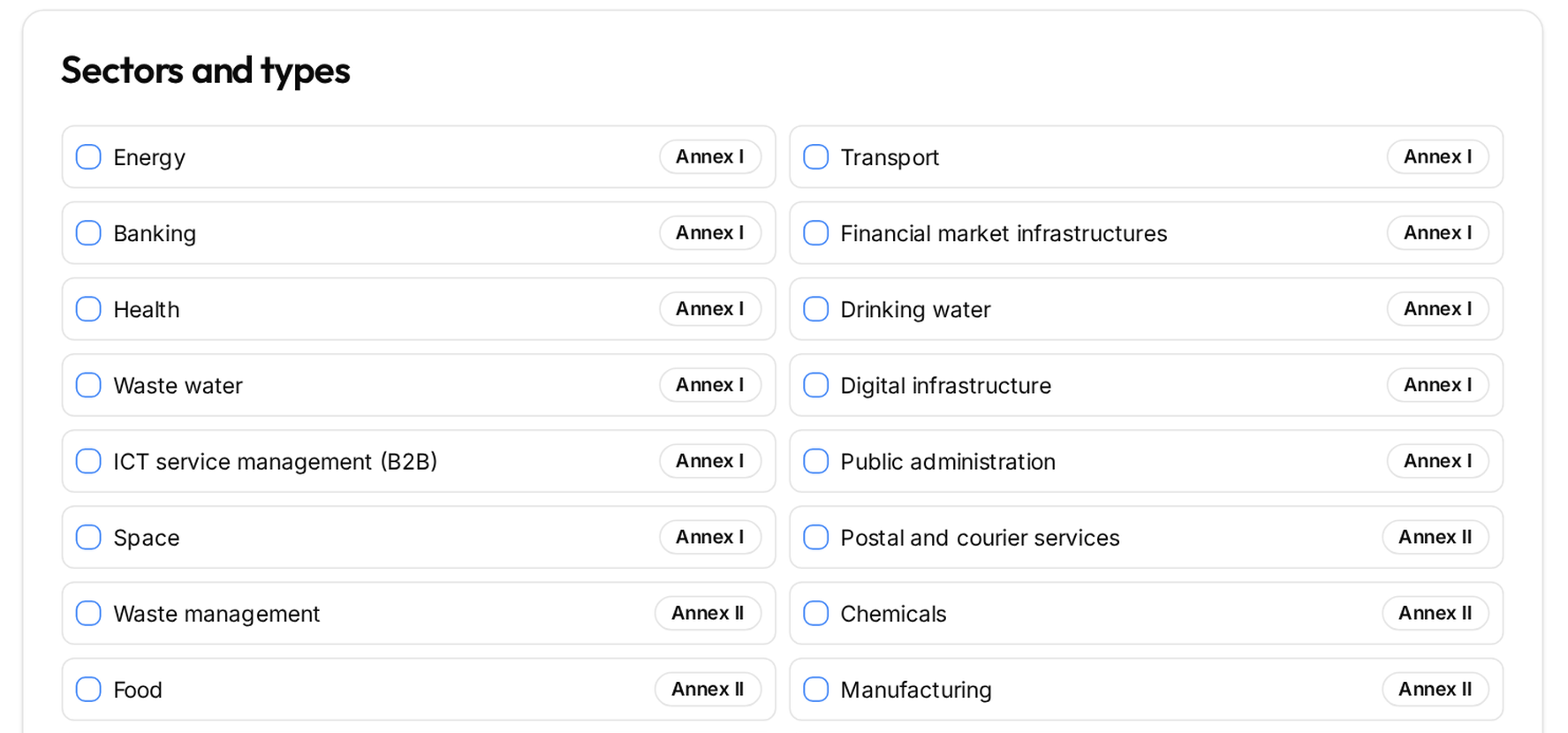
GRCompliance Core, the open-source edition. Your data stays on your infrastructure.
Ready-to-run training and audit kits for security and GRC teams.
Sources
- ENISA: Joint statement on cyber incidents in refrigeration systems across the EU (4 Nov 2026)
- CSIRTs Network advisory CNW-2026-05: Cyberattacks targeting retail sector refrigeration facilities (3 Nov 2026)
- CERT-FR alert CERTFR-2026-ALE-012: Incident de sécurité ciblant les contrôleurs à distance des installations de réfrigération (12 Oct 2026, updated 16 Oct 2026)
- Copeland Controls product bulletin: Avis de sécurité relatif aux systèmes de supervision XWEB (14 Oct 2026), linked from the CERT-FR alert
- NCSC Ireland advisory: Security Incidents Targeting Remote Refrigeration Controllers (3 Nov 2026)
- CERT.at blog: In Frankreich wurden Kühlanlagen manipuliert – geht das auch bei uns? (Oct 2026)
- ACN / CSIRT Italia: Misure urgenti di verifica e mitigazione per operatori della distribuzione alimentare e della filiera del freddo
- NCSC Netherlands: In het nieuws: cyberaanvallen op koelinstallaties in Europa (Nov 2026)
- INCIBE-CERT: Cyberattack on Supermarket Refrigeration Systems in France (Oct 2026)
- Cyber Resilience Act, Regulation (EU) 2024/2847, Articles 14, 69 and 71, EUR-Lex
- European Commission: Cyber Resilience Act, reporting obligations
- NIS2 Directive (EU) 2022/2555, Articles 2, 21 and 23 and Annex II, EUR-Lex
- CISA Known Exploited Vulnerabilities catalog, JSON feed (catalogVersion 2026.11.06, fetched 9 Nov 2026)
- Adobe Security Bulletin APSB26-73: Security update available for Adobe Commerce (14 Jul 2026, updated 11 Aug 2026)
- Apple: About the security content of Safari 17.5
- SonicWall advisory SNWLID-2026-0014 (as linked from the CISA catalog entry)
- ISO/IEC 27001:2022 Information security management systems
Facts as of 9 Nov 2026. Quotations are from the ENISA joint statement, the CSIRTs Network advisory, CERT-FR, CERT.at, NCSC Ireland, NCSC Netherlands, ACN, INCIBE-CERT, the Copeland Controls bulletin, the Cyber Resilience Act and NIS2 texts on EUR-Lex, and CISA's KEV feed. French and Italian quotes are translated by Killswitch. The damage figures are as reported by INCIBE-CERT from press reports. Defensive briefing: no exploit code or attack detail. The contractor questions and framework mappings are Killswitch's own suggestions. Not legal advice.
Emmanuel Aigbehi Walstra is a CISO who also serves as a virtual CISO (vCISO) for several organisations, with 30+ years in cybersecurity, 10,000+ people trained, and author of the CCSP Excellence books.
Checked against the primary sources cited above. Spotted an error? See our corrections page.